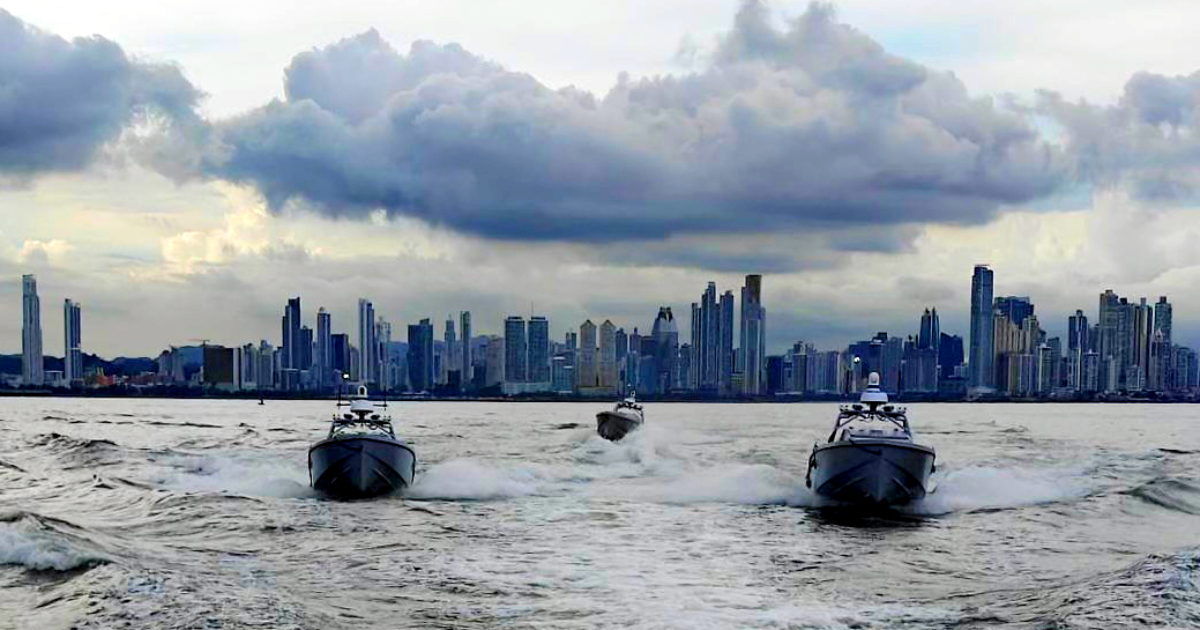
The U.S. Southern Command (SOUTHCOM) and Panama's National Aeronaval Service have revealed plans to increase the use of unmanned Corsair model vessels in Panamanian waters. This initiative aims to enhance coastal security and tackle drug trafficking along with transnational criminal networks.
The Corsair vessels participated in the Panamax 2026 exercise, which wrapped up in mid-August. Following an evaluation of their performance, the U.S. Embassy and SOUTHCOM collaborated with Panama's Ministry of Security to extend their deployment for a maritime security mission alongside the National Aeronaval Service (SENAN).
Persistent Patrols and Enhanced Surveillance
According to SOUTHCOM's official communication, the recently established SOUTHCOM Autonomous Warfare Command (SAWC) is working with Panamanian personnel to ensure "a persistent patrol presence" along key maritime routes, providing essential tools to detect, monitor, and respond to illegal activities.
The U.S. command hailed this bilateral deployment as "a significant step" in regional strategic cooperation. Official reports indicate operations will occur within Panamanian waters, though specific patrol zones were not disclosed.
The Corsair's radars and electro-optical sensors expand surveillance capabilities and help differentiate between routine activities and those warranting further investigation. These platforms support Panama's manned vessels, aircraft, and personnel, allowing these resources to focus on response and interdiction missions.
Technological Capabilities of the Corsair
The Corsair, developed by Texas-based Saronic Technologies, was founded in 2022. As per Forbes Spain, the vessel measures 7.3 meters in length, can reach speeds of up to 35 knots, and carries up to 454 kilograms of payload.
Its range exceeds 1,150 nautical miles, approximately 2,130 kilometers. However, this distance does not necessarily represent its operational range, which depends on mission profiles, navigation conditions, and return or reserve requirements.
Equipped with a 360-degree camera, long-range navigation radar, and electro-optical sensors, each unit is priced under a million dollars. The U.S. statement noted their recent role in rescuing AH-64 Apache helicopter pilots off Oman, highlighting their versatility beyond maritime surveillance missions.
Strategic Implications and Regional Tensions
Though the announcement did not mention Cuba, SOUTHCOM's expanded autonomous systems gain significance amid U.S. pressure on Havana and the inclusion of Guantánamo in SAWC's structure.
The autonomous command, established on April 21, 2026, designated Guantánamo Bay Naval Base as its inaugural training and mission support site. This location near Cuba introduces a strategic dimension to regional developments, even if there's no direct mission against the Island from Panama-deployed units.
Tensions between Washington and Havana over drones have been escalating for months. In May, Axios reported, based on classified intelligence, that Cuba had acquired over 300 Russian and Iranian-made military drones since 2023, with regime officials considering their potential use against Guantánamo, U.S. ships, and Key West.
In June, Defense Secretary Pete Hegseth visited Guantánamo, cautioning that it would be "reckless" for Cuba to acquire weapons capable of reaching the base or the U.S. mainland. The following month, Donald Trump commented on possible Iranian drones in Cuba: "If they have them, and they very well might, we'll deal with it promptly."
Havana has reasons to heed references to regional threats. In August, Diálogo Américas, a publication linked to SOUTHCOM, described GAESA's control over strategic infrastructure and its ties with China and Russia as a regional security threat.
This backdrop, along with Guantánamo's integration into SAWC, situates the Corsair expansion within a context that concerns the Cuban regime, even if Panama's mission announcement doesn't specify it as a target.
Understanding the Deployment of Maritime Drones in Panama
What is the purpose of deploying Corsair vessels in Panamanian waters?
The deployment aims to enhance coastal security, combat drug trafficking, and tackle transnational criminal networks by providing persistent patrols and advanced surveillance capabilities.
What are some capabilities of the Corsair vessels?
Corsair vessels feature a 360-degree camera, long-range navigation radar, and electro-optical sensors. They can reach speeds of 35 knots and carry up to 454 kilograms of payload, with a range exceeding 1,150 nautical miles.
How does the deployment of these vessels relate to regional tensions with Cuba?
The deployment is part of broader strategic initiatives amid rising tensions between the U.S. and Cuba over drone capabilities, including concerns about Cuba's acquisition of Russian and Iranian drones.