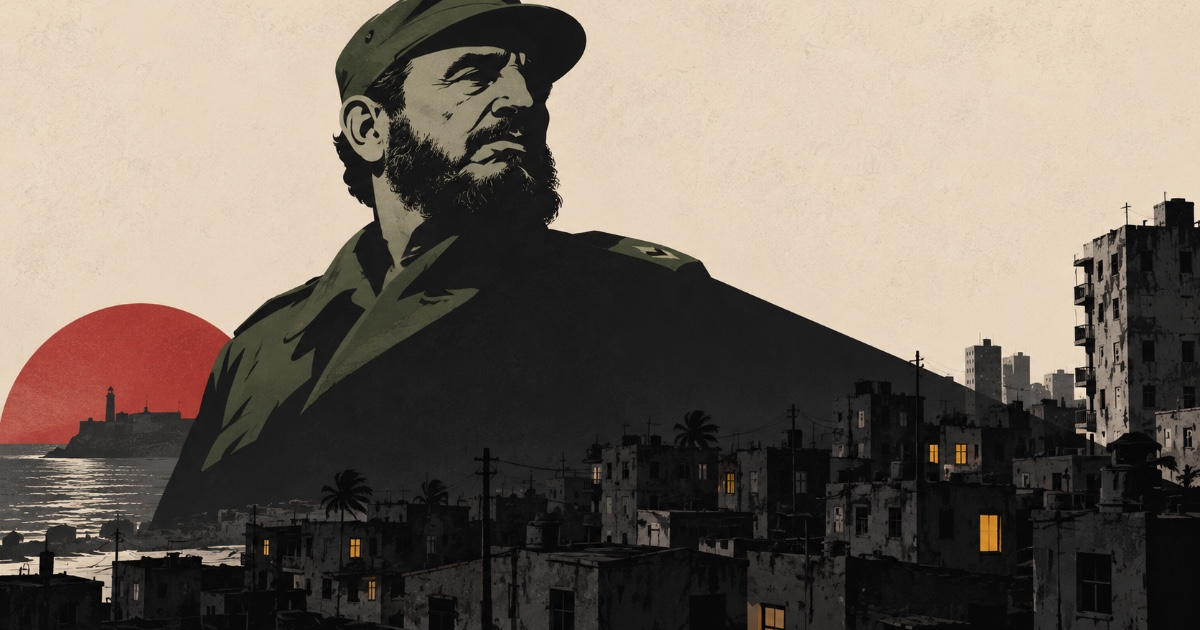
The Cuban News Agency (ACN) extended an invitation on October 10 to celebrate the "enduring legacy" of Fidel Castro. They marked the occasion with a photograph of the leader and a snippet from a 1968 speech urging the defense of the Revolution and the reinforcement of revolutionary thought. The homage was rounded off with the hashtag #100YearsWithFidel. Meanwhile, on the same Saturday, Cuba's electrical system predicted a shortfall of 1,680 megawatts during peak demand hours. Slogans, it seems, maintain more stability than the electricity supply.
The message shared by the ACN on X included excerpts from Castro's speech in La Demajagua, delivered on October 10, 1968, to commemorate the centennial of the start of Cuba's wars for independence. The agency highlighted his call to "defend the Revolution against imperialism," but omitted the more challenging promise: "to advance the fight against underdevelopment."
That particular promise is part of the 1968 speech, preserved in a historical edition by the Chilean National Congress Library. In ACN’s selection, the focus is on defending power and ideological formation, while the battle against poverty is conspicuously absent. This omission is significant, as it was one of the pledges that deserved scrutiny the most.
The Sugar Harvest That Fell Short
In the same address, Castro declared that the objective of producing ten million tons of sugar was "practically a battle won." However, two years later, the 1970 harvest concluded with approximately 8.5 million tons—a remarkable figure but insufficient to meet the goal. In a July 1970 speech, Fidel himself acknowledged that the sugar effort had caused imbalances and production declines in other sectors.
The contrast with today’s situation is stark. As per EFE's calculations based on official data, the Cuban sugar harvest of 2024-2025 did not exceed 150,000 tons. This estimate, not officially published by the Government, is based on available partial results. The country that once aspired to ten million tons couldn't reach even a small fraction of that target.
Repercussions of Persistent Underdevelopment
The United Nations World Food Program describes a Cuban economy that has shrunk by 15% in the past six years, plagued by inflation, fuel shortages, and difficulties accessing food. The organization notes that the state’s basic food basket relies almost entirely on imports, with the government acknowledging shortages and distribution delays.
In July 2026, the Ministry of Labor and Social Security set a minimum wage of 3,210 Cuban pesos per month through Resolution 14/2026. Two months later, the National Office of Statistics and Information (ONEI) reported an annual inflation rate of 25.19% for August, with a monthly increase of 4.92%. These figures represent the official index, which doesn't necessarily capture the full extent of price hikes in the informal market. While the minimum wage can be adjusted by decree, the cost of putting food on the table doesn't adhere to the same regulatory control.
Unfulfilled Promises and an Exodus of Citizens
The electricity sector further illustrates the gap between rhetoric and daily life. On October 10, 2026, the National Electrical System reported an available capacity of 1,250 MW at the start of the day, compared to a registered demand of 2,470 MW, predicting a nighttime deficit of 1,650 MW with 1,680 MW of expected impact. The previous day, service had been disrupted for 24 hours. Unlike anniversary slogans, the energy battle has measurable costs for households without power.
Demographic trends also contradict any celebratory narrative. According to ONEI figures cited by CiberCuba, the island’s population declined to 9,434,593 by the end of 2025—313,414 fewer than the previous year. There were 68,064 births compared to 136,214 deaths, with migration as another major factor in the population decrease. Official records document a Cuba that is increasingly empty and aging.
While state media call for defending the Revolution, many Cubans remain unable to freely challenge it. Human Rights Watch reported in July 2026 that organizations Justicia 11J and Prisoners Defenders estimated around 800 political prisoners in Cuba, nearly half linked to the July 11, 2021 protests. The organization has condemned sentences for exercising fundamental freedoms, mistreatment, and ongoing restrictions on dissent.
Attributing every power plant malfunction or ministerial decision to Castro would oversimplify history. However, it would be equally misguided to separate him from the political and economic system he established, characterized by the massive elimination of small businesses, a Communist Party monopoly, and decades of centralized planning. Raúl Castro and Miguel Díaz-Canel have perpetuated this model and are accountable for their decisions and the continuity of its outcomes.
The 2019 Cuban Constitution proclaims the Communist Party as the superior political force of society and the state, declaring the socialist system irrevocable. This unwavering aspect of the legacy remains intact. Nearly six decades after the promise to overcome underdevelopment, the country continues to count lost megawatts, citizens leaving, and unmet product deliveries. Yet one thing seems truly inexhaustible: the official readiness to celebrate the work without reckoning with its outcomes.
Understanding Fidel Castro's Legacy in Cuba
How has the economic situation in Cuba changed since Fidel Castro's rule?
Cuba's economy has faced significant challenges, including a 15% GDP decline over the past six years, inflation, and food and fuel shortages. These issues highlight the ongoing struggles that persist despite the revolutionary promises of economic improvement.
What are the current demographic trends in Cuba?
Cuba's population is decreasing, with more deaths than births, and significant emigration contributing to the decline. The population fell to 9,434,593 by the end of 2025, reflecting a trend of an increasingly empty and aging nation.
What impact has the centralized planning and policies had on Cuba's small businesses?
Centralized planning and policies under Fidel Castro led to the elimination of over 55,000 small businesses, including shops and workshops, as part of the 1968 Revolutionary Offensive. This approach has had lasting impacts on the country's economic landscape.