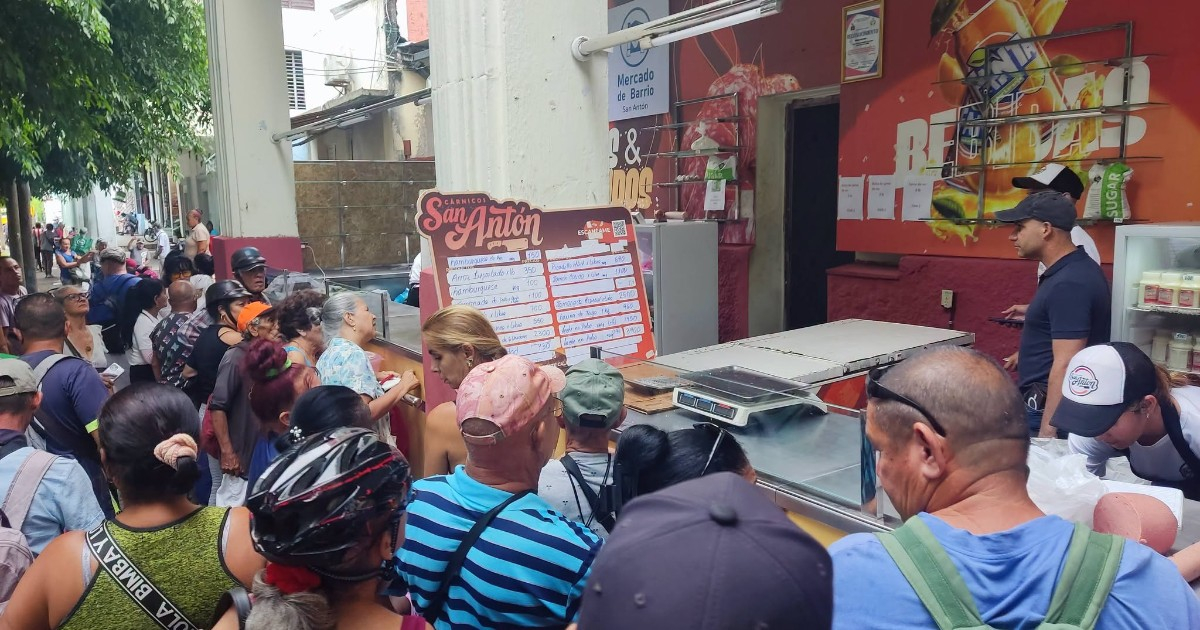
The microenterprise San Antón in Cienfuegos was recently designated a "Neighborhood Market" by the Cienfuegos Business Trade Group. This announcement was accompanied by promises of providing "access to basic goods at more accessible prices for every household."
The official statement, shared on Facebook and tagging Betsy Díaz Velázquez, the Minister of Domestic Trade, also mentioned plans to open more such establishments across various areas of the city soon.
However, the price lists revealed alongside the announcement tell a different story. A 460-gram package of powdered milk is priced at 1,950 Cuban pesos (CUP), a single egg costs 130 CUP, 460 grams of cooked ham is set at 1,800 CUP, 900 milliliters of oil is tagged at 2,500 CUP, five pounds of pork meatballs are 9,000 CUP, and 460 grams of beef is priced at 1,500 CUP.
These prices are staggering compared to the current minimum wage of 3,210 CUP per month, which is roughly equivalent to four dollars at an informal exchange rate of 780 CUP per dollar.
Public Outcry Over Prices
The public's response in the comments section was overwhelming, with numerous Cubans questioning whether this change was anything more than just a rebranding exercise.
Comments from the community included sarcastic remarks such as, "Just changing the name solved everything," and more direct criticisms: "Everything looks nice, blah blah blah... and the prices are the same, if not higher. Now microenterprises are called Neighborhood Markets. How lovely!"
The question that resonated most was about affordability: "Affordable prices, for whom?" one user asked, while another noted, "Affordable prices, but not for retirees."
Concerns About Legitimacy and Offerings
Some users questioned the legitimacy of the designation: "If you look at the criteria required to declare an establishment a Neighborhood Market, this one meets only about 90% of those requirements," one commenter pointed out. Others reminded readers that San Antón only sells meat products and cold cuts, lacking the variety of goods—including hygiene products—mandated by the regulations, which are not listed in the price offerings.
"The main requirement to approve a neighborhood market is to have lower prices than the average so that salaried workers can afford essential products. We hope it’s not just about benefiting from tax and banking advantages," another user commented.
Irony was not absent from the discussion: "Neighborhood Market? It must be a neighborhood for millionaires with those prices," quipped a user, while another added, "The last time prices were affordable for Cubans was on December 31, 1958, at 11:59 PM."
Summing up the general sentiment with sarcasm, one commenter said, "I think there was a mistake: they forgot to publish the new board with the affordable prices."
A Promise That Doesn't Add Up
Neighborhood Markets are governed by Resolution 16/2026 of the MINCIN, effective from August 11, 2026. This allows microenterprises, cooperatives, and self-employed workers to manage state-run establishments while the state retains ownership of the properties.
The official promise is to sell basic goods at 15% to 30% lower prices than other stores, but in practice, several openings have announced discounts of just 10% to 15%.
As of October 8, the network included 47 establishments nationwide. In Cárdenas, Cubans reported the same situation as in Cienfuegos: "This is the same dog with a different collar."
Frequently Asked Questions About Neighborhood Markets in Cuba
What is the purpose of the Neighborhood Markets in Cuba?
Neighborhood Markets aim to provide access to basic goods at more affordable prices for Cuban households by allowing microenterprises, cooperatives, and self-employed workers to manage state-run establishments.
Why are the prices at Neighborhood Markets considered high?
Prices at Neighborhood Markets are considered high because they often exceed the purchasing power of the average Cuban, with costs significantly surpassing the minimum wage in Cuba.
How are Neighborhood Markets regulated in Cuba?
Neighborhood Markets are regulated by the Resolution 16/2026 of the MINCIN, which outlines the management structure and pricing expectations for these markets.