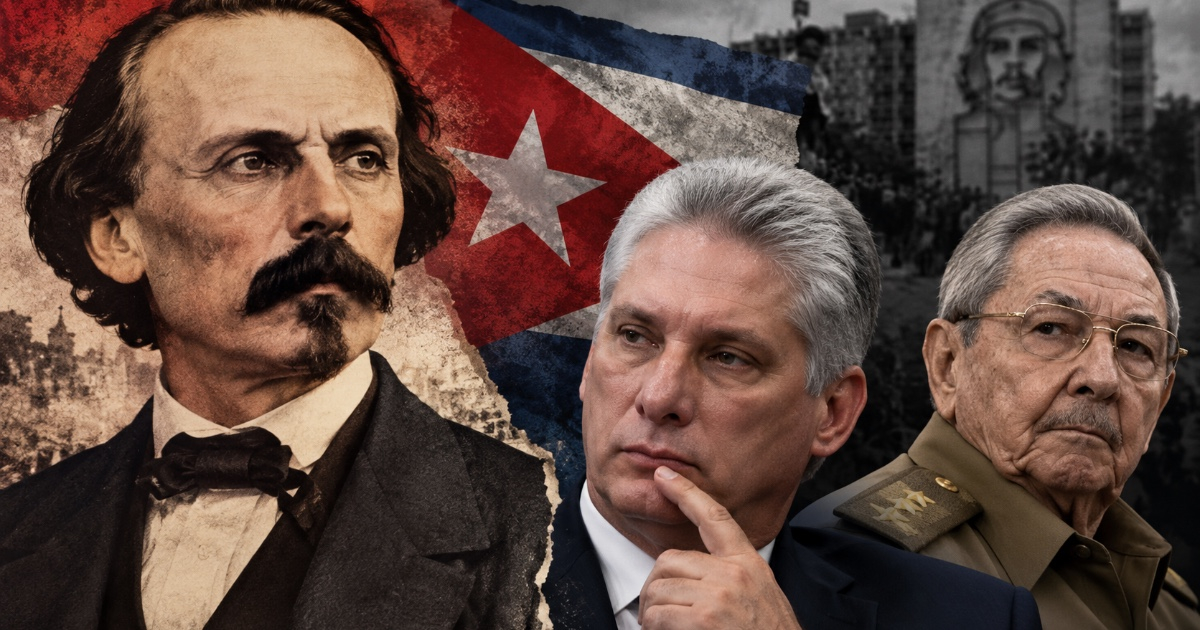
"No other recourse is granted but to remain silent and obey." These words used by Carlos Manuel de Céspedes to denounce the oppression of Cubans under Spanish colonial rule on October 10, 1868, resonate uncomfortably 158 years later. In Miguel Díaz-Canel's Cuba, where political competition among parties is nonexistent, a young woman has recently been sentenced for sharing a video of a police officer, and two critical content creators are facing potential prison terms of up to ten years.
The Manifesto of the Revolutionary Junta of the Island of Cuba, signed by Céspedes in Manzanillo, highlighted the lack of freedom of assembly for Cubans, who could be labeled rebels for asserting their rights. The manifesto also called for national representation, universal suffrage, freedom of commerce, and respect for individual rights. Although the uprising at La Demajagua sugar mill sparked the Ten Years' War, it did not immediately lead to the establishment of the Republic, which was founded in 1902.
Constitutional Rights vs. One-Party Rule
The Cuban Constitution of 2019 proclaims freedom of thought and expression in Article 54, press freedom in Article 55, and the right to assembly, protest, and association in Article 56. However, Article 5 establishes the Communist Party of Cuba (PCC) as the "sole" and leading force in society and the State. Article 4 solidifies the socialist system as irrevocable, while Article 229 prohibits any amendment to this irrevocability.
While the regime acknowledges individual freedoms in its constitutional text, it prevents alternative political organizations from competing for state leadership and enforces legal measures against dissent. Human Rights Watch reported arbitrary detentions, intimidation of dissidents, censorship, and punishment for public criticism in its World Report 2026, addressing events from 2025. The organization also highlighted the judiciary's subordination to political power and the challenges faced by independent journalism.
Consequences of Criticizing Authority: The Cases of Anna Bensi and El 4tico
One recent case involves Cuban creator Anna Bensi and her mother, Caridad Silvente. On October 1, the Popular Municipal Court of Habana del Este sentenced both women to two years of restricted freedom after they recorded and shared a video of an encounter with a Ministry of the Interior agent delivering a summons at their home.
The court argued that the video disclosed personal information about the agent and violated his privacy, a claim disputed by the defense and organizations like Cubalex, which argue that recording public officials can be a legitimate form of citizen oversight. Bensi deemed the sentence unjust. Although the penalty does not equate to two years in prison, it limits the freedom of both women.
In Holguín, prosecutors have requested eight-year and ten-year prison sentences for Ernesto Ricardo Medina and Kamil Zayas Pérez, respectively, founders of the independent audiovisual project El 4tico. Detained since February 6, they are accused of alleged crimes of propaganda against the constitutional order, defamation of institutions, and incitement to commit crimes through social media content. These are prosecutorial requests, not yet court rulings.
Political Prisoners and Suppression of Protest
The issue extends beyond these cases. As of August 2026, Prisoners Defenders recorded 1,339 individuals as political prisoners, including those incarcerated and others under restrictions of freedom. This number does not imply that all 1,339 are physically imprisoned. The organization also documented cases related to protests over water and electricity shortages and public denunciations of abuses.
In April 2026, Human Rights Watch reported that over 700 political prisoners remained jailed, including artist Luis Manuel Otero Alcántara, and criticized that government-announced releases excluded those imprisoned for dissent. The organization noted that some released individuals continue to face surveillance or restrictive conditions.
Castro's Enduring Influence and Economic Constraints
Although Miguel Díaz-Canel is the president and first secretary of the PCC, the political influence of Raúl Castro and his family persists within the power structure. In July, Elier Ramírez Cañedo, a PCC Central Committee official, justified Raúl Guillermo Rodríguez Castro, Raúl Castro's grandson known as "El Cangrejo," serving as a liaison with the United States by the "country's highest leadership" decision, despite not holding a popular electoral position.
This family prominence adds to the military's significant role in the economy through the GAESA conglomerate, managing strategic businesses. Former head General Luis Alberto Rodríguez López-Calleja, Raúl Castro's son-in-law and Raúl Guillermo's father, was integral to this enterprise network. Economists have described how this military-oriented business structure has been consolidated, raising accountability questions over decisions and resources impacting the entire population.
Lack of Economic Freedom and Unmet Basic Needs
The constitutional framework also limits economic autonomy: Article 18 mandates planned economic management, while Article 22 acknowledges private property as merely "complementary." In 2026, the government has expanded some opportunities for private enterprises but maintains numerous prohibited activities, reserved for the state or subject to licensing. Decree 160/2026 lifted bans on 46 activities and reorganized other restrictions without establishing general freedom to operate in any sector.
These economic constraints persist as many households struggle to meet essential needs. Human Rights Watch documented prolonged blackouts, food and medicine shortages, and significant difficulties accessing healthcare. A survey by the Cuban Observatory of Human Rights in mid-2025 found that seven out of ten respondents skipped meals daily. These are figures from that period, not a new assessment as of October 10, 2026.
The 1868 manifesto called for a free nation with a "broader representation" to determine its political organization. In contrast, Cuba in 2026 maintains a constitutional prohibition against reforming its socialist system's irrevocability, while courts and security bodies act against citizens advocating for change or publicly challenging their leaders.
Frequently Asked Questions about Cuba's Political and Economic Situation
What freedoms did Carlos Manuel de Céspedes demand in 1868?
Céspedes demanded national representation, universal suffrage, freedom of commerce, and respect for individual rights. He also highlighted the lack of freedom of assembly and expression for Cubans under Spanish colonial rule.
How does the Cuban Constitution of 2019 address political freedoms?
The 2019 Constitution declares freedoms of thought, expression, press, assembly, protest, and association but establishes the Communist Party of Cuba as the sole ruling force, limiting political competition and maintaining an irrevocable socialist system.
Why are Anna Bensi and her mother facing legal consequences?
Anna Bensi and her mother were sentenced to two years of restricted freedom for recording and sharing a video of an encounter with a Ministry of the Interior agent, which the court argued violated the agent's privacy. Their defense and some organizations dispute this claim.