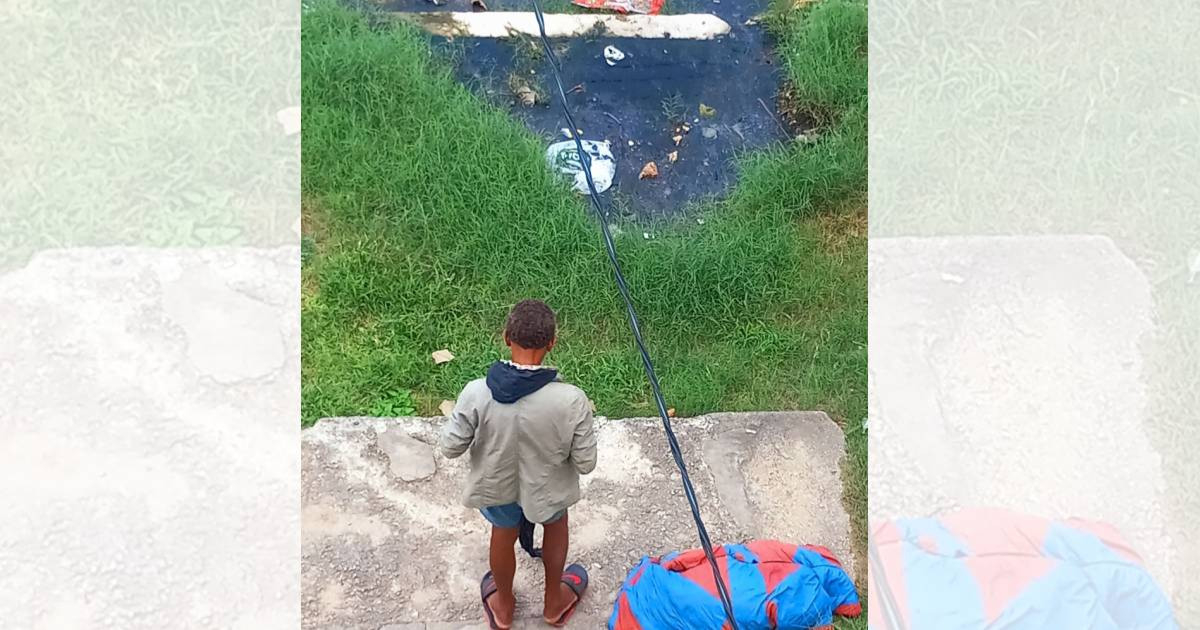
Cuban author and art critic Jorge de Mello recently shared a poignant scene on social media that he witnessed from his apartment window, prompting him to reflect deeply on the plight of the homeless in his neighborhood.
"My neighborhood, at the end of El Vedado, has gradually become one of those places where homeless individuals wander more frequently, poor souls abandoned by society," De Mello wrote on Facebook this Thursday.
The scene he described involved an elderly and extremely thin man dragging a heavy bundle. He paused at a puddle of putrid water that had been leaking for months, spreading its filth onto the street without much concern from anyone.
The situation took a different turn when the man tucked his shirt into his tattered shorts, rummaged through his belongings, and pulled out a piece of dark blue cloth. He fashioned it into a makeshift tie, wearing it over his jacket. With a dignified air, he straightened up and continued his journey.
This gesture moved De Mello, who expressed his frustration at being unable to remain indifferent to such a harsh reality. "I can't integrate them naturally into my daily life or look away with indifference. Nor can I do anything effective for them beyond documenting the injustice of these brutal times that no country should endure," he lamented.
The responses to his post highlighted that many residents see this as part of a broader decay. One reader noted that it has become commonplace to see homeless individuals in various cities, some even washing clothes in puddles. "Our fellow citizens tell the true story of what is happening to us," she wrote.
Another commentator, with a lifetime of experiences in El Vedado, summed up the neighborhood's decline with a stark statement: "All that remains of El Vedado is its name."
Contrasting the current situation with past promises, another commenter recalled the pledge to eliminate hunger, poverty, and desolation after 1959, lamenting, "67 years later, all we've seen is regression; everything is worse."
The Growing Indifference
Critics also pointed to the institutional response to social and urban decay. "I never thought we would reach this level of misery, especially the indifference, lack of will, and incompetence from the authorities to prevent this horror from escalating," another user remarked.
A reader of De Mello's post poignantly captured a common sentiment: "You document, and it is no small feat, in the most honest and sensitive way, the human costs of a prolonged crisis that those in power refuse to acknowledge, much less resolve."
A Broader Context of Decay
De Mello's narrative intertwines the plight of a man with a persistent sanitary issue that has gone unaddressed for months. Historically known for its residential areas, El Vedado now presents a reality increasingly difficult to ignore, as echoed in the comments.
Havana's sewage system, constructed between 1908 and 1914 for a city of about 600,000 residents, now struggles to serve over 1.8 million people, suffering from decades of inadequate maintenance.
The situation is exacerbated by the mounting garbage problem along numerous streets and avenues. In September, a significant accumulation of waste was recorded in the heart of Vedado, on 25th Street near the Avenue of the Presidents, stretching for nearly a block.
Homelessness is not a new phenomenon in the area. Reports from early 2025 mentioned an elderly man who had been sleeping for months in a doorway at Línea and 14th Street in El Vedado.
De Mello's account aligns with the latest data on poverty in Cuba. Following 1,318 interviews from June 27 to July 29 across 79 municipalities, the Cuban Observatory of Human Rights (OCDH) reported in August that 94% of those surveyed lived in extreme poverty.
A particularly troubling statistic highlights that individuals over 70 years old make up 44% of the homeless, according to the OCDH's findings.
Recently, Prime Minister Manuel Marrero acknowledged the existence of 883,000 vulnerable individuals and announced a monthly food aid package of five pounds of rice, one pound of sugar, and one pound of grains for this group.
Moreover, during a radio program, an audience member from Santiago de Cuba told leader Miguel Díaz-Canel that "we see the vulnerable on the streets, in the trash, begging for alms, money, and food."
Understanding the Crisis in El Vedado
What is causing the homelessness issue in El Vedado?
Homelessness in El Vedado is attributed to societal abandonment, economic decline, and insufficient government intervention to address growing poverty and decay.
How does the sewage problem affect the residents?
The outdated and poorly maintained sewage system leads to public health issues, with sewage water leaking onto streets, adding to the unsanitary conditions faced by residents.
What actions have been taken by the government to address these issues?
The government has acknowledged the vulnerability of many citizens and proposed food aid, but critics argue that these measures are insufficient to tackle the root causes of the crisis.