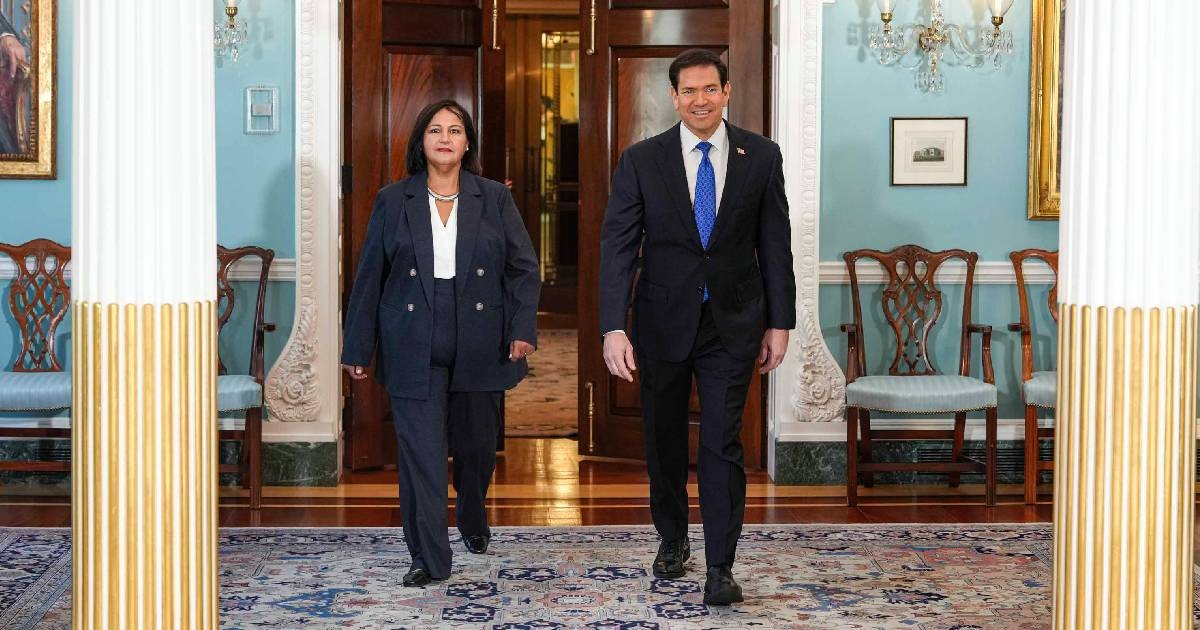
This Friday, Marco Rubio welcomed Dinorah Figuera at the State Department's Treaty Room in Washington. This marked the first official meeting between the U.S. Secretary of State and the president of Venezuela's 2015 National Assembly, which is recognized by Washington as legitimate. The meeting aimed to bolster discussions with the government led by Delcy Rodríguez.
"Our administration fully backs this initiative at the highest levels of the U.S. government, and I believe it's crucial to remain focused on that," Rubio stated to the press at the start of the meeting, as reported by EFE and covered by Telemundo 51.
The U.S. diplomat acknowledged the challenges of the process but expressed confidence that it would continue to achieve results. On his X account, Rubio described the gathering as a "productive meeting" and highlighted "tangible progress" made during the initial rounds of talks between the opposition and interim Venezuelan authorities.
"Following the Absolute Resolution Operation, significant progress has been achieved in the early phases of discussions with interim authorities," he noted on X.
Looking Forward to Further Progress
With the next round of talks set for October 14, Rubio expressed optimism for "ongoing progress that leads to lasting democratic change for the Venezuelan people."
"Our aim is to ensure this process achieves what we all desire: not just free and democratic elections at the earliest opportunity, which are undoubtedly necessary, but a democracy, a republic capable of governing the country sustainably," Rubio emphasized.
Figuera's Role and U.S. Support
Since August, Figuera has led an opposition bloc negotiating with the Chavista regime as part of Washington's transition plan. The political phase of this plan officially commenced following Nicolás Maduro's capture on January 3, during the so-called Absolute Resolution Operation.
Figuera expressed gratitude to the United States for paving "this path of hope for Venezuela" and described the dialogue as "the roadmap for elections," calling it a "possible process." She also thanked Washington for its investments in Venezuela's oil sector following Maduro's capture, amid restored diplomatic ties with Caracas and an agreement to access Venezuelan crude with Rodríguez's government.
Challenges and Tensions
A notable tension in the process is the absence of María Corina Machado, a Nobel Peace Prize laureate, from the negotiation table. Washington has chosen the 2015 National Assembly as the official dialogue channel, excluding Machado, who has been unable to return to Venezuela since December 2025 despite several attempts.
Machado's spokesperson stated in early October that the opposition leader would be open to direct negotiations with Delcy Rodríguez if it leads to free elections.
For Cuban readers, Venezuela's model holds particular relevance: Rubio, a Cuban-American from Miami, simultaneously exerts pressure on the Cuban regime. On September 29, he asserted on Fox News that "the Cuban regime has already collapsed"—in terms of functional breakdown—and that the only path is a transition to democracy, although he warned that, unlike Venezuela, the Cuban regime "has not sought agreements."
Maduro's capture has further worsened Cuba's energy crisis: Venezuela supplied around 26,500 barrels daily to the island in 2025, covering about a third of its needs, a supply that ceased in January.
The upcoming round of negotiations between the Venezuelan opposition and Delcy Rodríguez's government is scheduled for October 14, and Rubio mentioned on X his anticipation for "continued progress leading to lasting democratic change for the Venezuelan people."
Understanding the U.S. Role in Venezuela's Transition
What is the significance of Rubio's meeting with Dinorah Figuera?
The meeting underscores U.S. support for the dialogue process aimed at promoting a democratic transition in Venezuela, recognizing Figuera's leadership in the opposition bloc.
Why is María Corina Machado excluded from the negotiations?
Washington has chosen to use the 2015 National Assembly as the formal channel for dialogue, which excludes Machado, despite her willingness to negotiate if it leads to free elections.
How has the U.S. influenced Venezuela's political landscape recently?
The U.S. has played a crucial role by supporting the opposition, investing in Venezuela's oil sector, and facilitating dialogue aimed at achieving democratic governance.