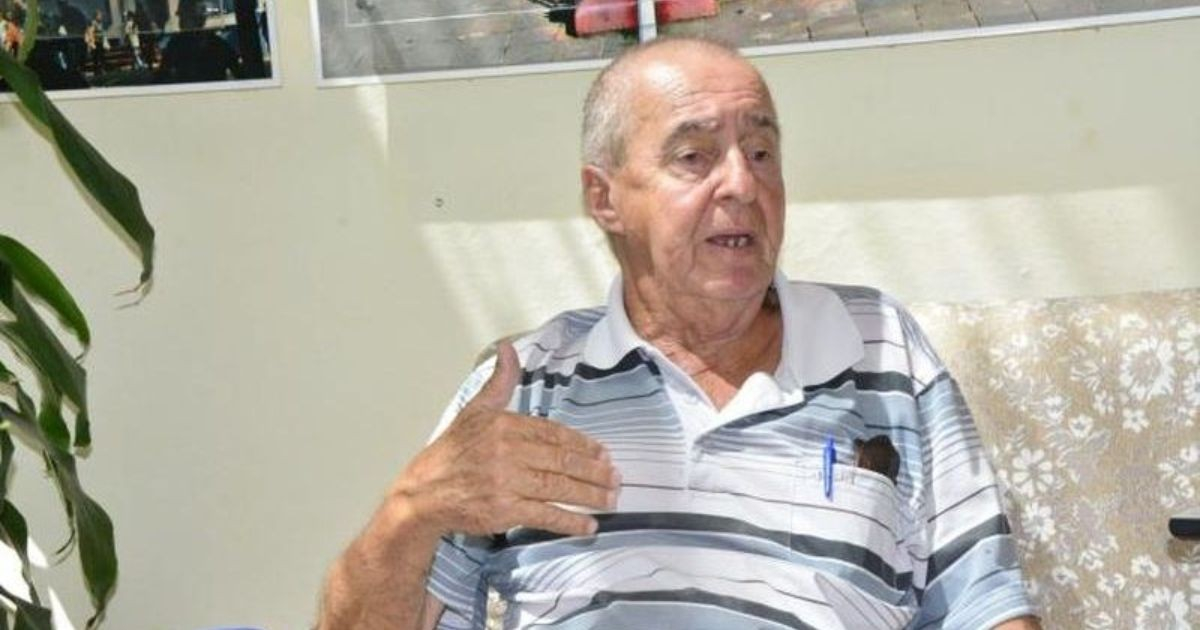
This week, the journalism community in Sancti Spíritus bid farewell to Pedro Larralde Machado, a distinguished veteran of Cuban media who dedicated over five decades to the profession and was revered as a mentor by his peers.
The news of his passing emerged on Wednesday when journalist Delia Rosa Proenza Barzaga shared it on social media. In tribute, the newspaper Escambray republished an interview conducted with him at the beginning of 2021.
Proenza described him as "an essential figure in the history of Escambray and Sancti Spíritus journalism." Born in Santa Clara, Larralde's career spanned print, radio, and television in Sancti Spíritus, and in 2020, he was honored with the Provincial Award Tomás Álvarez de los Ríos for lifetime achievement, the highest accolade in journalism in the province.
A Fortuitous Start in Journalism
Larralde's entry into journalism was unexpected. As a voluntary correspondent at the Inpud factory in Santa Clara, he began writing notes for the Vanguardia newspaper, not realizing these brief contributions would shape his life's path, as he recounted in that interview.
His career was marked by moments of intense engagement. He served as a war correspondent in Angola for 12 months during the late 1970s, reporting for the magazine Verde Olivo, and covered the XXI World Festival of Youth and Students in Havana in 1978.
A Career Defined by Dedication and Critique
In 1981, Larralde joined the newspaper Escambray, where he worked as a reporter and information chief for many years. Journalist Juan Antonio Borrego always admired Larralde's "keen eye" for both content and the visual presentation of the pages, as Proenza Barzaga noted in the interview. Reflecting on this period, Larralde remarked: "Escambray taught me a lot; one of the best things I found there was the understanding and camaraderie of my colleagues." He later transitioned to radio and then to the Centrovisión television center, where he worked as a reporter and news scriptwriter until his final years.
Larralde did not shy away from criticizing Cuba's official media. In the interview reprinted by Escambray, he stated: "I always insist that, with few exceptions, we are producing a very monotonous journalism, lacking appeal and critical thinking; it needs to be more aligned with what the reader wants to know and reflect the life of the Cuban people."
The Impact of Larralde's Legacy
This stance is particularly poignant today, as since March 2026, Escambray has ceased its print edition, shifting to digital due to paper shortages affecting all provincial media in Cuba.
The announcement of his death sparked an outpouring of condolences among colleagues and former coworkers, who affectionately referred to him as "Larra." A former colleague from Centrovisión's newsroom wrote that Larralde "never wanted to retire" and "was the kind of person who wouldn't leave until the news broadcast was ready." Another colleague who looked up to him admitted, "I've lost Rafa and Larra, the two inspirations for my love of journalism over a decade... and perhaps I never said 'thank you' enough."
The material crisis plaguing Cuban media in 2026—with national newspapers limited to weekly editions and provincial outlets lacking paper—alongside the deeper crisis of overwhelming propaganda over journalism, makes the voices of those like Larralde, who called for journalism more attuned to Cuban realities, all the more resonant.
"His conduct and ethics will be remembered by those of us in the field who learned to value him," wrote a colleague upon hearing the news.
The Legacy and Critique of Pedro Larralde Machado
What was Pedro Larralde Machado's contribution to Cuban journalism?
Pedro Larralde Machado was a revered figure in Cuban journalism, known for his five-decade-long career across print, radio, and television. He was recognized for his critical stance on the monotony and lack of critical thinking in the island's official media, advocating for journalism that resonates more with the Cuban populace.
How did Larralde's career in journalism begin?
Larralde's journalism career began unexpectedly while working as a voluntary correspondent at the Inpud factory in Santa Clara. His initial notes for the Vanguardia newspaper paved the way for a lifelong dedication to the field.
What was significant about Larralde's critique of Cuban media?
Larralde was notable for his critique of the monotonous and unappealing nature of Cuban official media. He called for journalism that reflected the realities and needs of the Cuban people, a perspective that remains particularly relevant given the current crises facing Cuban media.