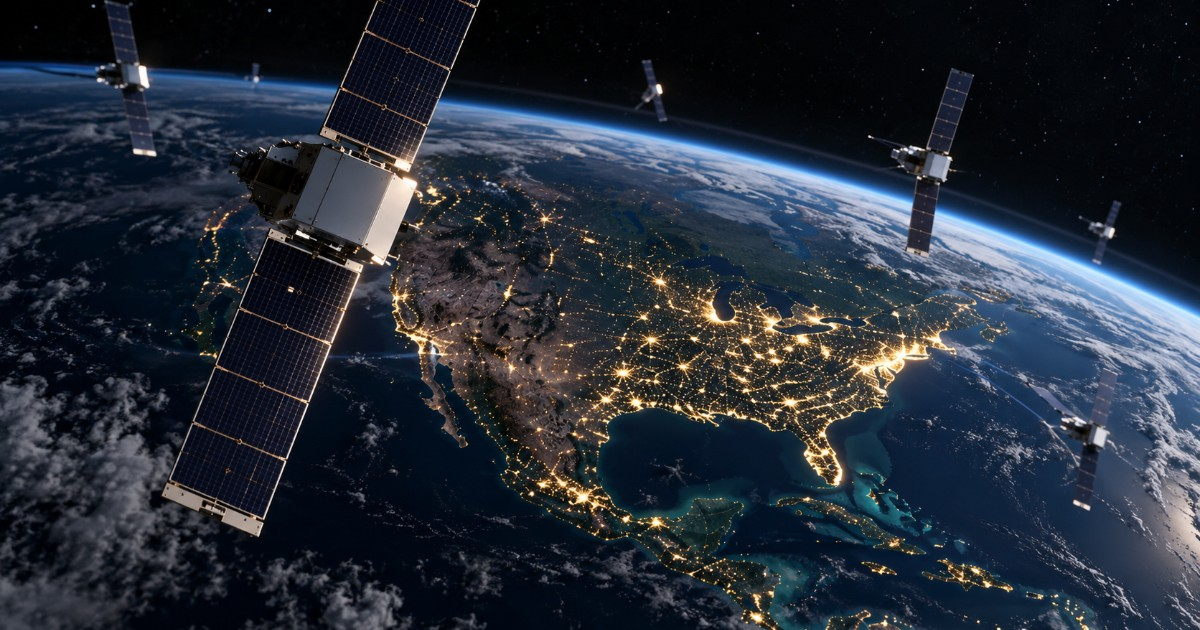
Elon Musk's SpaceX is making moves to position Starlink Mobile as a competitor to major U.S. telecom giants like AT&T, Verizon, and T-Mobile. The company has announced a deal that could secure mobile network frequencies, allowing it to merge its satellite network with ground-based infrastructure and enhance signal reception inside buildings.
On October 8, investment firm Grain Management revealed their plan to sell SpaceX their entire portfolio of national spectrum licenses in the 800 megahertz (MHz) band. This transaction still requires the green light from the Federal Communications Commission (FCC) and is subject to other conditions, meaning the deal hasn't been finalized yet.
In its statement on October 8, SpaceX detailed that the agreement involves up to 14 MHz of paired spectrum in the 800 MHz band, a critical asset for building a mobile network capable of connecting devices both from orbit and on the ground.
Potential Impact on Mobile Users
Starlink Mobile aims to blend satellite technology with terrestrial networks to broaden connectivity options. Different frequency bands serve distinct roles: the 2 GHz band would increase data transmission capacity, while the 800 MHz band would offer improved penetration through walls and other obstructions.
This aspect is particularly crucial in buildings and areas where mobile signals typically weaken. SpaceX claims that most current cell phones are already compatible with this band, although technical compatibility doesn't automatically enable consumers to access the forthcoming service.
The company is targeting an enhanced presence in rural areas, highways, and regions with inconsistent coverage, while also planning to extend its reach to urban locales. To effectively rival established telecom companies, SpaceX needs to deploy ground infrastructure, secure pending authorizations, and finalize its commercial offerings.
Regulatory Developments and Future Plans
The announcement of the purchase coincides with another regulatory milestone. On October 6, the FCC granted conditional approval for SpaceX's request to launch and operate a new constellation of up to 15,000 satellites designed for direct communication with devices. Some of SpaceX's requests are still under review.
This decision is separate from the acquisition of the 800 MHz frequencies, which still awaits official authorization. The approval of the satellite constellation doesn't mean the 15,000 satellites are already in orbit or that a comprehensive commercial network is in place.
SpaceX projects that its upcoming second-generation Starlink Mobile satellites could deliver over 100 times the bandwidth of the current generation. However, this is a technological capacity forecast and not a confirmed consumer connection speed.
Future of Starlink Mobile
Currently, SpaceX has not disclosed pricing, phone plans, or a specific launch date for its new hybrid network in the United States. There is also no verified comparison of prices or service quality to declare it cheaper or superior to AT&T, Verizon, or T-Mobile.
Starlink Mobile's market debut hinges on completing the frequency acquisition, building infrastructure, advancing the next-generation satellites, and navigating applicable regulatory conditions.
Implications for Cuba
The spectrum agreement announced by SpaceX pertains solely to the United States and doesn't signal the launch or authorization of Starlink Mobile in Cuba, where state-run ETECSA holds control over telecommunications.
In March 2026, Elon Musk mentioned that Starlink technology could function in Cuba, though it wasn't officially available on the island. This statement didn't mean that Cuban phones could directly connect to the satellites.
The acquisition of U.S. frequencies doesn't alter this scenario: to utilize satellite mobile services in any territory, the necessary technical, commercial, and regulatory conditions must exist.
Understanding Starlink's Move in the U.S. Telecom Market
What is SpaceX's recent deal about?
SpaceX has announced a deal to acquire the 800 MHz spectrum from Grain Management to enhance Starlink Mobile's capabilities, pending FCC approval and other conditions.
How will this affect Starlink's service?
The acquisition would enable SpaceX to integrate satellite and terrestrial networks, improving signal coverage and strength, particularly indoors.
Is Starlink Mobile available in Cuba?
No, the current agreement only applies to the U.S., and Starlink Mobile is not authorized for use in Cuba.