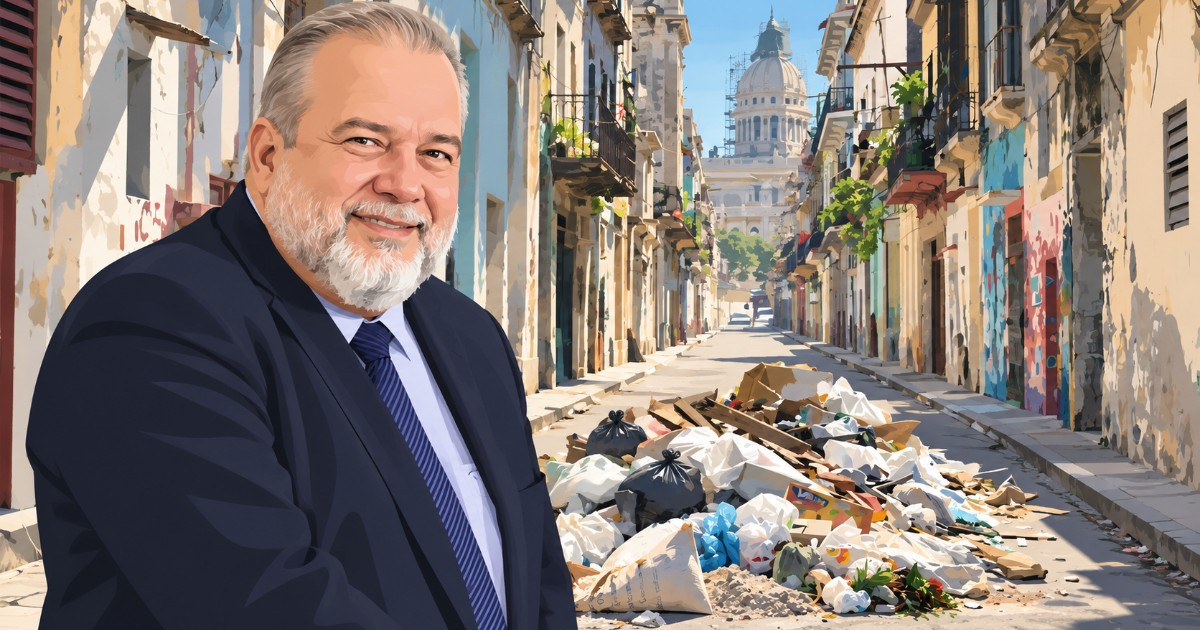
A Cuban citizen has openly challenged Prime Minister Manuel Marrero Cruz for claiming that the country's economic measures are poised to yield positive results. In a pointed Facebook post, this individual demanded the resignation of leaders deemed accountable for the nation's economic decline, reflecting on years of unfulfilled official promises that have failed to improve the population's living standards.
The message's author argued that officials unable to ensure the citizens' welfare should step down. To back up his criticism, he contrasted the economic announcements made since 2021 with the reality he observed during a recent visit to Cuba.
A Return to Havana Marked by Decay
The Cuban recounted his recent return to the island, where he encountered a bleak scene. His message paints a picture of neighborhoods with dwindling populations, a noticeable lack of young people, and streets littered with uncontrolled waste and debris.
He specifically mentioned the area around the Luyanó polyclinic in Havana, highlighting these scenes as indicative of everyday life deterioration. His main critique, however, targeted the prime minister's new statements regarding the results of economic reforms.
Unfulfilled Agricultural Measures and Economic Recovery Promises
The author finds it contradictory that Marrero maintains an optimistic tone while many families continue to struggle with shortages, inflation, and basic needs. To counter this, he referred to the regime's repeated announcements over the years.
His analysis begins in 2021, when the government unveiled 63 measures intended to boost food production, introduced by then Vice Prime Minister Jorge Luis Tapia Fonseca. These were meant to address organizational, productive, and structural agricultural challenges.
The citizen contends these measures failed to deliver the promised results and recalls the ongoing optimism in official forecasts. In December 2022, then Economy Minister Alejandro Gil Fernández projected a 3% GDP growth for 2023, based on a recovery in production activities and increased foreign currency income.
However, the economy fell short of this forecast: official data later revealed the GDP actually dropped by 1.9% in 2023 and contracted again by 1.1% in 2024.
The Responsibility of Those in Power Amid New Reforms
In his post, the author also revisited statements and assessments from 2024 and 2025 that presented the adopted measures as progress. His argument is that the succession of positive predictions and evaluations has not translated into tangible improvements for Cuban families.
The Cuban lamented that repetitive official promises have ultimately weakened the hope of those still awaiting economic recovery. He pointed out food shortages, rising prices, and the reduction of subsidized products as some of the most painful aspects of the crisis.
This controversy unfolds after the regime approved a package of 176 economic and social transformations in June 2026. In his recent television address, Marrero defended the administrative progress in implementing these changes but also acknowledged public dissatisfaction due to the lack of significant improvement in daily life.
The prime minister expressed confidence that the effects would become more evident in 2027. However, this new promise has sparked further public criticism from Cubans questioning why authorities continue to ask for patience following repeated economic programs.
For the testimonial author, the central issue is the political accountability of those who remain in power despite the accumulated deterioration. He believes it is the prime minister's duty to ensure a plan of progress that visibly benefits the citizens, rather than merely announcing new results.
The citizen argued that leaders of a government failing to enhance living conditions over the years should face political consequences for their management. Thus, he called for the resignation of the officials he considers incapable of fulfilling their duties, instead of continuing to announce outcomes that the public has yet to witness.
FAQs on Cuba's Economic Challenges and Leadership Accountability
What are the main criticisms against Cuba's economic measures?
Critics argue that the economic measures have not resulted in tangible improvements for the population, citing ongoing shortages, inflation, and unmet basic needs.
Why do some Cubans demand the resignation of government officials?
Many believe that officials who cannot ensure the welfare of citizens should resign, as repeated promises have not translated into real improvements in living conditions.
What was the outcome of the 63 agricultural measures announced in 2021?
The measures aimed at boosting food production did not achieve the expected results, according to critics, leading to continued challenges in the agricultural sector.