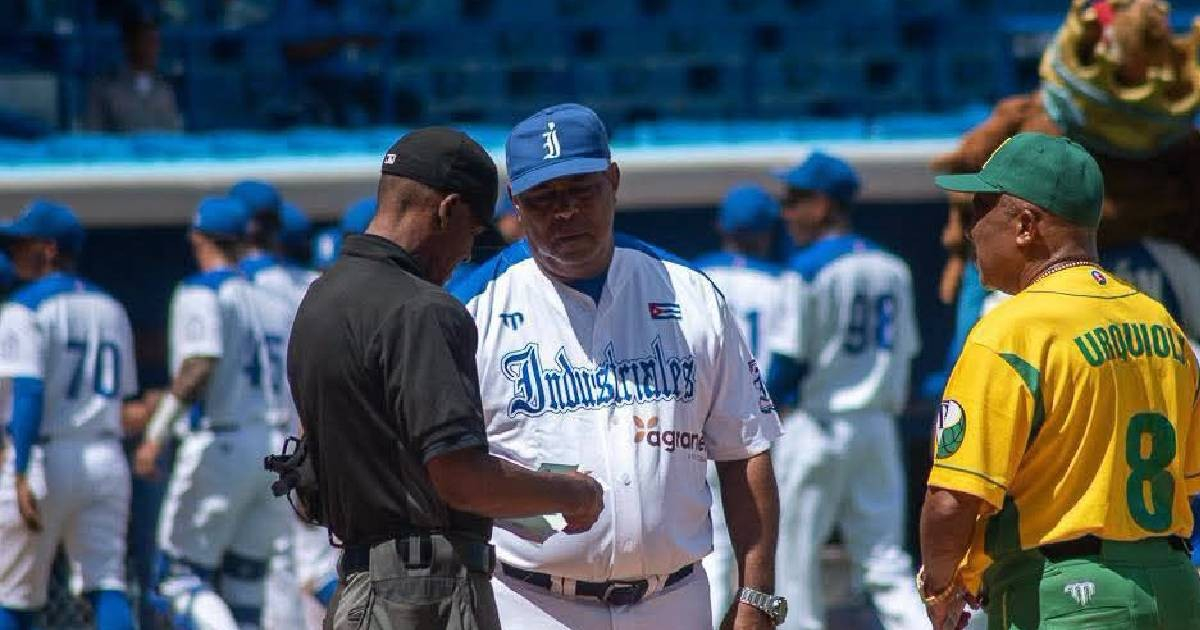
In an unprecedented move in the 65-year history of Cuba's National Series Baseball, a Cuban team is now sporting the logo of a private sponsor on their uniforms. For the 65th edition of the tournament, Industriales proudly displays the logo of A Granel—a Cuban private fuel distribution company—on their iconic white and blue jerseys.
The same advertisement was prominently featured on the centerfield billboards at Estadio Latinoamericano, the home base of the Havana team, as reported by AP from Havana.
The irony of the situation is striking: the regime, which for decades condemned professionalism and "capitalist" advertising—abolishing professional baseball after the 1960-1961 season and establishing INDER in February 1961 to promote amateurism—now finds itself relying on a private fuel company to provide resources for its flagship team.
Industriales manager Guillermo Carmona openly supported the sponsorship deal, stating, "I think it's a good idea. New measures are being taken, and there is a change in many policies in the country. I believe this is something that will help."
New Regulations Pave the Way for Sponsorships
This sponsorship is made possible by new regulations within the Cuban sports system approved last year. Just last Friday, Juan Reinaldo Pérez Pardo, President of the National Baseball Federation, confirmed that such contracts are explicitly authorized under this legal framework. National agreements must be processed through Cubadeportes S.A.
While the financial details of the contract remain undisclosed, both Carmona and Pérez Pardo outlined what the team will receive: bats, uniforms, fuel for transportation, player meals, and field improvements. The sponsorship benefits the entire team rather than individual athletes.
A Granel's Role in Cuban Baseball
A Granel has been operating since approximately June 2026 in Arroyo Arenas, La Lisa municipality, Havana. They sell imported diesel from the United States to registered Cuban private enterprises at $2.50 per liter, using facilities from Cubalub, a subsidiary of the state-owned Cupet. A company promoter mentioned that A Granel has foreign capital and pays taxes, although its partners and the exact origin of its funds have not been publicly identified. Its precise legal status has not been officially confirmed.
Challenges Amidst Sponsorship
This sponsorship comes amidst a deep crisis in Cuban baseball. The 65th National Series began on October 4 with a reduced schedule from 75 to 44 games per team and the competition divided into Eastern and Western zones to avoid interprovincial travel and save fuel. The logistical cost of a national tournament exceeds $600,000, according to official figures.
The shortages were glaring during preparations: only 300 baseballs were distributed for the 16 participating teams, and each province had to secure its own bats. In May, the regime suspended national youth championships for the Sub-12, Sub-15, and Sub-18 categories due to a lack of fuel for interprovincial transport. The exodus of players to foreign leagues continues unabated, with at least 103 athletes having left the island in recent years.
Luisa Álvarez, a 55-year-old Industriales fan, captured the sentiment shared by many Cubans regarding this development: "It's important that this step has been taken. We're aware of the situation the country is going through."
Understanding the Impact of Private Sponsorship in Cuban Baseball
Why is the sponsorship of Industriales by a private company significant?
The sponsorship marks a historic shift in Cuban baseball, traditionally state-controlled and devoid of private influence. It signifies a potential change in policy and openness to private sector involvement.
What benefits does Industriales receive from the A Granel sponsorship?
Industriales benefits from equipment such as bats and uniforms, fuel for transportation, meals for players, and improvements to playing fields, enhancing their operational capabilities.
How does the current crisis in Cuban baseball affect the teams?
The crisis has led to a shortened season, limited resources like balls and bats, and the suspension of youth championships, all of which strain the teams' ability to perform and develop talent.