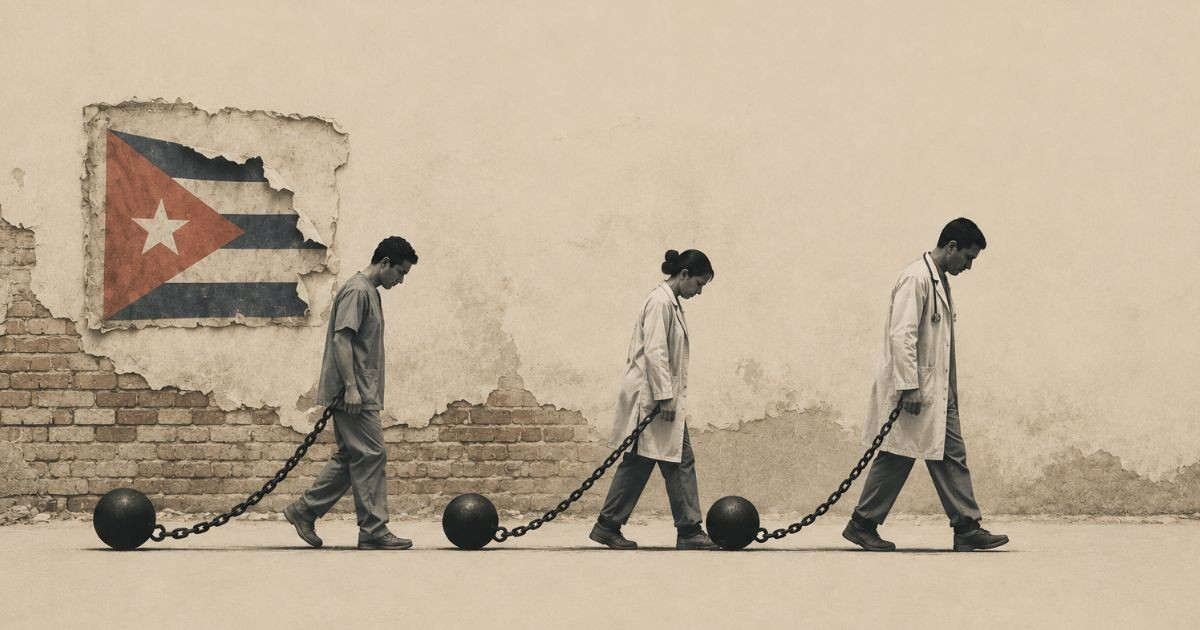
The U.S. Department of State has kept Cuba at Tier 3 in its 2026 Trafficking in Persons Report, which is the most severe category. This decision stems from the belief that the Cuban government continues to profit from a system of forced labor through its medical missions and other international professional deployment programs.
This report, released on Thursday, highlights that Cuban authorities fail to meet international minimum standards for combating human trafficking and make no significant efforts to achieve these standards.
A major criticism from Washington is that the Cuban state retains between 50% and 95% of the salaries paid by host countries for the services of professionals sent abroad.
Beyond financial exploitation, the document also points out practices like passport confiscation, worker surveillance, movement restrictions, curfews, and threats of retaliation against those who attempt to leave the missions or their families.
These allegations are part of a pattern documented by the United States over several years, which it views as incompatible with fundamental worker rights.
Thousands of Cuban Doctors Under Scrutiny
According to the 2026 report, between 15,000 and 18,000 Cuban healthcare professionals are stationed in more than 50 countries, a decrease from the approximately 24,000 reported at the beginning of 2025.
The Department of State estimates that healthcare professionals make up about 75% of the Cuban personnel deployed abroad through these programs.
Moreover, medical missions serve as a significant revenue source for the Cuban state. Official data cited by Washington indicates that the export of medical services generated $4.9 billion in 2022.
The Central Unit for Medical Cooperation (UCCM), under the Ministry of Public Health, is involved in the selection and coordination of professionals assigned to these missions.
In July, the U.S. sanctioned Cuba’s Health Minister, José Ángel Portal Miranda, and the UCCM director, Gretza Sánchez Padrón, for their roles in this system's operation.
International Pressure Mounts on Cuban Medical Brigades
Criticism of the Cuban professional deployment model has reached both Europe and Latin America.
On September 12, the Cuban Observatory for Human Rights (OCDH) urged the European Union to investigate the labor conditions of Cuban doctors sent to Calabria, Italy, where over 200 professionals are employed.
The organization called for an examination of potential labor rights violations and the control mechanisms imposed on brigade members.
More recently, Uruguay announced it would pay about 20 Cuban ophthalmologists directly, instead of transferring their salaries to the Cuban state, altering the traditional payment scheme used in these missions.
Cuba has remained at Tier 3 since 2019, downgraded to this category due to concerns over labor exploitation and medical missions.
Understanding Cuba's Tier 3 Status in the Trafficking Report
Why is Cuba in Tier 3 of the Trafficking in Persons Report?
Cuba is in Tier 3 because the U.S. Department of State believes the Cuban government benefits from a forced labor system through its international medical missions and other professional programs.
What are the implications of being in Tier 3 for Cuba?
Being in Tier 3 indicates that Cuba does not meet the minimum standards for eliminating trafficking and is not making significant efforts to do so, which can lead to international criticism and sanctions.
How do medical missions contribute to Cuba's Tier 3 status?
The medical missions are seen as a form of labor exploitation, where Cuba retains a significant portion of the professionals' salaries, and imposes restrictions and controls on them, violating international labor rights standards.