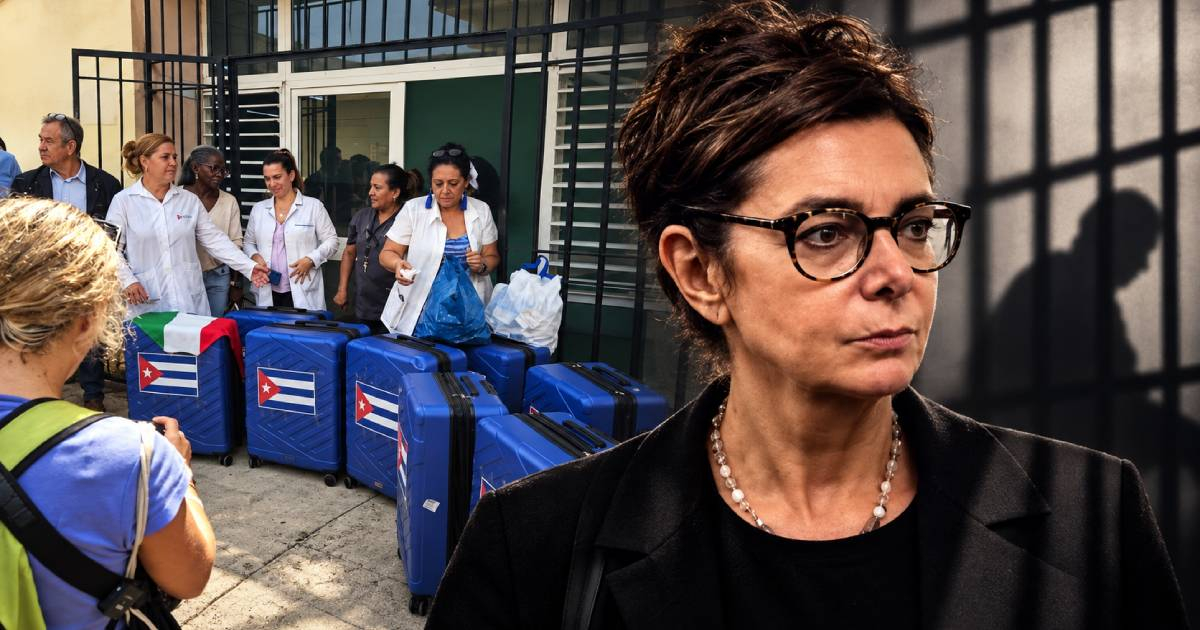
Italian lawmaker Laura Boldrini, who leads the Human Rights Committee in Italy's Chamber of Deputies, depicted a Cuba struggling with darkness, scarcity, and a decline in essential services. Yet, she attributed the island's crisis mainly to U.S. sanctions, while neglecting to address political repression or the plight of prisoners of conscience in Cuba.
In an interview published Thursday by Italy's L'Espresso magazine, the Democratic Party (PD) member shared her observations following a solidarity trip to Havana, which included representatives from the Five Star Movement.
"The Havana I remember from my 2006 visit is gone," Boldrini stated, describing a city almost devoid of vehicles, shrouded in darkness, with trash piling up and people scavenging through waste.
She recounted scenes of hospitals lacking medications and schools without water supplies, where students must use containers to flush toilets.
Blaming Washington for Cuba's Challenges
However, when addressing the causes of this decline, Boldrini focused her criticism on Washington, claiming that Cuban government reforms are unlikely to succeed as long as U.S. sanctions persist.
Boldrini branded the restrictions as "collective punishment" against the Cuban people, asserting they constitute a crime under the 1949 Geneva Convention.
She also urged the European Union to pressure then-President Donald Trump to lift the sanctions and foster dialogue with Cuban authorities.
A Human Rights Advocate Who Overlooks Political Prisoners
Despite heading the Human Rights Committee in Italy's Chamber of Deputies, Boldrini did not address the situation of political prisoners, the arrests of dissidents, or reports of repression against activists and independent journalists during the interview.
This omission occurs as human rights organizations continue to document violations of fundamental freedoms in Cuba.
As of the end of August 2026, Prisoners Defenders reported 1,339 political prisoners on the island, while the Cuban Observatory of Human Rights (OCDH) recorded over 3,000 repressive actions between January and September.
Recent cases include young activist Anna Bensi, who, along with her mother, received a two-year sentence of restricted freedom on October 1 for recording and disseminating a visit by a State Security agent to their home.
Overlooking Internal Economic Decisions
The interview also failed to examine the Cuban government's internal economic decisions or the lack of investments contributing to the deterioration of energy infrastructure.
This discussion involves the management of resources by the military conglomerate GAESA and the aging of thermoelectric plants, key factors in understanding the crisis beyond the impact of U.S. sanctions.
A Solidarity Campaign Welcomed by Díaz-Canel
Boldrini's visit, conducted from September 23 to 30, was part of the "Energy for Life" campaign led by Italian organizations such as Arci, ANPI, CGIL, and the Italy-Cuba Friendship Association.
The delegation brought 500 kilograms of medical supplies and school materials, with the initiative raising 380,000 euros, primarily for purchasing solar panels and other supplies for Cuban institutions.
During their stay, the parliamentarians were welcomed by Miguel Díaz-Canel, who publicly expressed gratitude for the Italian aid and highlighted the ties between the two nations.
Boldrini's stance contrasts with the position recently expressed by the European Parliament.
On September 17, the European Parliament approved, with 374 votes in favor, 198 against, and 19 abstentions, a resolution demanding the release of dissidents Félix Navarro and Saylí Navarro, and calling for action against human rights violations in Cuba.
Meanwhile, Italy's Chamber of Deputies' Foreign Affairs Committee unanimously approved a Democratic Party resolution on Wednesday to strengthen humanitarian assistance to the Cuban people. The initiative aims to expand cooperation in areas such as medical supplies, fuel for healthcare services, and maternal and child care.
Understanding the Impact of U.S. Sanctions on Cuba
How are U.S. sanctions affecting Cuba?
U.S. sanctions are blamed for contributing to Cuba's economic struggles, including shortages in essential goods and the decline of infrastructure, by restricting trade and financial transactions.
What is the current situation regarding political prisoners in Cuba?
As of August 2026, there are 1,339 political prisoners in Cuba, according to Prisoners Defenders, with ongoing reports of repression against activists and dissidents.
What actions has the European Union taken regarding human rights in Cuba?
The European Parliament recently passed a resolution demanding the release of political prisoners and calling for measures against human rights violations in Cuba.