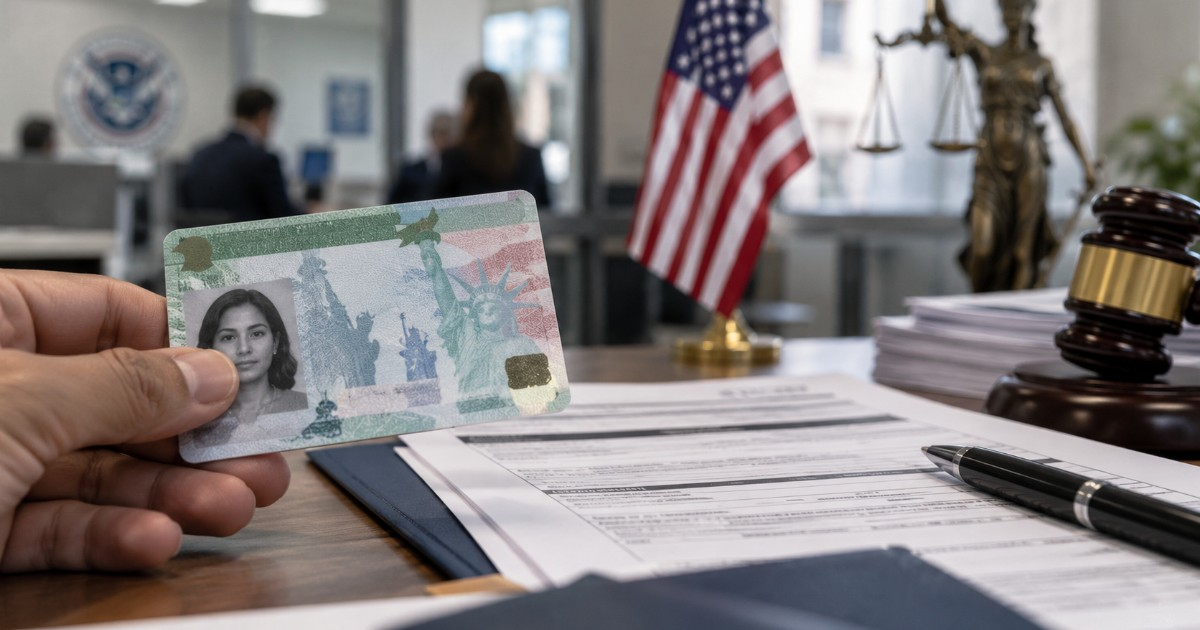
A group of immigrant organizations, academic unions, university professors, and permanent residency seekers have filed a federal lawsuit against the U.S. Citizenship and Immigration Services (USCIS) over two policies that tighten the criteria for obtaining a green card without leaving the country.
Filed on October 5, 2026, in the Federal District Court of Massachusetts, the lawsuit disputes a May memorandum that strengthens discretionary criteria for status adjustments and an August directive that permits the denial of certain immigration applications without first providing an opportunity to submit additional evidence.
The plaintiffs argue that these measures could lead to family separations, job disruptions, and hardships for immigrants legally residing in the United States who are pursuing permanent residency.
The case, known as American Association of University Professors et al. v. Mullin et al., Case No. 1:26-cv-14527, is in its early stages. Filing the lawsuit does not automatically halt the contested policies.
Details and documents related to the lawsuit are available on the official litigation page published by Democracy Forward, one of the organizations representing the plaintiffs.
The First Policy: Stricter Requirements for Green Card within the U.S.
The first policy under scrutiny is memorandum PM-602-0199, issued by USCIS on May 21, 2026, which frames status adjustments within the U.S. as an extraordinary discretionary benefit rather than an ordinary alternative to consular processing.
The USCIS document emphasizes that meeting the legal criteria for applying for permanent residency does not guarantee approval when the law provides the agency with discretion.
According to the plaintiffs, this new interpretation allows for a negative view of those applying for residency within the United States rather than securing an immigrant visa through a foreign consulate.
The policy also requires that certain adverse factors be outweighed by unusually positive or significant circumstances.
USCIS maintains that the memorandum reaffirms the discretionary nature of many status adjustments and underscores the importance of consular procedures in immigration law.
This does not imply that all foreign nationals must leave the United States to obtain residency. The document itself acknowledges exceptions, including immigration categories where in-country adjustment is the legally intended path.
Back in May, CiberCuba reported on the heightened criteria for status adjustments and the concerns raised among immigrants with pending applications.
The Second Policy: USCIS Can Deny Applications Without Requesting More Evidence
The lawsuit also challenges the update PA-2026-05, released on August 5, 2026, which altered USCIS procedures for requesting additional evidence before deciding on certain immigration benefits.
The directive allows officers to deny an application without first issuing a Request for Evidence (RFE) or a Notice of Intent to Deny (NOID) when essential initial evidence is missing or the file does not demonstrate eligibility requirements.
USCIS argues that the change aims to reduce incomplete or unfounded applications and enhance administrative efficiency. This policy applies to both pending applications and those submitted following its implementation, subject to relevant legal or regulatory exceptions.
However, the plaintiffs argue that the combined application of these two policies could especially disadvantage individuals who filed their applications before the new evaluation criteria were established, potentially leading to unfavorable decisions without an additional opportunity to submit related documentation.
This does not eliminate all requests for additional evidence: officers retain the authority to issue them when appropriate.
In August, CiberCuba explained how USCIS toughened evidence requirements and the potential consequences for incomplete applications.
Who Filed the Lawsuit and What They Demand
The plaintiffs include the American Association of University Professors (AAUP), its Harvard and Boston University chapters, the Service Employees International Union (SEIU), several affiliated labor organizations, and Americans for Immigrant Justice.
Six individual applicants for permanent residency are also involved.
The organizations are represented by legal teams from Democracy Forward, the American Immigration Council, the American Immigration Lawyers Association, and Colombo & Hurd.
The lawsuit challenges the legality of the policies under the Administrative Procedure Act of the United States, asserting that the agency exceeded its authority or adopted criteria incompatible with immigration procedural safeguards.
The plaintiffs request the court to temporarily block the measures and eventually nullify them, while also demanding that USCIS review the affected applications according to applicable law and precedents.
So far, the filing of the case does not constitute a judicial victory for the plaintiffs nor does it independently alter current procedures.
Impact on Cubans Awaiting Residency
This lawsuit holds particular significance for Cubans seeking permanent residency in the United States, but it is crucial to differentiate between various immigration procedures.
The Cuban Adjustment Act of 1966 provides a specific pathway for certain Cuban citizens or nationals who, among other requirements, have been inspected and admitted or granted immigration parole and have been physically present in the U.S. for at least one year.
This route should not be confused with ordinary adjustments based on family or employment petitions.
In fact, a federal court in Florida previously examined the application of memorandum PM-602-0199 to a group of Cuban applicants in the case Acosta Reynoso v. USCIS.
In an August 2026 ruling, the court noted the Government's position that the memorandum does not apply to applications under the Cuban Adjustment Act, finding this argument persuasive given the special pathway established for individuals physically present in the United States.
This distinction allows for a separation of the two legal regimes, but it does not mean that all Cuban applications must automatically be approved or that their files are exempt from other immigration rules.
The Cuban Adjustment Act itself includes an evaluation of eligibility and discretion, and USCIS's general policy on documentary evidence may be relevant for certain applications, including those filed using Form I-485.
Furthermore, a Cuban citizen applying for residency through a family or employment petition or another category outside the Cuban Adjustment Act may face a different legal situation.
The specific impact will depend on the route taken, available documentation, and individual circumstances.
This discussion arises as wait times for obtaining a green card via the Cuban Adjustment Act have significantly increased, according to official statistics recently analyzed by CiberCuba.
What Should Applicants with Pending Status Adjustments Do?
The filing of this lawsuit does not automatically change the timelines, requirements, or status of applications currently being processed by USCIS.
Therefore, those with pending applications should pay close attention to official notifications, keep their contact information updated, and ensure that submitted documentation meets the requirements for their immigration category.
It is also crucial to respond within the specified timeframe to any requests for additional evidence and not to assume that USCIS will always provide an opportunity to complete an insufficient application.
If someone receives a denial, has doubts about their eligibility, or is considering leaving the U.S. to continue a process, they should consult with an immigration attorney or an accredited legal representative beforehand, as the consequences can vary significantly based on their immigration history.
For now, the two contested policies remain in effect as the legal process continues in Massachusetts.
The main development will be whether the court grants any injunction to limit their application or allows USCIS to continue utilizing them while the lawsuit is resolved.
Key Questions About USCIS Green Card Policies
What are the two USCIS policies being challenged in the lawsuit?
The lawsuit challenges a May memorandum reinforcing discretionary criteria for status adjustments and an August directive allowing applications to be denied without requesting additional evidence first.
How might these policies affect Cuban nationals seeking a green card?
Cubans seeking residency may face challenges depending on the immigration procedure used. The Cuban Adjustment Act provides a specific pathway, but policies may still affect those applying through other categories.
What should applicants do if they have a pending status adjustment?
Applicants should carefully review official communications from USCIS, ensure their documentation is complete, and respond promptly to any requests for additional evidence.