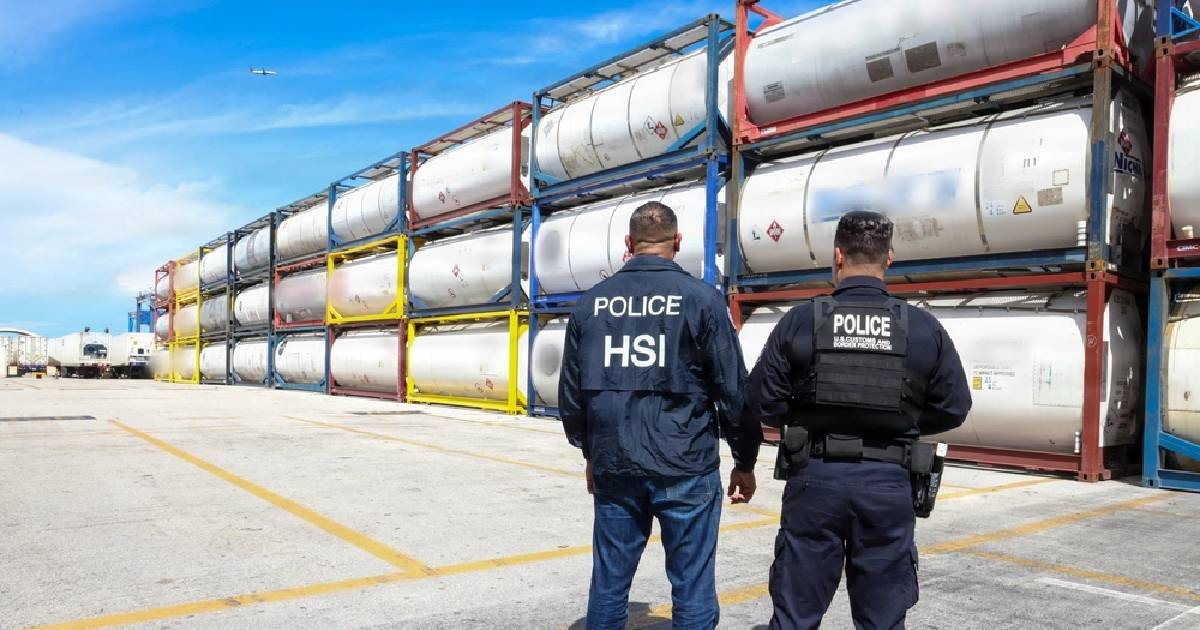
The U.S. Department of Homeland Security unveiled images on Wednesday depicting a federal operation where agents seized 90 shipments of biodiesel, valued at over $2.8 million, which were allegedly being smuggled to Cuba. This was confirmed by the Department of Defense's visual distribution system.
Captured on Tuesday at facilities in Fort Lauderdale, Florida, the photographs reveal rows of ISO tanks under the watchful eye of Homeland Security Investigations (HSI) agents and Customs and Border Protection (CBP) officers. Authorities described this as an illegal attempt to export fuel to Cuba, contravening federal laws.
The collaborative operation, which also involved the Department of Commerce's Bureau of Industry and Security (BIS), was announced during a press conference in Miami on Wednesday.
In total, the shipments amounted to over 620,000 gallons of biodiesel. At Port Everglades, 71 tanks containing approximately 500,000 gallons were detained, while an additional 19 shipments with around 120,000 gallons were seized at the Port of Houston, Texas.
According to an NBC Miami investigation, CBP intercepted the shipments in early September through trade data analysis and intelligence. The export documents identified the final consignee as ENETEC S.A., a Cuban state-owned company engaged in wholesale fuel and lubricant trade, sanctioned by the Office of Foreign Assets Control (OFAC) on July 13, 2026, under Executive Order 14404.
The interdictions were conducted due to alleged violations of the International Emergency Economic Powers Act (IEEPA) and export administration regulations.
At the time of the announcement, the involved exporters were not publicly identified, nor were any criminal charges reported.
José R. Figueroa, the special agent in charge of HSI Miami, emphasized the goal of "continuing to identify, disrupt, and investigate efforts to evade U.S. sanctions, protect the integrity of export controls, and deny the Cuban government access to resources obtained unlawfully."
Daniel Alonso, CBP's Director of Field Operations for Miami and Tampa, reiterated that the agency "remains steadfast in enforcing U.S. laws across all domains, both in incoming trade and outgoing shipments."
This seizure is part of a series of recent interdictions under the Trump administration's maximum pressure policy against the Cuban regime.
In the summer of 2026, the Coast Guard intercepted the M/V Jaira Provider near Mayagüez, Puerto Rico, with roughly 220,000 gallons of diesel on board.
On September 5, another cargo ship, the M/V Grace, was boarded in the Caribbean between Cuba and Mexico and led to the Mexican port of Progreso. There, the Mexican Navy confirmed the presence of fuel in its ballast tanks and containers.
The pressure on Cuba's energy supply comes amidst an unprecedented electrical crisis on the island. Cuba produces about 40,000 barrels of oil daily but requires between 90,000 and 110,000, relying heavily on imports to meet approximately 60% of its demand.
After Venezuela halted crude shipments in November 2025 and Mexico drastically reduced supplies, Cuba suffered at least eight total national power grid collapses in 2026, with generation deficits exceeding 2,000 MW and blackouts lasting up to 87 consecutive hours in some areas.
The most severe collapse occurred on September 18, leaving nearly nine million people without electricity for about 32 hours.
Understanding the Seizure of Fuel Shipments Destined for Cuba
Why were the fuel shipments to Cuba seized by U.S. authorities?
The shipments were seized because they were part of an illegal attempt to export fuel to Cuba, in violation of U.S. federal laws and regulations, specifically the International Emergency Economic Powers Act (IEEPA) and export administration regulations.
What role did the Department of Commerce play in the operation?
The Department of Commerce's Bureau of Industry and Security (BIS) participated in the operation, which was a collaborative effort to enforce U.S. export controls and prevent unlawful shipments to sanctioned entities.
How has the energy crisis affected Cuba?
Cuba is experiencing an unprecedented electrical crisis, producing only 40,000 barrels of oil per day but needing between 90,000 and 110,000. This shortfall has led to frequent power outages and a heavy reliance on imports to meet 60% of its energy demand.