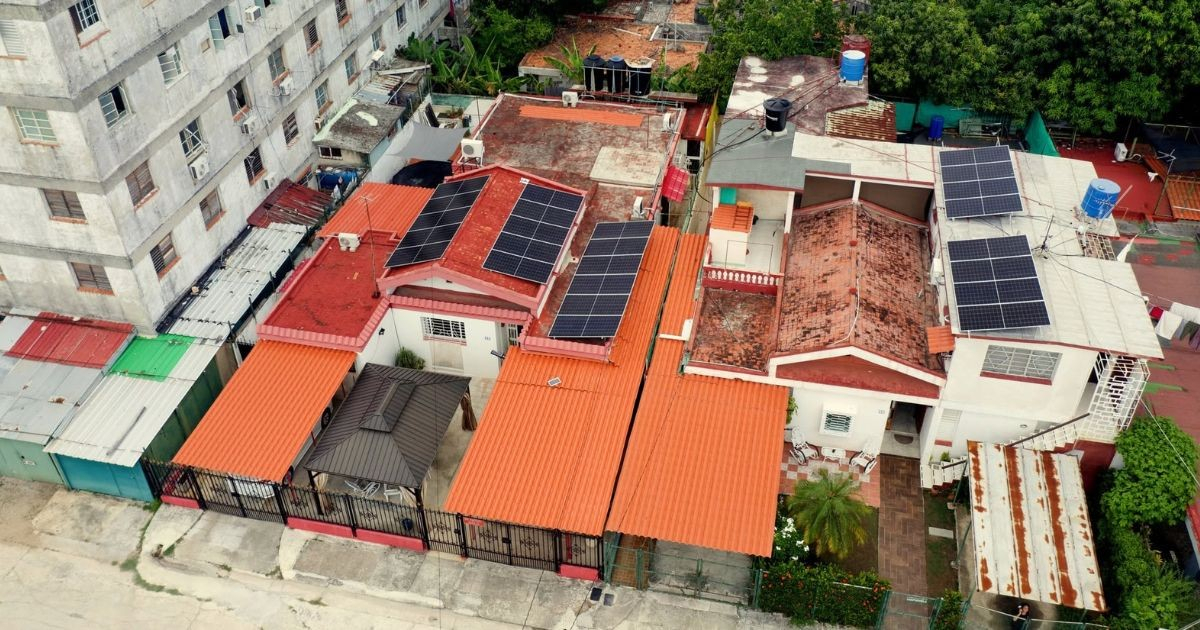
During the first seven months of 2026, exports of solar equipment from the United States to Cuba surged dramatically amid an ongoing energy crisis forcing island residents and businesses to seek alternatives to cope with frequent blackouts.
Between January and July, the U.S. shipped $6.3 million worth of solar cells and modules to Cuba, a staggering 1,070% increase compared to the entire year of 2025, when exports were a mere $538,000, according to U.S. Census data cited by Bloomberg.
This surge sharply contrasts with China's role as Cuba's primary solar technology supplier. By the end of July, China had exported $19.5 million in solar equipment to the island, reflecting an 83% decline from its 2025 total, as reported by BloombergNEF.
The Shift in Solar Dynamics
Despite a recent donation of 5,000 solar systems from China in September, Bloomberg highlights that the increasing shipments from the U.S. have become a crucial lifeline for Cubans trying to keep their phones charged, power essential appliances, or sustain small businesses during power outages.
A case in point is Ramiro Llovet, owner of La Campana, an event space in his Havana home accommodating everything from small celebrations to events with up to 350 attendees. For years, Llovet relied on a small generator to withstand power cuts. However, the persistence and frequency of these outages prompted him to invest in a personal solar system.
Llovet recounted that last year, he began gathering the components and found the 5-kilowatt-hour lithium batteries he needed only on Amazon. He sent them to a relative in Miami, who then forwarded them to Cuba through a parcel service. After investing approximately $10,000, his business now runs almost entirely on energy produced by his own system.
Policy and Economic Implications
This growth in imports is occurring despite the Trump administration's strict sanctions on the Cuban regime. Nevertheless, Bloomberg notes that certain goods can still reach private entrepreneurs on the island under existing embargo exceptions.
John Kavulich, president of the U.S.-Cuba Trade and Economic Council, commented on the significance of increased use of ports in Florida, Texas, and Louisiana to send solar technology to Cuba. "It's somewhat ironic that Cuba could become a notable market for U.S. renewable energy exports," he noted, especially given the White House's less favorable stance on this energy sector.
Cuba's Energy Crisis and Solar Expansion
The expansion of private solar systems coincides with one of the most challenging periods for the National Electroenergetic System. Due to fuel shortages and frequent breakdowns in the aging thermoelectric plants, the country increasingly relies on solar generation during daylight hours.
Vice Minister Carlos Fernández de Cossío told Bloomberg that over the past eight months, he has had electricity in his home for only two to three hours daily. He attributed part of the crisis to U.S. pressure on international fuel suppliers.
The Cuban government claims that 144 solar parks with a total capacity of 1,418 megawatts are operational, roughly accounting for a fifth of the national electricity generation, according to figures provided by Miguel Díaz-Canel. The president also reported that the private sector currently produces around 20% of the energy it consumes.
However, experts warn that solar expansion alone cannot address the systemic issues. Jorge Piñón, a researcher at the University of Texas Energy Institute, told Bloomberg that Cuba is rapidly increasing its photovoltaic capacity but lacks a proper storage strategy. The country has virtually no large-scale grid-connected batteries, limiting the daytime use of solar park-generated electricity and failing to adequately compensate for nighttime generation shortfalls.
"Solar is a wise investment if done intelligently, something not happening right now," Piñón asserted. He also reminded that due to the characteristics of Cuba's electrical system, solar energy cannot fully replace the large thermoelectric plants responsible for providing stable base load generation.
Government Incentives and Challenges
The growing installation of panels in homes and businesses has already prompted Cuban authorities to address the need to "regulate" the rise of domestic solar systems, amid concerns over installation safety, urban integration, and the lack of uniform technical standards.
Simultaneously, the regime has expanded incentives to facilitate the entry of these technologies. In August, it extended the exemption from Customs Duty for importing photovoltaic solar systems and other renewable energy-related equipment until December 31, 2027.
The Ministry of Finance and Prices' Resolution 180/2026 allows the importation of solar panels, batteries, inverters, and other essential parts without this tax, as well as solar water heaters, photovoltaic pumps, small wind turbines, and other renewable energy equipment.
For individuals, these goods are also not counted within the maximum authorized value for non-commercial imports, although they must be presented separately to Customs.
The measure also introduced tax benefits for certain investments and the commercialization of these technologies, as more Cubans turn to independent systems due to the state electricity system's inability to ensure a stable supply.
Understanding the Solar Tech Boom in Cuba
Why have U.S. solar exports to Cuba increased so dramatically?
The spike in U.S. solar exports to Cuba is driven by the island's energy crisis, which has prompted residents and businesses to seek alternative power sources due to frequent blackouts.
What challenges does Cuba face with its solar energy expansion?
Cuba's solar energy expansion is hampered by the lack of large-scale grid-connected batteries, limiting the effective use of solar power during nighttime and failing to provide a consistent energy supply.
How is the Cuban government supporting solar energy adoption?
The Cuban government has extended tax exemptions for importing solar equipment and introduced fiscal incentives to encourage the adoption and commercialization of renewable energy technologies.