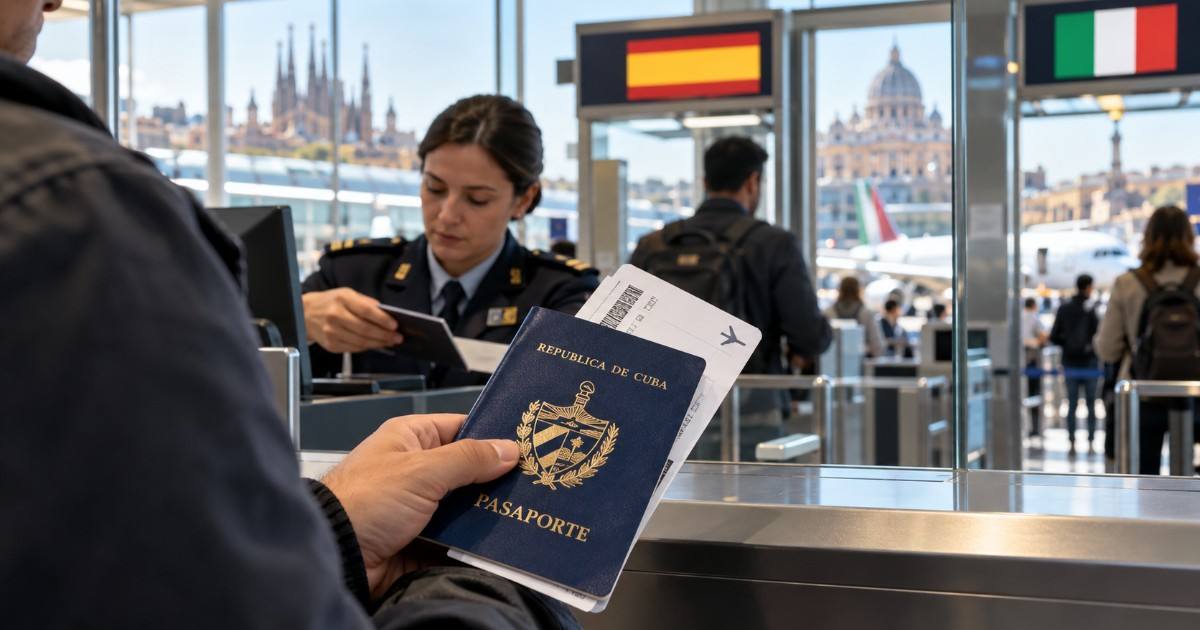
The Spanish government has extended its temporary border checks on travelers arriving from Italy by air or sea until October 22, 2026. This decision also affects Cubans traveling between the two countries, necessitating a close attention to immigration documents.
The extension is outlined in Order INT/1033/2026, published in Spain's Official State Gazette. The order specifies that these controls will be in effect from midnight on October 8 until midnight on October 22.
This move prevents the earlier planned end of controls on October 7, maintaining them beyond the previously scheduled date.
CiberCuba had previously detailed what documentation Cubans need when traveling between Spain and Italy, cautioning that the Spanish measure was due to expire on October 7 unless a new extension was approved by the government. Now, that extension has been confirmed.
Which Travel Routes Are Affected?
The extension does not universally apply to all travelers entering Spain from European countries. The order continues the terms set when Spain reintroduced controls on August 8, covering passengers arriving from Italy via air and sea routes.
Specifically, it includes flights whose last departure airport before reaching Spain is in Italy, as well as ships, ferries, and other passenger maritime services departing from Italian ports.
This measure does not concern a nonexistent land border between Spain and Italy, nor does it convert all Schengen area travel into external border crossings.
Clarifying the Scope of the Extension
Importantly, this extension does not imply that Spain has closed its borders with Italy or that the countries have exited the Schengen area. The core principle within Schengen remains free movement without internal border checks, though European rules allow states to temporarily reinstate such controls in response to serious threats to public order or internal security.
The Spanish Ministry of the Interior has updated its official information to reflect this new extension within the Schengen framework.
Practically speaking, individuals traveling from Italy to Spain may be asked to present documentation, despite the journey being between two Schengen countries.
Reasons Behind Spain's Continued Border Checks
The Spanish government asserts that the urgent reasons and serious threats to public order and internal security that initially justified the measure persist. The original August order linked the decision to migration pressure from the central Mediterranean route, risks associated with irregular movements within the Schengen area, usage of these routes by criminal organizations, and potential security threats.
The new order maintains these arguments, emphasizing that the conditions necessitating the controls remain unchanged.
Travel Requirements for Cubans with a Schengen Visa
For Cubans traveling with just a Cuban passport, the extension doesn't introduce a new visa requirement or necessitate a special permit to travel from Italy to Spain. They must carry a valid Cuban passport and, when necessary, a current Schengen visa, while being able to prove legal presence within the Schengen area.
Authorities may also request additional documentation related to the purpose of the stay, accommodation, financial means, or travel plans.
A valid uniform Schengen visa generally allows travel across the area for the authorized days, respecting applicable stay limits.
Cubans Residing in Spain or Italy
Cuban nationals legally residing in Spain, Italy, or another Schengen state should carry a valid travel document and their current residence card or permit. The Spanish Ministry of the Interior notes that foreign residents in a Schengen state can travel to other Schengen countries for up to 90 days within any 180-day period, provided they meet relevant conditions.
These temporary checks do not negate this right but underscore the importance of having documents ready during travel.
Cubans with Spanish Citizenship
Those with dual Cuban and Spanish citizenship can prove their EU citizenship using their Spanish ID or valid Spanish passport. During temporary Schengen controls, it's advisable to use Spanish documentation to directly confirm the right to free movement as a European citizen.
What About Cuban Americans?
Cubans who are also U.S. citizens and traveling with a U.S. passport fall under the regime applicable to American travelers for short stays in Schengen. The presence of these temporary checks does not, by itself, require additional Spanish or Italian visas. However, travelers must carry a valid passport and demonstrate compliance with legal stay conditions.
These checks should not be confused with ETIAS. CiberCuba recently explained which Cubans will be subject to ETIAS and who will continue needing visas for European travel.
Italy's Border Measures for Arrivals from Spain
Spain's measure isn't the only one in force. On September 30, Italy's Ministry of the Interior announced an extension of its air and maritime controls on passengers arriving from Spain. Italy linked its decision to the migration situation related to Ceuta, potential secondary movements within Europe, and internal security considerations.
This means travelers might face controls both on routes from Italy to Spain and, during the relevant period, when traveling in the opposite direction.
Possibility of Early Termination Before October 22
Yes, the Spanish order states that the measure will undergo continuous evaluation and could be lifted before October 22 if the threats justifying its adoption dissipate or if less restrictive measures can address them.
It also clarifies that the controls cannot be automatically extended beyond October 22. If the government wishes to maintain them past this date, a new justified decision and evaluation of necessity and proportionality would be required. As such, Cubans planning to travel between Spain and Italy in the coming weeks should ensure their passport, visa, or residence permit are valid and check for potential updates from authorities before departure.
Frequently Asked Questions About Spain's Extended Border Controls
Why did Spain extend border controls with Italy?
Spain extended the controls due to ongoing urgent threats and migration pressures from the central Mediterranean route, along with security concerns within the Schengen area.
Do Cubans need a new visa to travel from Italy to Spain?
No, Cubans do not need a new visa. They must travel with a valid Cuban passport and a current Schengen visa, if required, to enter Spain from Italy.
Are these border controls the same as ETIAS?
No, these controls are separate from ETIAS, which will apply to certain travelers once implemented. The current controls are temporary measures due to security threats.
Can the border controls end before October 22?
Yes, the Spanish government can end the controls earlier if the threats diminish or alternative measures are sufficient. The situation is under constant review.