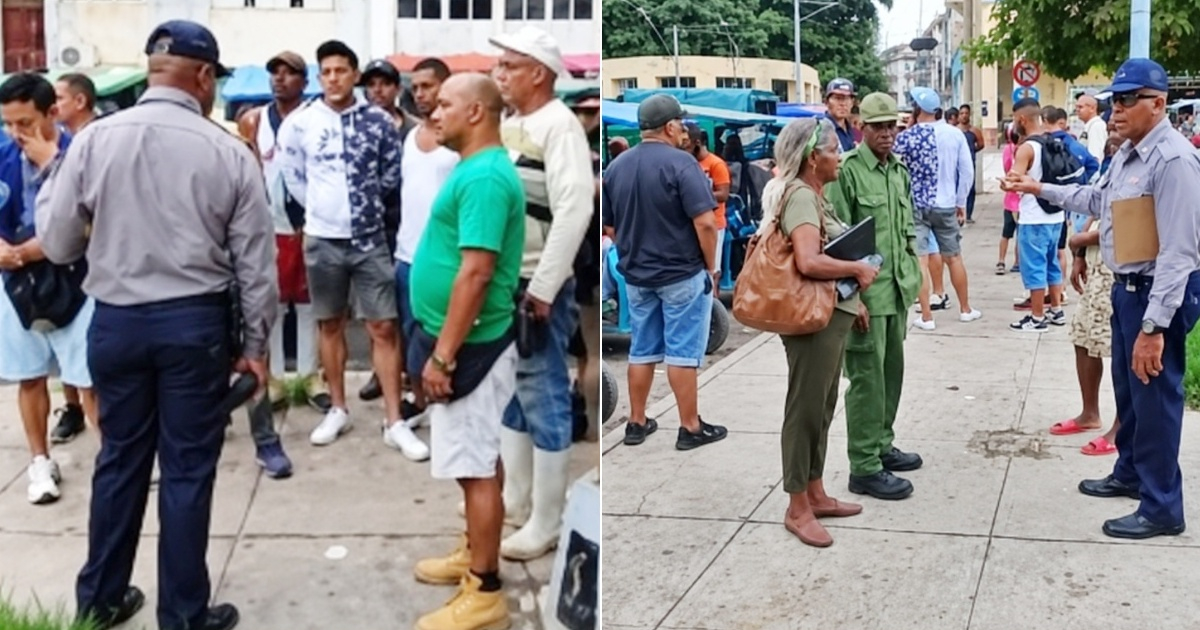
A recent police operation across various neighborhoods in Havana resulted in the confiscation of nearly 1.5 million Cuban pesos in cash and 22 fines imposed on drivers operating illegally. This action was reported on the official Facebook page "Héroes de Azul en Cuba," closely linked to the Ministry of the Interior (MININT).
The post quickly went viral, igniting a widespread debate that revealed the deep frustration of Havana's residents over the public transportation crisis, rather than celebrating the operation.
Details of the Police Operation in Havana
The operation, carried out by the National Revolutionary Police in Centro Habana alongside the Technical Investigations Department, initially targeted the intersection of Industria and Neptuno. Citizens found with substantial amounts of cash were detained there.
Subsequently, the crackdown extended to El Curita Park and its vicinity, the Guanabacoa terminal, and Galiano Avenue with its boulevard—areas well-known for their concentration of informal transportation services in the city.
Authorities arrested drivers involved in illegal "boteo," which involves charging passengers fares higher than the legal rates, as well as unlicensed bicitaxi drivers and motorcyclists lacking necessary documentation.
In addition, three speakers with audio players and a previously monitored exhaust pipe were confiscated due to noise pollution.
Official Statistics and Public Response
The official report, delivered with a tone of triumph, highlighted the following:
- Two fines issued under Article 7, clause L (8,000 pesos).
- Three fines under Decree 261, Article 1, clause K (500 pesos).
- Seventeen fines under Decree 91, clause C (16,000 pesos).
Furthermore, Traffic Chief Alain Blanch Aldana and the Vice Supervisor of Oversight conducted two educational sessions: one for car drivers and another for electric tricycle operators.
The post generated a flood of comments reflecting three main sentiments: frustration, fear, and demands for genuine solutions. The prevailing tone was one of ironic skepticism.
One user sarcastically remarked, "And just like that, the transportation problem is solved." Others were more direct in their criticism: "Where is the state transportation?" and "Who will ensure the much-needed passenger transport?"
There is widespread concern that these penalties will further diminish an already inadequate transportation supply. A commenter succinctly observed, "End result... less transport."
Some predict an unintended consequence—reduced availability of drivers might lead to those remaining in operation raising their fares even higher.
Calls for Action Beyond Crackdowns
While some recognized the necessity of curbing illegal practices, they insisted that enforcement must come with viable alternatives. "The problem is not getting rid of the transporters we desperately need," one commenter noted.
Another posed a critical question: "How many state-run public transport routes have been added?" Even among those who supported the operation, there was a common demand: "This should not be a one-day action," one commenter insisted.
Another summarized the sentiment: "Anything done for the people's welfare is good. But consistency is key to success."
Sarcastic remarks like "Tomorrow we'll have buses every 15 minutes" or "The buses are coming to fill the gap soon" were not celebrations of improvement but rather derisions of the notion that fines could replace a sustainable transportation policy that the state has failed to maintain for years.
Some users outright labeled the operation as a "circus" or a "distraction."
The Broader Context Unaddressed by the Crackdown
State-run passenger transport in Cuba collapsed by 93% between January and September 2025. In February 2026, Transportación Habana halted all urban routes due to a diesel shortage, leaving none in operation.
The situation became so dire that residents had to walk across the bay tunnel—733 meters—after waiting more than seven hours for a bus that never arrived.
In this void, unlicensed drivers, bicitaxis, and electric tricycles became the only viable options for millions, albeit with rising costs: informal gasoline prices soared to about 4,000 pesos per liter, further inflating operating costs and passenger fares.
The government's response has been contradictory: initially easing licensing requirements through the Ministry of Transport's Instruction No. 1, allowing 1,912 people with electric vehicles to obtain licenses by July 2026, followed by intensified operations with fines and confiscations against those operating without licenses or charging excessive fares.
A commenter summed up the sentiment of many Havana residents: "What this operation achieved is reasonable; everyone must obey the law, but the question remains—who will solve the transportation issue for the Cuban people?"
Common Questions About Havana's Transportation Crisis
Why did the police operation target unlicensed drivers in Havana?
The operation aimed to crack down on illegal transportation activities, such as overcharging passengers and operating without required licenses, to enforce legal compliance.
What has been the public's response to the police operation?
The public response has largely been one of frustration and skepticism, with many residents questioning the effectiveness of fines in solving the underlying transportation crisis.
What alternatives are available for transportation in Havana?
With the state-run public transport system severely deficient, residents often rely on unlicensed drivers, bicitaxis, and electric tricycles, despite their rising costs.