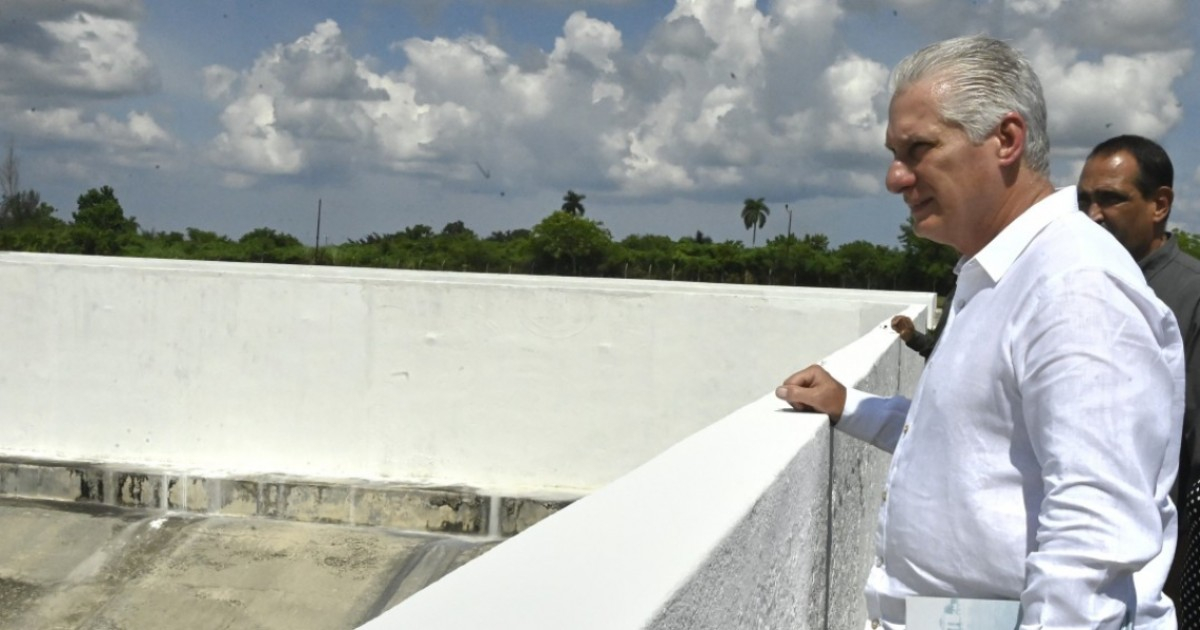
During a visit to the "El Gato" Main Tank in Havana's Cotorro district on Tuesday, Miguel Díaz-Canel claimed the Comprehensive Water Supply Program in Havana "has been progressing" and that "results are already visible." However, hundreds of thousands of residents continue to struggle with a lack of running water in their homes.
Díaz-Canel also mentioned that as improvements are made in the capital, this experience could be expanded to other provinces to address the water deficit.
That same morning, Aguas de La Habana announced a water cutoff of up to 14 hours affecting six municipalities—Plaza de la Revolución, Cerro, Diez de Octubre, Boyeros, Centro Habana, and Habana Vieja—between 6:00 a.m. and 8:00 p.m., due to electrical work in Cuenca Sur and maintenance on the 78-inch water main.
The stark contrast between official optimism and the everyday reality of Havanans was evident: while Díaz-Canel praised supposed advancements in water infrastructure, half the city remained without water supply.
Yosvani Rubí Bazail, General Director of Aguas de La Habana, offered figures that the regime claims as progress: "We started with a peak impact affecting about 577,000 people, and today we're down to around 282,000." According to his data, 296,000 residents have been relieved from the affected group since the program's inception, with 14,500 improvements in the last week.
Rubí Bazail admitted, however, that water shortages exist in all municipalities of the province, and improvements will be gradual.
Yet these figures coexist with a national reality that contradicts the triumphalist narrative. The regime itself acknowledged last week that 2.7 million Cubans experience full or partial disruptions in water service nationwide, a figure that has barely changed since May. The UN Office for the Coordination of Humanitarian Affairs (OCHA) estimates that 3.5 million people lack access to running water.
In September, Díaz-Canel had promised that by the end of the month improvements would be seen in two or three of Havana's water systems and that other sources would be consolidated in October. Current data confirms that the national figure remains unchanged.
The crisis has deep structural roots that no presidential tour can conceal. A staggering 87% of the capital's pumping system relies on the electrical grid, meaning every blackout halts water supply. Only 135 of the country's 480 pumping stations have protected circuits.
Moreover, over 40% of pumped water is lost to leaks before reaching homes, and some main pipelines have been in operation for 60 to 70 years without comprehensive rehabilitation.
The 78-inch main from Cuenca Sur, which prompted Tuesday's cutoff, suffered a major breakdown in August, leaving six municipalities without water after three leaks were detected.
The health consequences are severe. The Ministry of Public Health reported a simultaneous increase in dengue, diarrhea, hepatitis A, and respiratory infections at the end of September, with dengue being 7.4 times above expected levels, all directly linked to limited water access and sanitation.
The regime's long-term solution—installing 200 megawatts of solar photovoltaic energy to make water pumping independent of the electrical grid—is not expected until early 2027, ensuring that the crisis will continue to affect Havanans for several more months.
Understanding Havana's Water Crisis
What are the main causes of Havana's water crisis?
Havana's water crisis is primarily due to reliance on an outdated electrical grid, significant water losses from leaks, and an aging infrastructure that hasn't been rehabilitated in decades.
How many people are affected by the water shortages in Cuba?
Approximately 2.7 million Cubans are affected by full or partial water service disruptions, with the UN estimating up to 3.5 million people lacking access to running water.
What is the government's plan to address the water crisis?
The government plans to install 200 megawatts of solar photovoltaic energy to make water pumping independent of the electrical grid, but this is not expected until early 2027.