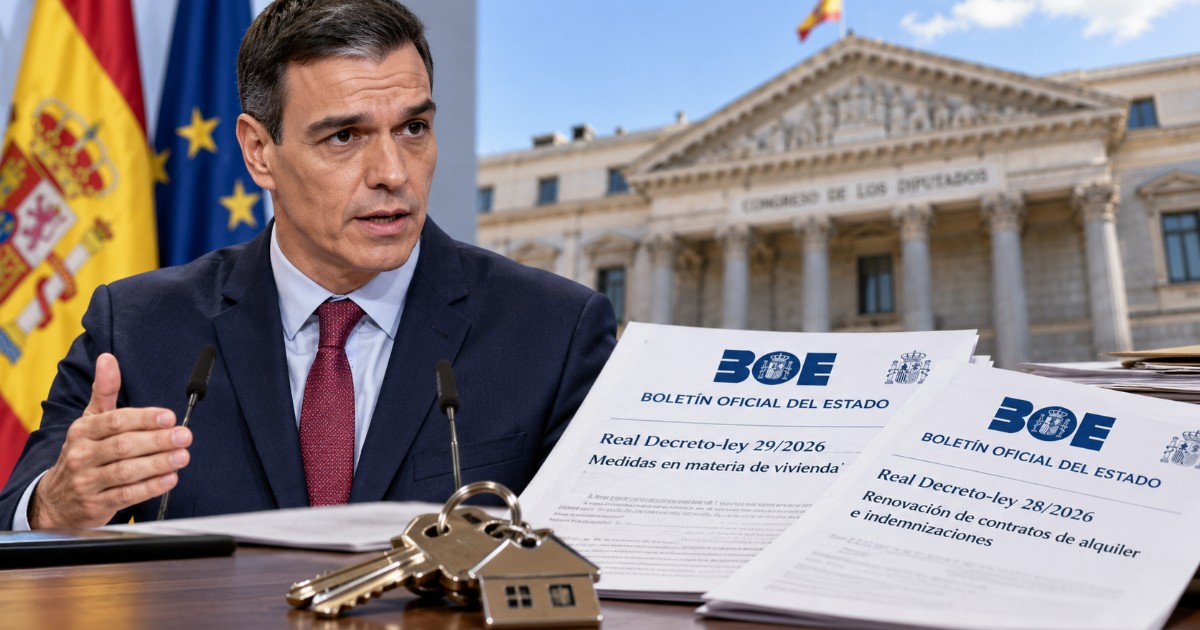
Spain has officially released two new royal decrees on housing, directly impacting tenants, landlords, and prospective first-time homebuyers. These were approved by Prime Minister Pedro Sánchez on October 6 and subsequently published in the Official State Gazette (BOE) on October 7.
The first, Royal Decree-Law 29/2026, offers a comprehensive package of housing measures, while Royal Decree-Law 28/2026 focuses on the duration and renewal of standard residential lease agreements.
Decrees Amidst Political Transition
These decrees emerge after previous housing bills were rejected by parliament. The current scenario differs significantly as both the Congress of Deputies and the Senate are dissolved ahead of the general elections scheduled for November 29.
Normally, the Congress of Deputies would vote on these decrees. However, with the dissolution of the legislative bodies on October 6, the Permanent Deputation of Congress now holds the authority to address these legislative texts until a new Congress is formed.
Key Dates and Implementation
Royal Decree-Law 29/2026 takes effect on October 8, 2026, just a day after its publication, with some provisions having their own timelines. This means that certain measures will start applying immediately without waiting for ratification by the Permanent Deputation.
If the Permanent Deputation ratifies it, the decree remains in force; if not, it will be nullified instantly.
Significant Housing Reforms
Among the impactful changes for tenants is the reinstatement of an extraordinary lease extension of up to two years for select residential contracts. This allows tenants to request annual renewals, up to a total of two additional years, for contracts ending before December 31, 2028. Conditions include the tenant’s consistent rent payment for the past eight months.
Regarding rent increases, the decree imposes a special cap on annual rent adjustments until December 31, 2027. If the rent exceeds the state reference limit, no increase is permitted. Otherwise, landlords and tenants can agree on new terms, but without consensus, increases cannot exceed 2%.
Additional Leasing Regulations
The decree also introduces guidelines for temporary rentals and room leasing, aiming to prevent misuse of temporary contracts as regular housing leases. Existing temporary contracts remain under their original terms until renewed, at which point they must comply with new regulations.
Specific rules apply to room rentals, including rent aggregation when multiple rooms in the same property are leased concurrently.
Tax Benefits and Financial Assistance
The decree introduces a new 10% income tax deduction for tenants paying for their primary residence, applicable to those with an annual taxable income below €33,007.20. The maximum deduction base is €11,630 for incomes up to €23,007.20, decreasing progressively for incomes above this threshold.
Furthermore, the TU CASA program, managed via the Official Credit Institute (ICO), offers interest-free loans up to €50,000, or 20% of the property value, to assist first-time homebuyers who can afford a mortgage but struggle with down payment savings.
Implications of the Upcoming Elections
Both decrees are subject to ratification by the Permanent Deputation before they can fully take effect. If ratified, they remain in law regardless of the election outcomes on November 29. A new government wishing to amend these decrees post-election would need to legislate new measures to alter them.
Understanding Spain's New Housing Decrees
What are the main objectives of Royal Decree-Law 29/2026?
The decree aims to establish comprehensive housing measures, including rent control mechanisms, lease extensions, and detailed regulations for temporary and room rentals.
Who will decide on the ratification of these decrees?
With the Congress dissolved, the Permanent Deputation holds the authority to ratify or repeal the decrees, ensuring legislative continuity until a new Congress is elected.