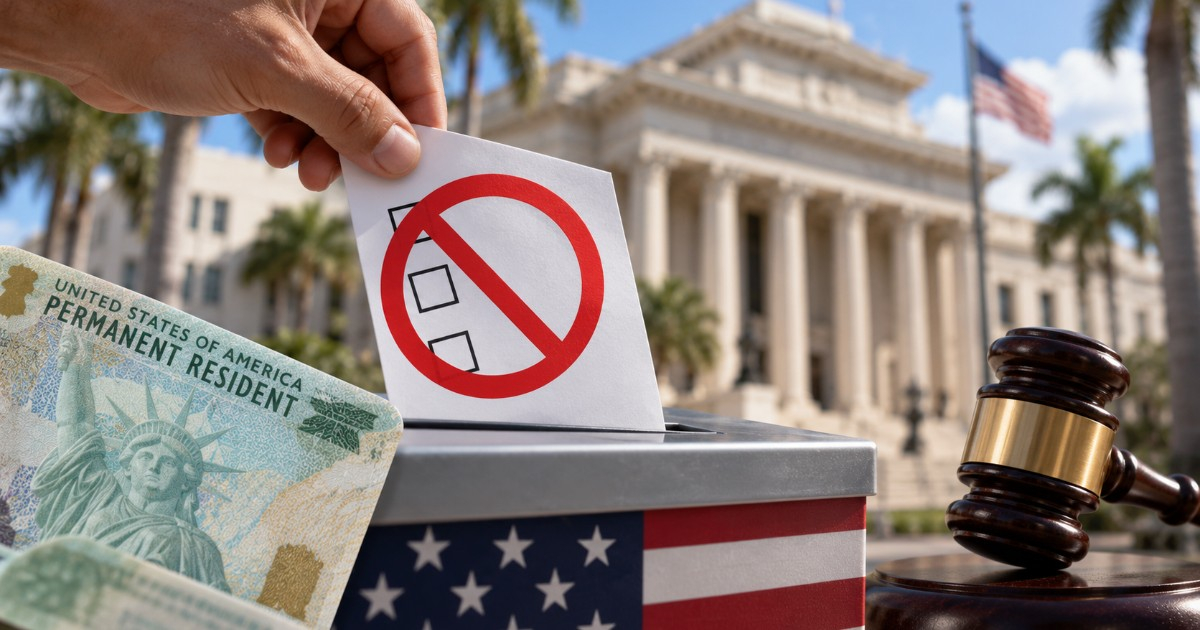
A federal judge in Miami has sparked a significant legal debate on who has the authority to penalize non-citizens for voting. However, this ruling does not imply that permanent residents or other foreigners can start voting legally in the United States.
District Judge David S. Leibowitz from the Southern District of Florida dismissed a federal criminal case against Chelsea Michelle Ann Cox, a Jamaican citizen accused of voting in the 2020 presidential election without U.S. citizenship.
In a 31-page decision dated October 1, Judge Leibowitz argued that Congress overstepped its constitutional authority by enacting Section 611 of Title 18 of the U.S. Code, the federal statute used to prosecute Cox.
The full resolution in United States v. Cox asserts that the general power to establish voter qualifications belongs to the states, not Congress.
Nonetheless, the ruling's impact is more limited than it might seem: the judge addressed the constitutionality of the law as applied in Cox's case, without nullifying the statute nationwide.
Federal Law in Question
The case revolves around 18 U.S.C. § 611, a federal law incorporated into the Criminal Code in 1996.
Currently published by the U.S. House of Representatives, it generally prohibits foreign nationals from voting in elections for president, vice president, senator, or representative, with certain exceptions.
Violating this law can result in a fine, up to a year in prison, or both.
Cox was charged with a misdemeanor for allegedly voting in Broward County on October 29, 2020, despite knowing she wasn't a U.S. citizen.
Judge’s Reasoning on Constitutionality
Judge Leibowitz’s argument does not grant new voting rights to foreigners. The issue addressed was whether Congress has the constitutional power to directly set voter qualifications for federal elections.
The judge interpreted the U.S. Constitution as leaving the definition of voter qualifications to the states, even though Congress can regulate aspects like the time, place, and manner of federal elections.
Since Section 611 imposes a condition on who can vote rather than regulating how elections are conducted, Leibowitz concluded that Congress had intruded on a state-reserved power.
Voting Rights for Non-Citizens Remain Unchanged
Importantly, this decision does not authorize non-citizens to vote. Florida, like many states, requires U.S. citizenship for voter registration.
Florida Statutes Section 97.041 mandates U.S. citizenship, a minimum age of 18, legal residency in Florida, and valid voter registration. Additionally, state law imposes separate criminal penalties.
Florida Statutes Section 104.15 dictates that knowingly voting without being a qualified elector is a third-degree felony.
Judge Leibowitz emphasized that Florida can still prohibit and punish the conduct Cox was accused of.
Federal Law Remains in Effect
It’s crucial to note that this ruling came from a federal district court, meaning it resolves Cox's case but doesn't automatically apply to other federal judges in Florida, Missouri, Texas, New York, or any other state.
Section 611 remains part of the U.S. Code, and the Department of Justice continues to bring cases under this statute.
The federal government has begun the process to appeal Leibowitz’s decision, which will be reviewed by the Eleventh Circuit Court of Appeals, where it could be upheld, modified, or overturned.
Different Judicial Opinions in Miami
The legal controversy is further complicated by differing judicial opinions. On September 9, another federal judge in Miami, Jacqueline Becerra, denied a motion to dismiss the case against Wilner Renaud, a Haitian citizen accused of voting in the 2022 federal elections.
Renaud also argued that Congress lacks the constitutional authority to enact the federal prohibition, but Judge Becerra allowed the case to proceed.
These contrasting decisions within the same judicial district illustrate the ongoing uncertainty around the law's constitutionality.
Impact on Cuban Community in Missouri
The debate holds immediate interest for the Cuban community following the arrest of Andrés García, a 64-year-old Cuban with legal permanent residency in the U.S.
According to the Federal Prosecutor's Office in the Western District of Missouri, García, who emigrated from Cuba during childhood and became a permanent resident in 2009, was accused of illegally voting in the 2022 and 2024 federal elections.
Authorities allege he registered to vote years ago and participated in at least 15 elections over two decades, knowing he was not a U.S. citizen.
Miami Ruling’s Influence on Missouri Case
The Miami decision doesn't automatically impact García’s case, which is handled in a different federal court under another appellate circuit. The judge in Missouri is not required to follow Leibowitz’s interpretation.
García's defense could use the Miami ruling as a persuasive argument if they challenge the federal law's constitutionality, but the Missouri court may reject that reasoning. Therefore, it would be incorrect to claim that García’s arrest was nullified by the Florida decision.
Increased Federal Prosecutions Under Trump Administration
This legal battle occurs amid an increase in federal investigations into potential non-citizen voting. This week, the Department of Justice announced election-related charges against 16 foreigners across various states.
The charges include illegal voting in federal elections, fraudulent voter registrations, false citizenship declarations, and falsities in naturalization processes. The Department of Justice asserts that these investigations aim to protect election integrity.
The accused individuals maintain their presumption of innocence until proven guilty in court.
Permanent Residency Does Not Grant Voting Rights
For Cubans with legal permanent residency, the practical conclusion remains unchanged: possessing a green card does not equate to U.S. citizenship.
A permanent resident can live and work legally in the U.S. but does not gain the right to vote in federal elections. In Florida, they cannot register or vote in state elections without obtaining citizenship.
Judge Leibowitz’s ruling debates which government—federal or state—has the constitutional authority to set and enforce certain electoral requirements. It does not transform permanent residents into voters.
Immediate Consequences of the Ruling
For now, the direct outcome is narrow: the federal charge against Chelsea Cox under Section 611 was dismissed.
The decision provides a new legal argument for other foreigners facing charges under the same law.
But it does not eliminate state prohibitions, compel other judges to dismiss similar cases, or grant a general voting right to non-citizens.
The next significant legal battle will be in the appellate courts. Until a higher court establishes a binding rule—or potentially the Supreme Court weighs in—the federal law’s constitutionality will continue to be a subject of judicial dispute.
FAQs on Non-Citizen Voting and Legal Challenges
What is the significance of the Miami judge's ruling?
The ruling highlights a legal debate over the federal government's authority to impose voter qualifications, emphasizing states' rights in this area, but it does not change existing laws preventing non-citizens from voting.
Can non-citizens legally vote in U.S. elections now?
No, non-citizens cannot legally vote in U.S. elections. The ruling does not alter state laws requiring U.S. citizenship for voter registration.
How does the Miami ruling affect other cases?
The ruling is specific to Chelsea Cox's case and does not automatically impact other cases. However, it provides a potential legal argument for similar cases challenging the same federal statute.
What happens next in the legal process?
The federal government has appealed the decision, and the case will be reviewed by the Eleventh Circuit Court of Appeals, which could uphold, modify, or overturn the ruling.