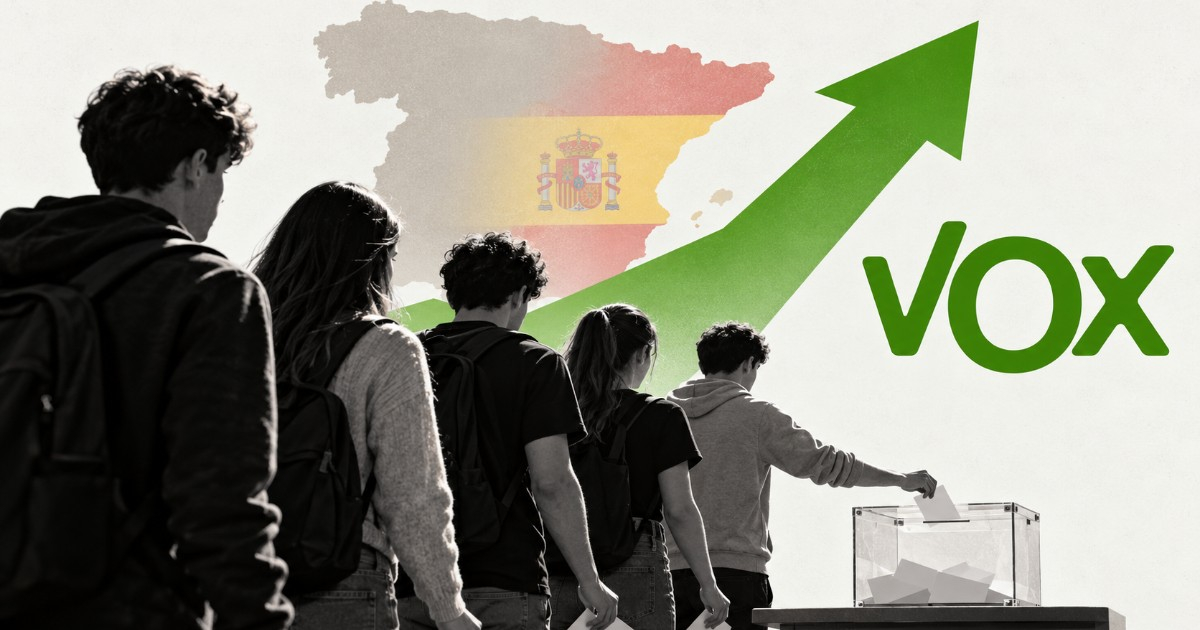
With Spain's general elections less than two months away on November 29, the political landscape is shifting as Vox finds increasing support among the nation's younger demographics and lower-income groups. This trend marks a notable change in Spain's political dynamics.
For those not closely following Spanish politics, it's important to understand the context: Vox, led by Santiago Abascal, is positioned further right than the Popular Party (PP). The party's platform focuses on stringent immigration controls, tax reductions, deregulation, reinforcing Spain's territorial unity, and prioritizing national interests in specific public policies.
In the July 2023 general elections, Vox garnered 3.03 million votes, representing 12.39% of the total, securing 33 seats in Congress. Fast forward three years, and surveys indicate rising support not only in numbers but also among new voter segments.
Young Voters Propel Vox's Growth
An analysis by El País, utilizing data from the Center for Sociological Research (CIS), highlights the demographic shifts since the 2023 elections. Among voters aged 18 to 24, Vox's support has surged by approximately seven to eight percentage points, nearing 26%—nearly tying with the PP and surpassing the PSOE, which hovers around 22% in this group.
The trend is even more pronounced among those aged 25 to 34, with Vox approaching 30% support, making it the leading choice in this age bracket. However, this doesn't necessarily mean three out of ten young Spaniards will vote for Vox this November. These figures are projections based on surveys and, as with any polling data, are subject to change during the campaign.
Unexpected Support Among Young Women
Traditionally, Vox's voter base has skewed male, but recent data indicates a shift. Analysis of CIS data shows that Vox has nearly doubled its support among women aged 18 to 44 compared to 2023. This is significant as young women were historically one of the party's most challenging demographics to penetrate.
While the gender gap persists, with Vox still enjoying stronger support among men, its growing appeal among young women signifies a broader reach beyond its traditional electorate.
Vox's Appeal Among Lower-Income Households
Another pivotal change is Vox's inroads into lower-income households. According to the CIS barometers, Vox's support among individuals living in households earning less than 1,100 euros monthly has risen by about eight points, reaching approximately 21%.
Conversely, among households earning over 5,000 euros monthly, growth is around four points, with support at about 16%. This trend challenges the notion that Vox's rise is solely among affluent or traditional conservative voters, as the party is also gaining traction among those directly affected by low wages, housing costs, and difficulties in achieving independence.
Understanding Vox's Policy Proposals
While economic struggles coincide with issues Vox emphasizes—such as housing, immigration, taxes, cost of living, and young people's challenges in starting families or buying homes—attributing these problems solely to Vox's rising support requires more nuanced research into voter motivations.
For instance, Vox proposes eliminating taxes on first-home purchases, liberalizing land, and cutting bureaucratic red tape. The party also links housing pressure and public service strain to immigration, advocating for the removal of illegal immigrants and promoting "remigration" policies.
Following the announcement of early elections, Abascal underscored Vox's core principles: national priority, deregulation, and remigration. Whether these stances fully explain the party's growth among young voters would need dedicated studies on their voting motivations.
Comparing Vox and the Popular Party
For those observing Spanish politics from abroad, distinguishing between the two main right-wing parties is crucial. The Popular Party (PP), headed by Alberto Núñez Feijóo, is a longstanding major political force in Spain, having governed at various times.
In contrast, Vox, a newer entity led by Santiago Abascal, takes a tougher stance than the PP on immigration, territorial organization, nationality policies, and several social issues. It also advocates for a significant reduction in government size, tax cuts, and recentralization of powers currently managed by autonomous communities.
As support shifts between these electorates, data from CIS analyses reveal the PP losing ground, particularly among ideologically right-leaning individuals, where Vox is gaining its strongest foothold.
Vox's Rising Influence in Spanish Politics
Vox's growth is evident across the broader electorate. In the July 2023 general elections, the party secured 12.39% of the votes and 33 congressional seats. According to a recent 40dB. poll conducted between September 25 and 28, Vox's estimated vote share is now at 18.4%.
In the same survey, the PP registered 31.6%, and the PSOE 27.4%. Meanwhile, the CIS's September barometer, based on 4,042 interviews conducted from September 1 to 4, put the PSOE at 31%, the PP at 25.5%, and Vox at 16.6%.
The variance between these studies highlights an important reminder: polls are not election results. Different methodologies and samples can lead to divergent estimates. However, both polls agree on a fundamental trend: Vox is performing better than in the 2023 elections.
Implications for Spaniards and Cubans Alike
The upcoming Spanish elections on November 29, 2026, carry particular interest for the Cuban community, given the number of Cuban-born individuals holding Spanish citizenship, many through the Democratic Memory Law, also known as the Grandchildren's Law.
Cubans with Spanish nationality enjoy the same electoral rights as any other Spanish citizen, provided they meet the registration requirements. A CiberCuba survey targeting Cubans with Spanish citizenship identified the PSOE and Vox as the top choices.
The survey's results cannot be directly compared to national Spanish polls, as it was voluntary, conducted among CiberCuba's audience, and not based on a representative sample. Its value lies in showcasing the preferences of a segment of the Cuban Spanish community, not in predicting the voting behavior of all Spaniards or Cuban-Spaniards.
CiberCuba has also published a voting guide for Spanish citizens residing in Cuba who wish to participate in the November 29 election.
Looking Ahead to the Election
The latest 40dB. poll concluded on September 28, over a week before the formal call for early elections. Thus, these figures do not yet capture the electorate's reaction to Pedro Sánchez's decision to call elections or subsequent political events.
What the accumulated studies of 2026 do show is a deeper transformation: Vox has expanded its support since 2023, particularly among young people, young women, and lower-income citizens. Whether this trend will persist in the coming weeks and how much of it will translate into votes when Spaniards head to the polls on November 29 remains to be seen.
Key Insights into Vox's Rising Support
Why is Vox gaining popularity among young voters in Spain?
Vox's growing popularity among young voters can be attributed to its focus on issues that resonate with them, such as housing affordability, immigration, and the cost of living. The party's policies addressing these concerns have attracted younger supporters.
What demographic changes are contributing to Vox's increased support?
Vox is seeing increased support from younger demographics, particularly those aged 18-34, and among lower-income households. Additionally, its appeal is growing among young women, a group that previously posed challenges for the party.
How do Vox's policies differ from those of the Popular Party (PP)?
Vox's policies are more stringent than the PP's on issues like immigration and territorial organization. Vox advocates for more significant tax cuts, reducing government size, and recentralizing powers from autonomous communities.
What impact could Vox's rise have on the upcoming Spanish elections?
Vox's rise could significantly influence the election outcomes, especially if it continues to draw support from younger and lower-income voters. Its growing popularity might affect coalition formations and the overall political landscape.