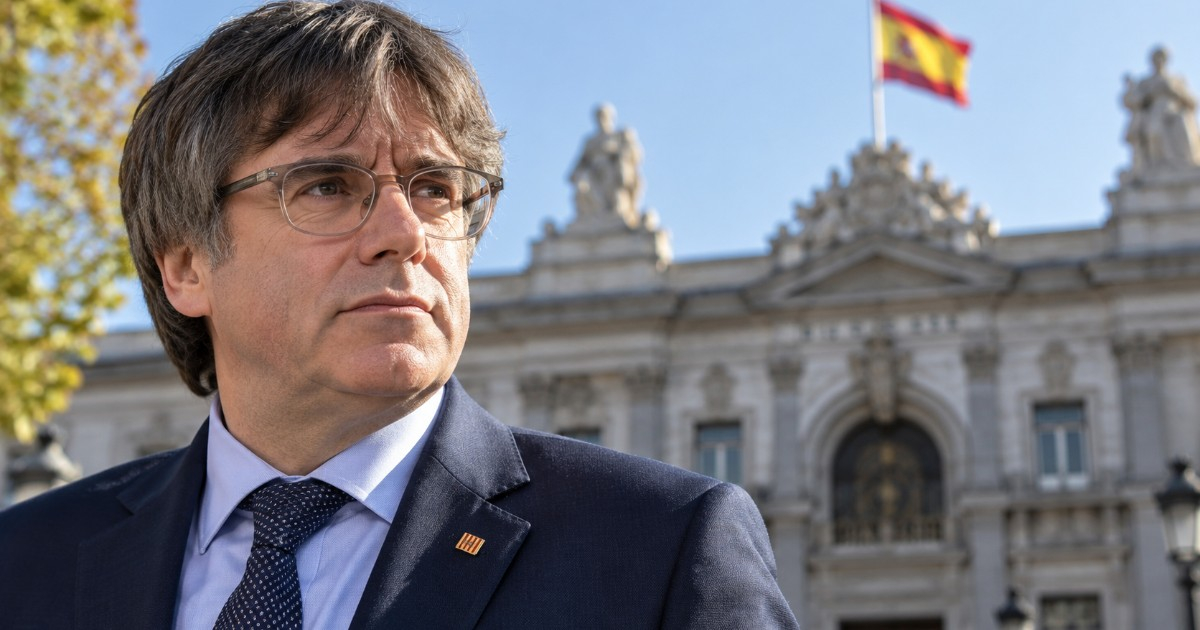
Carles Puigdemont, a prominent and divisive figure in Spanish politics over the past decade, is now able to return to Spain without the threat of arrest, thanks to a recent development in the legal proceedings concerning the 2017 Catalan independence movement.
The Supreme Court judge, Pablo Llarena, has immediately lifted the national search and arrest warrants that were previously in place against the former president of Catalonia, as well as former regional ministers Antoni Comín and Lluís Puig.
This decision follows the Constitutional Court's acceptance of an appeal by former Catalan minister Dolors Bassa, who challenged the Supreme Court's refusal to apply the Amnesty Law regarding charges of embezzlement of public funds.
The Legal Context
On October 6, the Constitutional Court officially sided with Bassa, a ruling that may have significant implications for other pro-independence leaders facing similar legal issues. However, it is crucial to note that Puigdemont has not yet received a definitive application of amnesty in his particular case.
Llarena has suspended the arrest warrants pending a new judicial resolution, while he reviews the Constitutional Court's ruling and decides how it should be applied to Puigdemont's situation.
Carles Puigdemont: A Political Profile
Carles Puigdemont served as President of the Generalitat of Catalonia from 2016 to 2017, becoming the primary face of the movement seeking Catalonia's secession from Spain during that period. He remains a key figure in Junts per Catalunya, an influential pro-independence party that played a pivotal role in securing the parliamentary votes for Pedro Sánchez's appointment as Prime Minister in 2023.
Understanding Puigdemont's nearly nine-year absence from Spain requires revisiting the political crisis of 2017.
The 2017 Independence Referendum
Under Puigdemont's leadership, the Catalan government organized an independence referendum on October 1, 2017, despite its suspension by the Spanish Constitutional Court. Following the vote, Puigdemont asserted that the result provided a mandate to establish a Catalan republic, although he initially called for a suspension to seek negotiations.
The conflict escalated when the Catalan Parliament unilaterally declared independence on October 27, 2017. In response, the Spanish government, led by Mariano Rajoy, invoked Article 155 of the Constitution, dissolving the Catalan government and calling for regional elections.
Why Did Puigdemont Flee to Belgium?
Shortly after the declaration of independence, Spanish prosecutors filed charges against Puigdemont and other members of his government for rebellion, sedition, and embezzlement. Puigdemont left Spain for Belgium in late October 2017, alongside several former government officials.
Since then, Puigdemont has largely conducted his political activities from outside Spain, primarily in Belgium, and has not been tried alongside other leaders of the independence movement because he remained beyond the reach of the Supreme Court.
Legal Developments and Amnesty
The scenario changed significantly with the introduction of the Amnesty Law following the 2023 general elections. The law aimed to absolve those involved in the Catalan independence process of their legal responsibilities. However, its application to embezzlement charges led to legal challenges.
Judge Llarena and the Supreme Court's Criminal Chamber argued that the embezzlement charges against Puigdemont were not covered by the amnesty, maintaining the national arrest warrant. The Supreme Court cited exceptions in the law concerning financial gain and the European Union's financial interests.
Recent Judicial Shift
A significant shift occurred on October 6, 2026, when the Constitutional Court upheld Dolors Bassa's appeal against the denial of amnesty for embezzlement. Although the ruling directly pertains to Bassa, Llarena deemed it could impact the basis for maintaining the arrest warrants against Puigdemont, Comín, and Puig, leading to their immediate suspension.
Practically speaking, as long as this decision is in effect, Puigdemont can enter Spanish territory without facing arrest related to this case. However, this does not yet equate to a permanent resolution of his legal situation.
Political Implications Amidst Upcoming Elections
The timing of this development adds a significant political dimension, as Spain is set to hold early general elections on November 29, following Prime Minister Pedro Sánchez's decision to dissolve Congress and the Senate.
Puigdemont has not specified when he will return to Spain. His potential return, after nearly nine years abroad, comes at a time when Junts plays a crucial role in national political debates.
The upcoming Spanish elections hold particular significance for the Cuban community. Many Cubans hold Spanish citizenship, and others have recently acquired it through the Democratic Memory Law, commonly known as the Grandchildren's Law.
As Puigdemont's situation continues to evolve, its impact on the political landscape remains to be seen. For now, the immediate consequence is that Carles Puigdemont can re-enter Spain without arrest over the contentious 2017 process, though the judicial chapter regarding amnesty is yet to be conclusively closed.
Key Questions About Carles Puigdemont's Legal Situation
Why can Carles Puigdemont return to Spain without arrest?
The Constitutional Court's recent ruling in favor of Dolors Bassa's appeal has led to the suspension of arrest warrants against Puigdemont, allowing him to return without immediate arrest.
What are the implications of the Amnesty Law for Puigdemont?
The Amnesty Law aimed to absolve those involved in the Catalan independence process, but its application to embezzlement charges has been contested. Recent legal shifts may influence Puigdemont's case.
How does Puigdemont's situation affect upcoming Spanish elections?
Puigdemont's potential return adds a complex layer to the political landscape as Spain prepares for early elections, with Junts playing a significant role in political discussions.