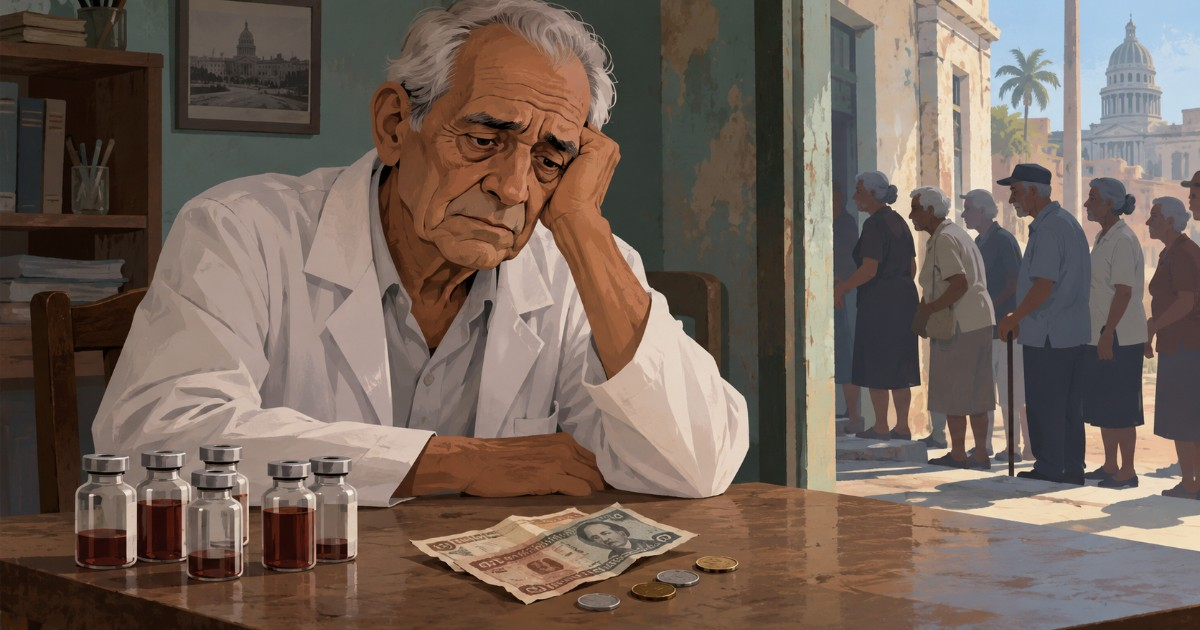
Elizabeth González Aznar, the daughter of Cuban scientist Raúl González Hernández, who developed the anti-anemic Trofin, has issued a strong condemnation of Miguel Díaz-Canel regarding the dire conditions faced by many retirees and elderly individuals in Cuba.
Highlighting her father, who is 81 years old, González Aznar directly challenged the Cuban leader on the hardships faced by a generation that, as she reminded, devoted decades of service to the country and now has to confront old age with inadequate pensions amid high living costs.
"They are dead while alive," she wrote at the end of a Facebook post directed at Díaz-Canel.
The Creator of Trofin: A Life of Scientific Contribution
Born in 1945 in Madruga, now part of the Mayabeque Province, Raúl González Hernández had a prolific scientific career tied to the National Center for Biopreparations (BioCen). He was instrumental in the development of Trofin, a Cuban product used for decades to treat and prevent iron-deficiency anemia.
His daughter recalled that González Hernández grew up in a large family, started working at a young age, and eventually pursued a career in science. Currently, he receives a monthly pension of 4,500 Cuban pesos.
"How do you think he lives? He doesn't live, he survives," González Aznar wrote, addressing Díaz-Canel.
Inadequate Pension Increases and Government Acknowledgment
The figure shared by González Aznar is particularly telling given the state of Cuban pensions. In 2025, the government authorized a partial increase for those with lower incomes: pensions up to 2,472 pesos were raised by 1,528 pesos, while pensions between 2,473 and 3,999 pesos were adjusted to 4,000 pesos monthly.
Official information at the time admitted that the increment was partial and that the country’s financial conditions hindered a comprehensive reform of the pension system.
Voicing the Frustrations of a Generation
Elizabeth's denunciation extended beyond her father's economic situation. She criticized the treatment experienced by many from his generation and questioned whether the authorities feel "shame" regarding the struggles of those who dedicated much of their lives to work.
"Disappointed is an understatement. Abandoned, mocked, ignored," she declared.
González Aznar contrasted this reality with the official promises linked to the 176 economic and social changes the Cuban government began implementing in 2026. Her message comes at a time when Díaz-Canel and other top officials are defending these changes as a means to revive the economy and progressively improve social conditions in the country.
Challenges in Accessing Social Assistance
The scientist's daughter also stated that her father had to persistently engage with Social Security institutions to receive assistance as an elderly dependent.
Additionally, she mentioned that González Hernández visits the Family Attention System (SAF) in San Agustín, located in Havana’s La Lisa municipality, where he has witnessed distressing situations.
"He has seen horrors that have made him cry," Elizabeth noted, accusing authorities of having a skewed perception of local realities instead of listening directly to those utilizing these services.
The SAF targets, among others, elderly individuals living alone or with other seniors who lack family support, as well as vulnerable individuals and families. Requests must be reviewed and approved by municipal authorities.
A Longstanding Battle for Recognition and Support
The challenges faced by González Hernández are not new. In December 2024, his family reported his struggles to obtain Trofin even when it was needed for relatives suffering from anemia.
CiberCuba reported that González Hernández had to reach out to former colleagues to try and secure the product he helped develop. Months later, in June 2025, when he turned 80, his daughter revealed that the researcher had started selling coffee to supplement the family’s income.
The family has consistently advocated for greater recognition of González Hernández’s role in developing Trofin and his scientific contributions.
The Scientist Speaks Out
Elizabeth's letter comes at a time when González Hernández himself has intensified his criticisms of the Cuban leadership.
This week, the researcher stated that the authorities had exhausted their opportunity to govern and urged them not to prolong the population's suffering.
"Understand that your opportunity is over," González Hernández expressed in a message calling for changes with greater citizen participation.
CiberCuba documented his statements and the scientist’s career, which spanned over four decades of research related to anti-anemic products.
Now, his daughter has taken the complaint a step further by presenting her father's situation as indicative of what she considers a generational debt owed by Cuban institutions.
"This Cuban is named Raúl González Hernández and he is my father," she wrote. "For all that he and his generation endure, I will not remain silent."
Understanding Cuba's Pension Crisis
What is Trofin?
Trofin is a Cuban product used for the treatment and prevention of anemia caused by iron deficiency. It was developed by Raúl González Hernández and his team at the National Center for Biopreparations.
Why did Elizabeth González Aznar criticize Díaz-Canel?
Elizabeth González Aznar criticized Díaz-Canel for neglecting the welfare of retirees and elderly Cubans, highlighting inadequate pensions and poor treatment, which she argues are unfit given their lifetime contributions to the country.
What are the challenges faced by Cuban retirees?
Cuban retirees face challenges such as insufficient pensions, high living costs, and inadequate social assistance, which make it difficult to maintain a decent standard of living in their old age.