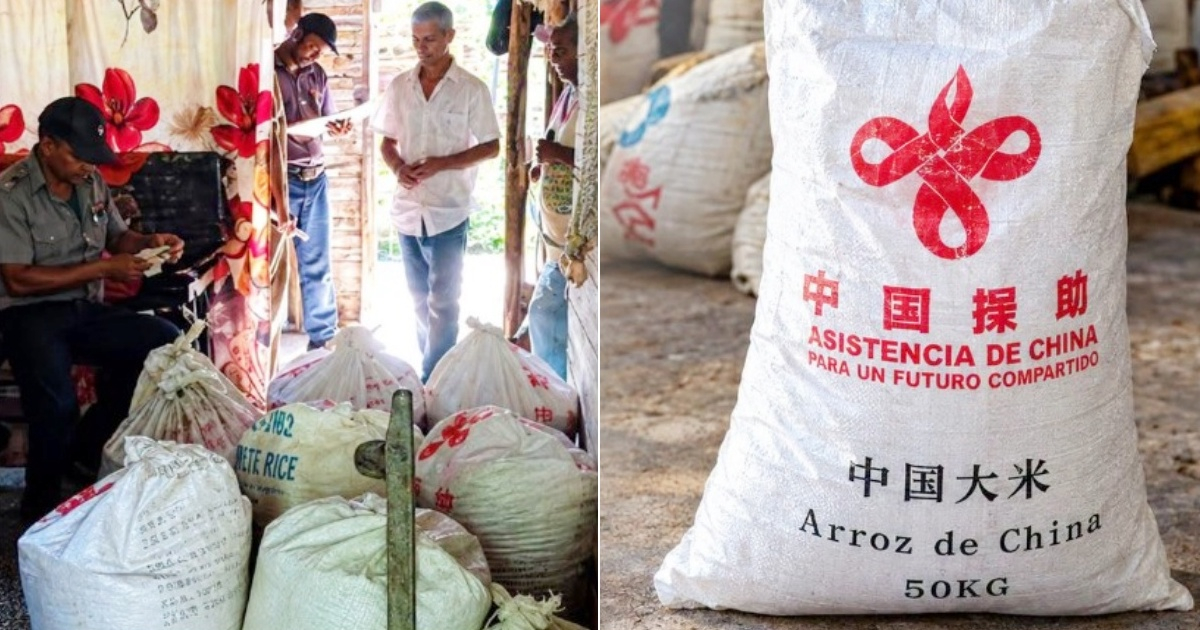
Officials in Guantánamo are currently investigating the alleged unauthorized sale of at least eight bags of imported rice discovered in a home in Campanón, El Salvador municipality. This rice is suspected to be part of a donation from China, intended for basic supply distribution.
The case came to light through a report by the pro-government Facebook page "Guantánamo y su Verdad." Suspicion arose when a local resident noted the specific characteristics and packaging of the rice, leading to concerns about its possible illegal sale.
Authorities seized the rice during a search of the residence. The individual involved, who reportedly lacked employment, was unable to provide an explanation for the rice's origin, further fueling suspicions of illicit acquisition and prompting official investigations.
While there has been no official confirmation linking the rice to the Chinese donation, unofficial sources suggest it might be connected to the aid provided by the People's Republic of China, meant for the basic food basket.
Community Reactions: Support and Skepticism
The investigation has sparked a wave of mixed reactions from the public. Many users expressed support for the operation but also voiced skepticism about its effectiveness.
Comments from the public emphasized the need for a thorough investigation. "It's crucial to trace it back to the supplier," one user insisted. Another called for uncovering the entire supply chain, "from where it originated to the implicated residence."
Mistrust was a common theme in many responses, with users expressing doubts about the transparency and fairness of the process. Statements like "The public never sees the donations" and "This isn't new; it's widespread, especially with donations" reflect the underlying disbelief.
Background on Chinese Rice Donation
In January 2026, Chinese President Xi Jinping approved a donation of 60,000 tons of rice to Cuba, along with $80 million for electrical equipment. Including a previous shipment, the total rice donation to the island in 2026 amounts to 90,000 tons. The third shipment, consisting of 15,000 tons, arrived on August 13 at the Haiphong terminal of Havana's port, overseen by Vice Premier Óscar Pérez-Oliva Fraga.
The bags from this donation are distinctly marked with Chinese and Spanish inscriptions, such as "Assistance from China," "Rice from China," and "For a Shared Future," making them identifiable outside official distribution channels. These features were likely what caught the attention of the reporting neighbor.
Following the shipment, Cuban Foreign Minister Bruno Rodríguez Parrilla expressed gratitude for the donation, highlighting it as a testament to the "steadfast solidarity and friendship between the two nations during challenging times."
Previous Incidents of Misappropriated Aid
Earlier in February 2026, five employees from the Las Tunas Wholesale Food Company received sentences ranging from 11 to 13 years for embezzling rice, sugar, peas, and beans meant for family rations, resulting in damages estimated at 623,088 pesos, affecting over 50,000 families.
Additionally, in April, the NGO Food Monitor Program alleged that donations from Mexico ended up in state stores selling in foreign currency, a claim denied by the Cuban government.
Key Questions on Rice Donation Investigation
What is being investigated in Guantánamo?
Authorities in Guantánamo are investigating the alleged illegal sale of rice, suspected to be part of a Chinese donation, found in a local residence.
How did the investigation begin?
The investigation was initiated after a neighbor reported the rice's specific features and packaging, suggesting it might be part of a donated batch.
What has been the public reaction to the investigation?
The public reaction has been a mix of support for the operation and skepticism about its effectiveness in tracing the true source and distribution network.