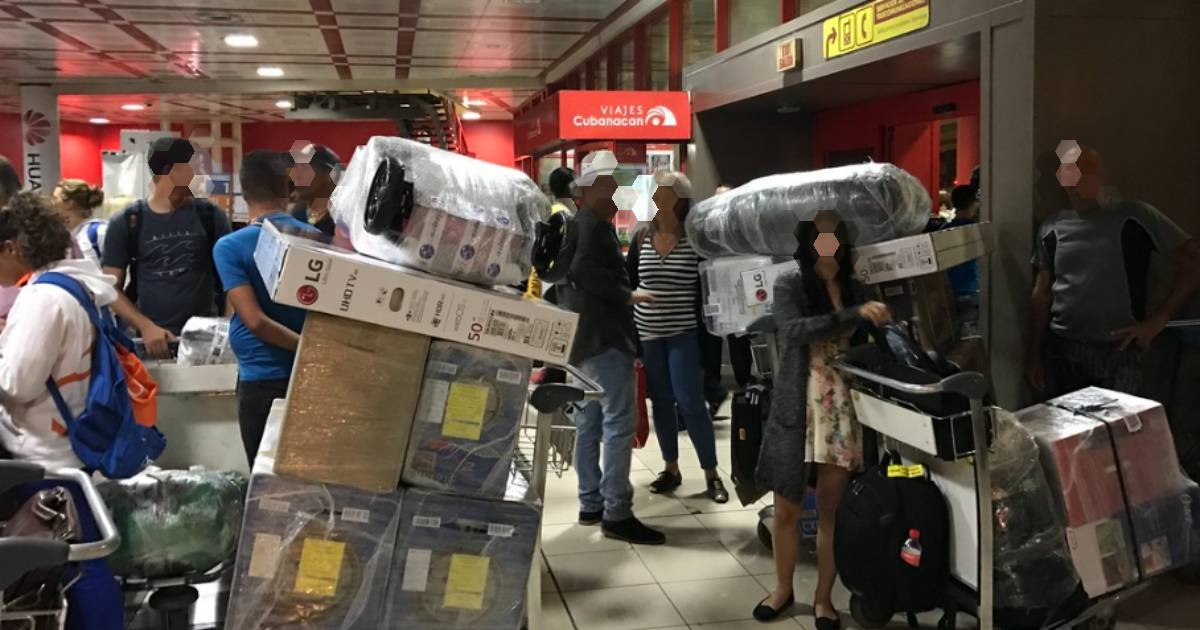
The Cuban regime announced on Monday through the Official Gazette No. 83 Ordinary of 2026 that it is granting permission for individuals to import goods for commercial purposes, with the stipulation that the associated tariffs and taxes must be paid in US dollars.
Three regulations were published — Decree-Law 132/2026 by the Council of State, Resolution 197/2026 from the Ministry of Finance and Prices, and Resolution 340/2026 from the General Customs of the Republic — which will take effect on October 12, 2026, a week after their announcement.
While this mechanism doesn't establish a full commercial import regime for private citizens, it does allow travelers, when customs identify imports exceeding non-commercial limits or having a commercial nature, to formalize their imports instead of facing confiscation by paying the necessary tariffs in foreign currency.
Decree-Law 132 explicitly states that this method “does not constitute foreign trade activity,” but rather provides a way to regularize situations that previously resulted in confiscation.
Progressive Tariff Structure for Commercial Imports
The tariff rates for commercial imports by travelers are progressive: 15% for the first $2,000; 20% for amounts between $2,000 and $4,000; 25% for amounts between $4,000 and $6,000; and 30% for any amount exceeding $6,000. For goods arriving via shipments, a flat rate of 30% applies.
Payments must be made using international or domestic cards in US dollars, with cash accepted only at designated airport facilities.
Detailed Guidelines and Regularization of Informal Trade
Resolution 340/2026, signed by Nelson Enrique Cordovés Reyes, head of the General Customs, also outlines the criteria for determining when an import is commercial, with reference values provided for categories such as appliances, electronics, construction materials, tools, and others. For instance, up to five cell phones may be imported as non-commercial, while only two of the same type of appliance are allowed.
This regulation is part of a set of economic and social reforms, announced by Prime Minister Manuel Marrero Cruz in June before the National Assembly, encapsulated in Axis 15 focusing on foreign trade.
Historically, thousands of Cubans have acted as "mules" — travelers bringing goods from abroad to sell informally within the island — operating within a legal gray area and subject to customs' confiscations. The new rules provide a path to legalization, albeit at a cost in foreign currency that many may struggle to afford.
Impact on Informal Economy and Regulatory Changes
Economist Elías Amor warned in September that these measures, along with Decree 160/2026 which bans wholesale trade for individual entrepreneurs, aim to push "mules" out of the import business to favor micro, small, and medium-sized enterprises (MSMEs) and cooperatives, which are subject to greater state oversight.
By the end of September, the Cuban government reported implementing 158 of the 176 announced measures — accounting for 89% of the package — supported by 197 legal norms. Monday's publication represents the final regulatory pieces of one of the most anticipated transformations for those supplying Cuba's informal market.
Common Questions About Cuba's New Import Regulations
What are the new tariffs for commercial imports in Cuba?
The tariffs are progressive: 15% for the first $2,000; 20% for amounts between $2,000 and $4,000; 25% for amounts between $4,000 and $6,000; and 30% for any amount over $6,000. Shipments have a flat rate of 30%.
How must payments be made for these imports?
Payments should be made using international or domestic cards in US dollars. Cash is only accepted at designated airport facilities.
What defines a commercial import under the new regulations?
An import is considered commercial if it exceeds non-commercial limits as per the guidelines provided in Resolution 340/2026, which includes reference values for various categories like electronics and appliances.