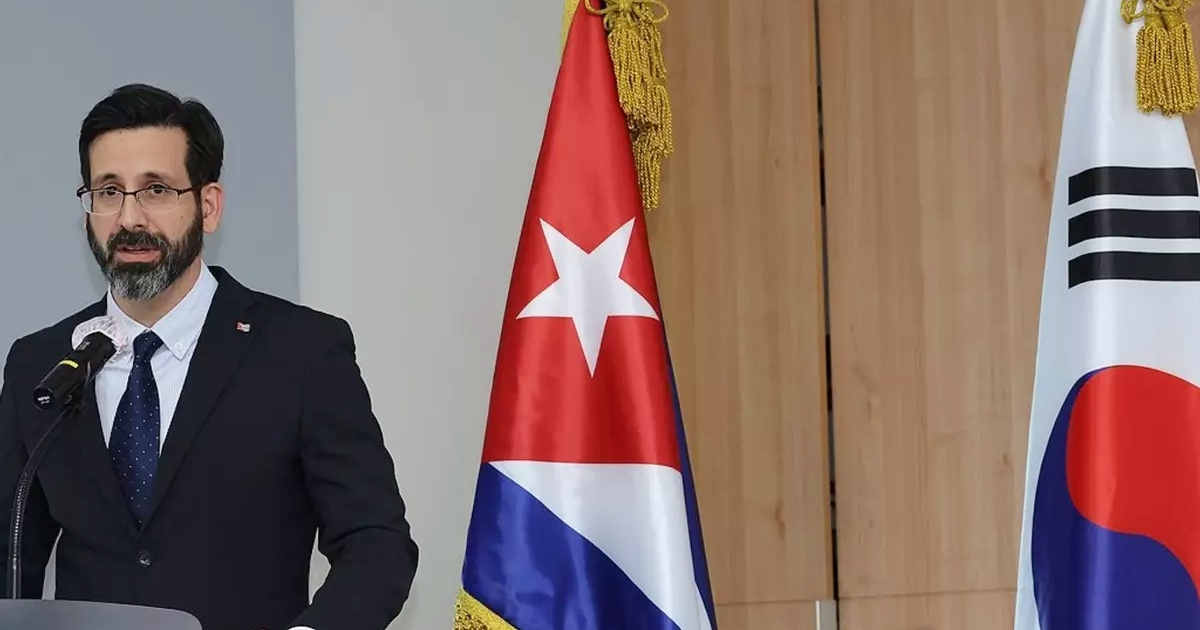
In an exclusive report, the South Korean economic newspaper Seoul Economic Daily divulged that half of Cuba's diplomatic personnel stationed in Seoul have been summoned back to Havana. This sudden move, which bypassed the usual diplomatic rotation, left South Korean authorities without any formal explanation.
Two out of the four diplomats assigned to the Cuban mission departed unexpectedly.
The only Cuban officials remaining in Seoul are the ambassador, Claudio Raúl Monzón Baeza, and counselor Patricia Flechilla Prometa.
The Embassy's Short-Lived Presence
South Korea's Foreign Ministry confirmed they received no specific reasons from Cuba regarding the departures. The Cuban embassy in Seoul, which had only been operational for a year since its opening on June 10, 2025, marked a significant milestone following the reestablishment of diplomatic relations on February 14, 2024, ending a six-decade rift.
The reestablishment of embassies in Havana and Seoul concluded a diplomatic break dating back to 1959, when Fidel Castro's government severed ties with South Korea in favor of aligning with North Korea. Despite limited interactions for decades, by 2015, both nations began exploring cooperation in economic, technological, energy, and cultural domains, paralleling the thawing of relations between Washington and Havana.
Official Silence and Unconfirmed Theories
The Cuban embassy's response to inquiries from Seoul Economic Daily was that "all embassy administrative decisions are internal and bear no political implications or bilateral connection." Diplomatic sources cited in the report speculate two unconfirmed theories: the reduction might be a tacit protest against an undisclosed friction with Seoul, or it could be part of personnel adjustments due to Cuba's severe economic crisis.
The potential decline in relations is noteworthy as Seoul has been actively engaging nations traditionally aligned with North Korea, including Cuba. South Korea maintains five officials in its Havana embassy and has no plans to alter its representation.
The Illusion of Economic Cooperation
Just three months before the reduction, in June 2026, the Cuban embassy in Seoul hosted a forum to attract South Korean investors, with Ambassador Monzón Baeza asserting that "Cuba remains a land of opportunities and possibilities." On June 15, the Cuban Chamber of Commerce and the Korea Importers Association (KOIMA) signed a collaboration agreement in sectors like agrifood, renewable energy, and biopharmaceuticals.
Nevertheless, economic ties remain modest. In 2022, South Korea exported goods worth approximately $14 million to Cuba and imported Cuban products totaling around $7 million. In 2023, bilateral trade hit $43 million, favoring South Korea with a significant surplus. Key exports from South Korea include technology, vehicles, heavy machinery, and plastics, while Cuba exports tobacco, alcoholic beverages, scrap metal, and biotechnological products.
Consular Relations and Challenges
Before the pandemic, about 14,000 South Korean citizens traveled annually to Cuba, where around a thousand descendants of Korean immigrants reside. South Korea's Foreign Ministry stressed the importance of providing stable consular assistance to its citizens in Cuba, justifying its embassy's establishment in Havana.
However, representatives from the Korea Trade-Investment Promotion Agency (KOTRA) have warned that "Cuba is not a market where businesses can simply apply the same standards used for ordinary trade with other countries." South Korean representatives also advised businesses to examine each operation individually due to U.S. sanctions and financial risks associated with Cuban entities.
A Pattern of Diplomatic Retrenchment
The reduction in Seoul is not isolated. In August 2026, the Dominican Republic expelled nine Cuban diplomats accused of intelligence activities. Similarly, Costa Rica closed its embassy in Havana in March 2026, and Ecuador expelled Cuban diplomatic staff that same month. On September 3, Foreign Minister Bruno Rodríguez Parrilla led a virtual meeting with mission heads to emphasize the regime's continued diplomatic activity, indicating Havana's awareness of its deteriorating international presence.
Understanding Cuba's Diplomatic Moves
Why did Cuba reduce its diplomatic staff in Seoul?
The reasons behind the reduction remain unclear, with speculations ranging from a silent protest to personnel adjustments due to Cuba's economic crisis.
What is the current state of Cuba-South Korea relations?
Although the reduction in diplomatic staff suggests potential strains, South Korea continues to engage with Cuba, maintaining its embassy staff in Havana without changes.
How have economic relations between Cuba and South Korea evolved?
Despite efforts to boost cooperation, economic exchanges remain limited, with South Korea enjoying a trade surplus due to its significant exports to Cuba.