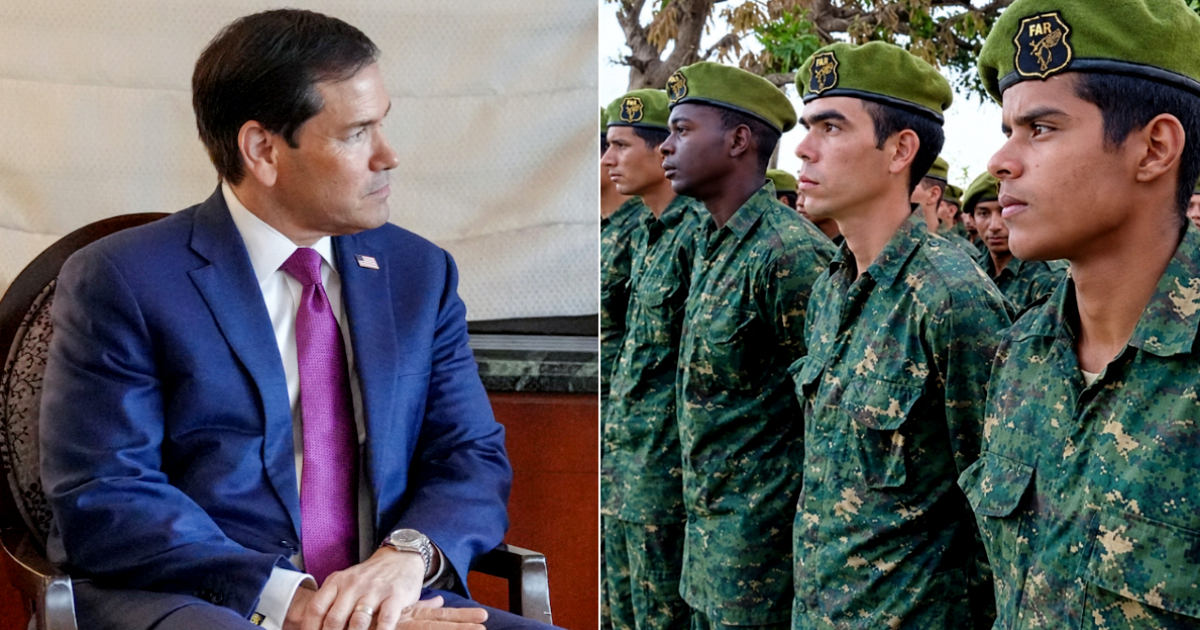
In a recent statement, Marco Rubio shifted his focus from the formal government led by Miguel Díaz-Canel to address a different audience: the military, security forces, and internal sectors that uphold the real power structure of the Cuban regime.
"We hope that those who currently, in some way, control the weapons and the repressive regime will have people among them who open their eyes to the reality they face," stated the U.S. Secretary of State during an interview with Sean Hannity on Fox News.
This message was not merely about reforms, dialogue, or potential economic openness. Rubio's words were aimed at those who "control the weapons" and manage the "repressive regime," directing attention to military leaders, the State Security, the Ministry of the Interior, the Armed Forces, and economic structures tied to the regime's power.
Signs of a Shift for Cuba's Military
In essence, Washington seems to be signaling to Cuban uniformed forces to consider whether continuing to protect an increasingly isolated, impoverished, and pressured elite is in their best interest, or if facilitating a transition toward significant political and economic changes is a better path forward.
Rubio's statement aligns with a strategy that the Trump administration has been developing over months: the Cuban issue won't be resolved with minor economic tweaks or an internal succession controlled by the Communist Party, but rather through a genuine transition involving political freedoms, economic openness, and a new relationship with the United States.
Previously, Rubio had indicated a willingness to engage with certain figures within the Cuban regime, provided they are committed to real transition rather than superficial changes.
U.S. Military Pressure and Cuban Uniformed Forces
The Cuban military is under considerable pressure, as evidenced by increased U.S. military activity in the Caribbean. Recent months have seen heightened military exercises, naval presence, intelligence operations, and leaks about potential contingency scenarios concerning Cuba.
In particular, the FLEX2026 exercise was activated in Key West in April, coinciding with intensified drone flights, intelligence aircraft, and naval activities near the island. These maneuvers reportedly practiced a comprehensive chain of detection, tracking, and interception of targets in the Caribbean.
Moreover, there have been reports of Marine Corps training in the Caribbean, maritime interdiction exercises, and movements linked to Operation Southern Spear, a campaign presented as targeting drug trafficking and illicit transnational networks. Analysts, however, interpret this as part of a broader strategic pressure on Cuba.
These developments, while not proof of an imminent intervention, indicate that the military factor is part of the pressure surrounding the regime.
The Broader Implications of Rubio's Message
Rubio's remarks transcend a mere moral appeal for some within the regime to "open their eyes." It is a political message issued at a time when Cuban military officials are witnessing sanctions, isolation, economic pressure, military maneuvers in the Caribbean, and a more explicit discourse from Washington.
The Trump administration has paired warnings with conditional offers. In July, Rubio disclosed that the U.S. proposed economic aid, reconstruction assistance, and a new bilateral relationship if the regime accepted real political and economic reforms.
Washington has also reiterated its commitment to using "all tools" available to promote changes in Cuba, demand the release of political prisoners, and press elites blocking significant reform.
This context frames Rubio's message to those who control the weapons. He is not asking them to save the regime with a superficial reform. Rather, he is diplomatically but unmistakably stating that the current model is untenable and those supporting it must decide on their stance as events accelerate.
A Society Demanding Change
Rubio's call aligns with a political reality the regime tries to ignore: a significant portion of Cuban society is demanding profound systemic change.
An independent survey, "Cuba: Political and Social Perspectives," supported by over 20 independent digital media outlets, revealed overwhelming rejection of the current model.
According to results reported by CiberCuba, 75.1% of participants supported a transition to a liberal democracy with a market economy, while over 91% backed some form of deep structural change in the country.
Additional results from the same survey pointed in the same direction: 94% of respondents expressed significant dissatisfaction with the current system, and 95% deemed political change as extremely urgent.
Although this is an independent digital survey and not a state poll, its political value lies in breaking the official narrative of unanimity. It also explains why Rubio's message to the military carries particular weight: if the societal majority wants change, the military faces the dilemma of continuing to repress a nation demanding a solution or facilitating a transition to prevent further suffering.
The Military's Dilemma
For decades, the Armed Forces and security agencies have been portrayed by the regime as guarantors of national sovereignty. However, in practice, they have become guardians of a political and economic elite unable to provide food, electricity, transportation, decent wages, or a future for millions of Cubans.
Thus, Rubio's statement is crucial. By addressing those who control "the weapons and the repressive regime," the Secretary of State is speaking to specific individuals within a concrete structure: commanders aware of the country's actual condition, officers who understand the extent of the deterioration, and operatives who recognize that blind allegiance to the elite could also become a historical responsibility.
Washington's message seems clear: a diplomatic and orderly solution is still possible, but achieving it requires recognition from within the apparatus that time is running out.
Rubio summed it up in his interview, warning that some Cuban leaders believe they can endure without change until the Trump administration passes. "They are mistaken and will learn the lesson the hard way if they don't correct course," he said.
This was not merely a warning to the regime but also an invitation to the military to face reality without slogans: a country in ruins, a population seeking change, a leadership without answers, and an American administration no longer willing to let Havana keep stalling for time.
In this scenario, Rubio's words were not just about Cuba. They were aimed at those wielding the arms, urging them publicly to open their eyes.
Understanding Rubio's Call for Cuban Military Recognition
What was the main message Marco Rubio conveyed to the Cuban military?
Marco Rubio urged the Cuban military and security forces to recognize the reality they face and consider facilitating a transition toward substantial political and economic reforms instead of continuing to protect an isolated regime.
How has the U.S. increased pressure on the Cuban military?
The United States has increased pressure through military exercises, naval presence, intelligence operations, and strategic maneuvers in the Caribbean, signaling the broader strategic pressure on Cuba.
What percentage of the Cuban population supports a transition to a market economy?
According to an independent survey, 75.1% of the Cuban population supports a transition to a liberal democracy with a market economy, indicating widespread demand for change.