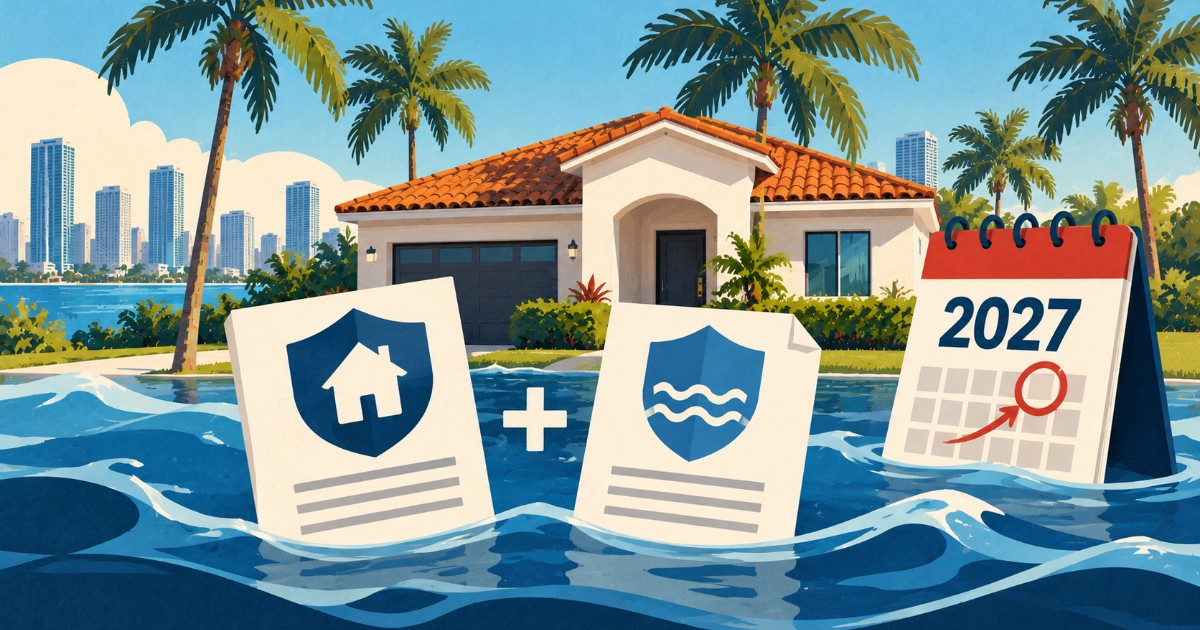
Starting January 1, 2027, a significant policy shift will impact thousands of homeowners insured by the Citizens Property Insurance Corporation in Florida. Most residential policies that currently include wind coverage will also be required to carry flood insurance, even if the home is not located in a high-risk flood zone as designated by FEMA.
This change is the final phase of a mandate that the Florida Legislature approved, which has been gradually implemented over the past few years.
Previously, outside of special flood hazard areas, the requirement largely depended on the insured value of the home. As of 2027, this threshold will be eliminated.
Expanding Flood Insurance Requirements
According to Citizens' official guidelines, any new or renewed policies with wind coverage starting January 1, 2027, will need to include flood insurance, regardless of the property's insured value. This change is likely to catch many homeowners off guard, especially those whose homes are not within a Special Flood Hazard Area (SFHA) as defined by FEMA.
Homes in these high-risk areas have already been required to have flood insurance from earlier phases of the program. However, Citizens has been phasing in this requirement for properties outside these zones:
- 2024: Homes with Coverage A of $600,000 or more.
- 2025: Homes with Coverage A of $500,000 or more.
- 2026: Homes with Coverage A of $400,000 or more.
- 2027: All affected policies, regardless of value.
This means a home insured for $250,000, $300,000, or any lower amount that previously fell outside FEMA's high-risk zones could be required to have flood insurance when the policy is issued or renewed after January 1, 2027.
Timing and Policy Details
The January 1, 2027 date marks the start of the next phase but doesn't imply that every Citizens policy will change on that exact day. The requirement applies to new policies and renewals with effective dates starting from January 1, 2027. For instance, if a homeowner's policy renews in March 2027, they must have the necessary flood coverage in place by then. Homeowners should proactively check the expiration and renewal dates of their policies.
Which Policies Are Impacted?
Citizens indicates that the requirement affects most personal residential policies with wind coverage. This includes single-family homeowners and other residential property owners insured by Citizens for wind or hurricane protection. Florida law allows Citizens to deem an applicant or policyholder ineligible for residential coverage if they refuse to obtain and maintain the required flood insurance.
Exemptions and Exceptions
Not every Citizens policy is subject to this requirement. There are notable exceptions, including:
- Policies for condominium unit owners.
- Renter’s content policies.
- Policies that exclude wind or hail coverage.
This is particularly relevant in Miami-Dade and other parts of South Florida, where condominium ownership is widespread. Condominium owners should verify their specific policy type with Citizens to understand their obligations.
Citizens Does Not Offer Flood Insurance
A crucial aspect to remember is that Citizens does not directly provide flood insurance. Florida law prohibits Citizens Property Insurance Corporation from offering this coverage. Homeowners must obtain a separate policy through the National Flood Insurance Program (NFIP) or a private insurer that meets Florida and Citizens' requirements.
This means a homeowner using Citizens as their primary home insurer may end up paying for two separate coverages: a Citizens residential policy and a separate flood insurance policy.
Flood Insurance Coverage Requirements by Citizens
For homes subject to the requirement, Citizens generally mandates that flood insurance coverage for the structure must be equal to or greater than the insured value under Coverage A of the Citizens policy. However, there is an important limitation. The NFIP typically caps structural coverage at $250,000 for residential properties. If the required level of coverage by Citizens is unavailable through NFIP, Citizens will accept the maximum coverage for which the homeowner is eligible.
Currently, Citizens publicizes a maximum of $250,000 for Coverage A under the regular NFIP program, and $35,000 in certain communities under the NFIP emergency program. Homeowners can also explore private flood insurance options that comply with Florida's legal requirements.
Understanding Coverage A
During previous phases, thresholds of $600,000, $500,000, and $400,000 referenced the insured reconstruction value known as Coverage A. This was not necessarily the purchase price, land value, or market value of the property. A house worth $700,000 on the market, for example, might have a different Coverage A figure, as insurance primarily calculates the reconstruction cost of the structure. As of 2027, this difference becomes less significant in determining final phase eligibility, as the requirement expands to all affected policies regardless of Coverage A value.
Documentation Requirements for Homeowners
Citizens requires new clients and those renewing affected policies to demonstrate they have the necessary flood insurance. They must also complete the Policyholder Affirmation Regarding Flood Insurance (CIT FW01) form. As proof of coverage, Citizens currently accepts:
- Flood insurance policy declarations.
- A flood insurance application with proof of payment while the policy is pending.
- In certain cases, proof of a flood endorsement meeting the applicable requirements.
Homeowners should coordinate this process with their agent before renewal to avoid eligibility issues.
Consequences of Non-compliance
The repercussions can be significant. Florida law allows Citizens to deny coverage or maintain a property's eligibility if the insured refuses to obtain and keep the required flood insurance. Citizens has also stated that affected policyholders may receive non-renewal notices related to non-compliance with the flood requirement. This does not mean such a notice is irreversible. If the issue is solely the absence of required documentation or coverage, the homeowner should promptly contact their agent to determine what must be submitted before permanently losing the opportunity to renew.
Implications Beyond Citizens
It's important to note that this requirement is directly tied to maintaining a Citizens policy. It does not mean that as of 2027, all Florida homeowners, regardless of their insurance company, must purchase flood insurance. Private insurers may have their own requirements, and a mortgage company may also require flood coverage in certain situations. However, the final phase in 2027 specifically pertains to Citizens' rules.
Federal Mortgage Requirements
An additional requirement independent of Citizens exists. Properties in certain special risk zones with a federally backed mortgage typically must maintain flood insurance. Therefore, some homeowners were already obligated to have an NFIP policy or equivalent well before Citizens' change. Citizens' requirement expands the situation to many homes outside those zones and not subject to federal requirements due to location.
Conventional Home Policies vs. Flood Coverage
One reason these two coverages are handled separately is that a standard residential policy usually does not cover damage caused directly by flooding. A hurricane, for example, may cause various types of damage. Wind damage may be covered by the residential policy, while flooding from water accumulation or entry may require a specific flood policy. Thus, having wind or hurricane coverage does not automatically ensure protection against floods.
Discount Opportunities in Miami-Dade
For residents of Miami-Dade, there's an additional factor that may help lower costs. Recent reports indicate that specific NFIP policies in unincorporated areas of Miami-Dade can receive discounts of up to 35% thanks to the county's rating within FEMA's Community Rating System. However, this discount does not mean all county residents automatically pay 35% less. It depends on the jurisdiction, policy, and specific NFIP conditions. Citizens policyholders who need to secure flood coverage should check if their address qualifies for federal program discounts.
Starting the Process Early
New NFIP policies generally have a 30-day waiting period before coverage begins. Exceptions exist, including certain cases linked to obtaining, expanding, or renewing a mortgage. Official NFIP information recommends not waiting until a storm approaches to secure coverage. While Citizens allows the initial submission of an insurance application with proof of payment when the flood policy is still pending, starting the process early reduces the risk of issues during renewal.
Action Steps for Current Citizens Policyholders
Check the renewal date of your Citizens policy.
Confirm if your policy includes wind coverage.
Verify the exact policy type to determine if it falls under exemptions.
Request flood insurance quotes from NFIP and the private market.
Consult with your Citizens agent about required documentation.
Review Coverage A and the necessary flood insurance level.
Check for available discounts in your community.
Do not wait until the renewal date to begin the process.
Final Phase Begins in 2027
The flood requirement began rolling out after insurance market reforms were passed by Florida in 2022. Homeowners in special flood zones were the first affected, followed by homes outside those zones according to different Coverage A levels. On January 1, 2027, the final phase begins: for new and renewed policies affected, it will no longer matter if the home is worth less than $400,000 or is outside a FEMA high-risk zone. The key will be whether the Citizens residential policy falls within the obligated categories and offers wind coverage; the insured must obtain and maintain separate flood coverage to remain eligible.
Frequently Asked Questions About Citizens' Flood Insurance Requirement
Why is flood insurance being mandated by Citizens?
The mandate is part of a broader legislative effort to ensure adequate protection for homeowners against flood damage, which standard home insurance policies typically do not cover.
What happens if I don't comply with the flood insurance requirement?
Failure to obtain and maintain the required flood insurance could result in Citizens denying coverage or deeming the property ineligible for renewal.
Are all Florida homeowners required to get flood insurance by 2027?
No, the requirement specifically applies to Citizens policyholders. Private insurers and mortgage companies may have their own flood insurance requirements.
How can I qualify for flood insurance discounts in Miami-Dade?
Discounts may be available through the NFIP for properties in specific areas, thanks to Miami-Dade's rating in FEMA's Community Rating System. Check if your property is eligible.