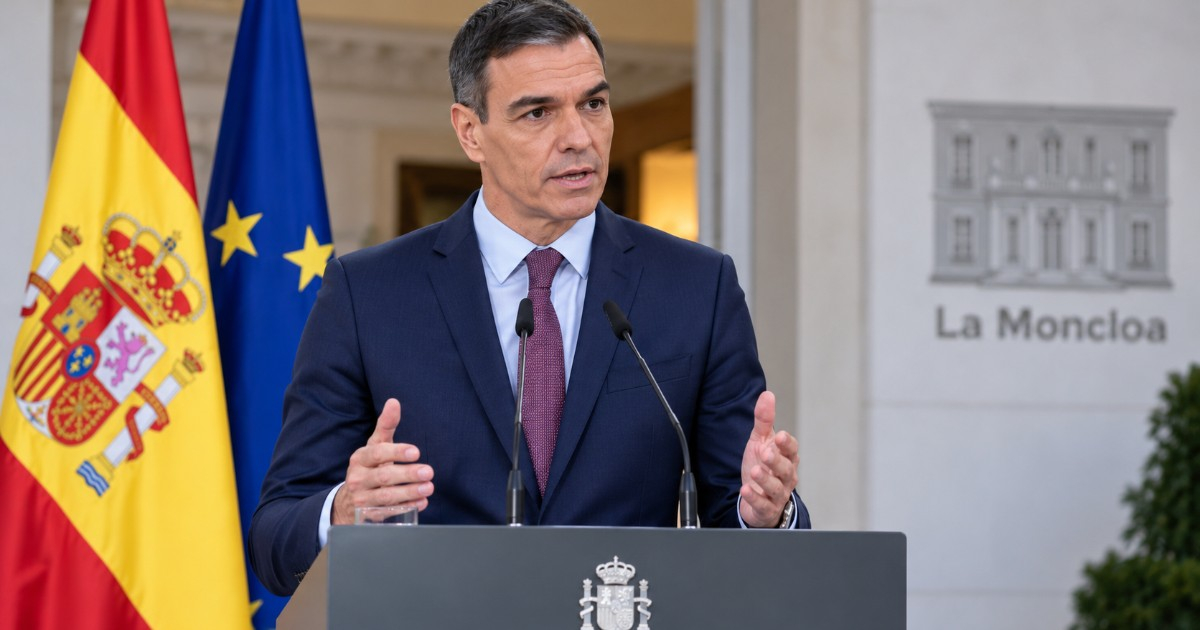
Spain's Prime Minister, Pedro Sánchez, has announced a snap general election for Sunday, November 29, 2026, effectively bringing the current legislative period to an early close.
Sánchez made this announcement during an official statement from the Palace of La Moncloa at 9:00 a.m., with no questions taken from the press.
This call for elections comes just three days after the Spanish Congress rejected two housing-related royal decree-laws proposed by the government, highlighting once again the administration's struggle to secure a majority in significant legislative votes.
After the defeat, it was reported by CiberCuba that Sánchez had entered a period of contemplation regarding the possibility of calling an early election, following the opposition from PP, Vox, and Junts against the housing measures. The date of November 29 was identified as the earliest legal option and has been confirmed by the Prime Minister.
Why November 29 Was Chosen for the Election
The selection of November 29 is not arbitrary. Article 42 of the Organic Law of the General Electoral Regime (LOREG) mandates that when the Prime Minister exercises the power to dissolve the legislative chambers early, elections must occur 54 days after the announcement.
This process requires a Royal Decree that formalizes both the dissolution and the election call. According to the Spanish Constitution, specifically Article 115, the Prime Minister can propose the dissolution of the Congress, the Senate, or both, after consulting with the Council of Ministers, and this action is sanctioned by the king.
If the announcement is published in the Official State Gazette (BOE) on Tuesday, October 6, the 54-day period prescribed by law results in the election falling on Sunday, November 29, 2026.
Awaiting the Official Decree
The political announcement made by Sánchez on Monday must be followed by the appropriate legal procedures. As of early Monday, the Official State Gazette's ordinary summary for October 5 did not yet include the Royal Decree for the dissolution of the legislative chambers and the call for elections.
The LOREG specifies that for an early dissolution, the decree should be published the day after it is issued and take effect the same day as its publication. Thus, the official document will confirm the dissolution of the legislative bodies, the election call, and all formal details of the electoral process.
Impact on Spanish Citizens in Cuba
This election is also significant for the growing community of Spanish citizens residing in Cuba. Spaniards registered abroad have the right to participate in general elections according to electoral census and external voting rules.
In recent years, tens of thousands of Cubans have acquired Spanish citizenship through the Law of Democratic Memory, popularly known as the Law of Grandchildren. The situation of the external census has also been subject to recent judicial disputes over certain registrations, a matter gaining new importance with the announcement of the early election.
CiberCuba had previously examined the potential impact of early elections on Spaniards living abroad, including those residing in Cuba.
A Change from Sánchez's Earlier Promises
This announcement marks a shift from Sánchez’s previous stance. During a control session on June 10, he assured Congress that the legislative term would complete its four-year cycle, with elections scheduled for 2027.
The newly announced decision brings the election forward by several months, concluding a legislative period that began after the general elections on July 23, 2023.
The Beginning of the Electoral Process
Sánchez’s announcement initiates a new political phase in Spain. However, the next step is legal: the publication of the Royal Decree dissolving the legislative chambers and calling for elections in the BOE.
This document will officially set November 29 as the election date and trigger the electoral timelines set by law. Until its publication, the decision made by the Prime Minister remains a political declaration; the Royal Decree will serve as the formal mechanism for the election call.
Key Questions About Spain's Early Elections
Why did Pedro Sánchez decide to call early elections?
Pedro Sánchez decided to call early elections following the parliamentary defeat of two housing-related decree-laws, which highlighted the government's difficulty in securing a legislative majority for critical votes.
What legal provisions allow for early elections in Spain?
The Organic Law of the General Electoral Regime (LOREG) allows for early elections if the Prime Minister dissolves the legislative chambers. It requires elections to be held 54 days after such an announcement, formalized through a Royal Decree.
How does this election impact Spaniards living in Cuba?
Spanish citizens residing in Cuba are eligible to vote in the general elections, following the regulations of the electoral census and external voting. Recent legal disputes over the electoral census add significance to their participation.
When will the new Spanish Congress be convened?
The newly elected Spanish Congress must be convened within 25 days of the election, which, if held on November 29, means it must convene by December 24, 2026, at the latest.