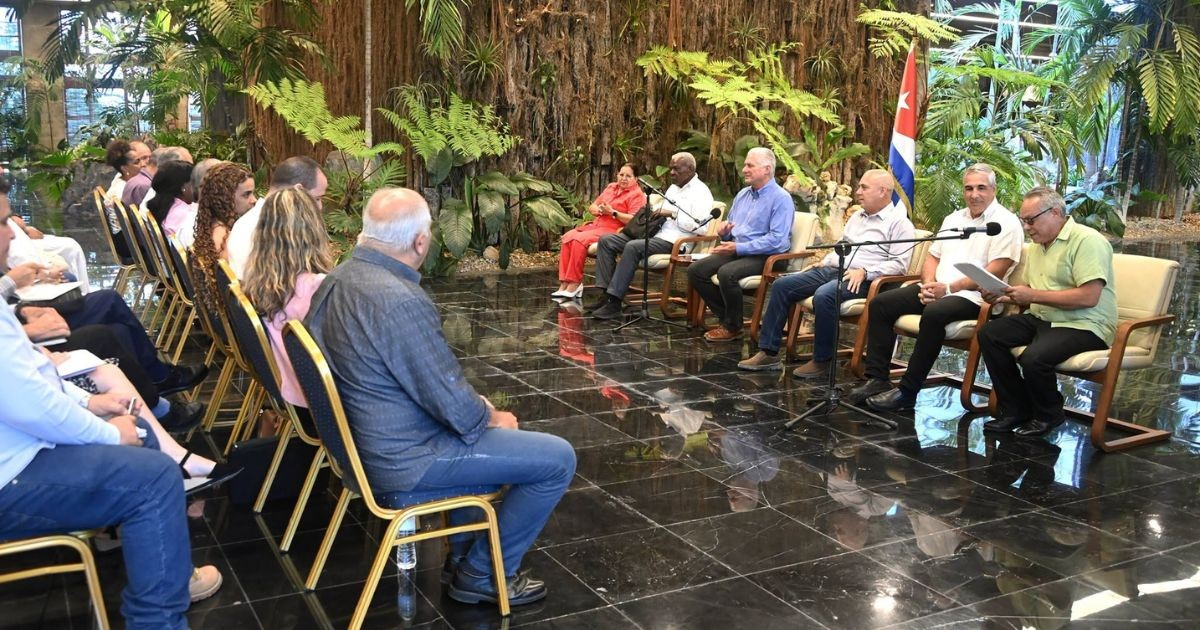
Roberto Morales Ojeda, the Organization Secretary of the Central Committee of the Communist Party of Cuba, took to Facebook last Friday to reiterate the official rhetoric on public involvement, social justice, and inclusion. His post referred to a meeting held by President Miguel Díaz-Canel on October 1st with representatives from various organizations and institutions tied to the so-called 176 Economic and Social Transformations.
In his social media message, Morales Ojeda, a key member of the Political Bureau, declared, “In Cuba, popular participation remains the strongest pillar of unity and a guarantee of sovereignty.” He echoed Díaz-Canel's assertion that “social justice isn't defended with speeches; it's upheld by institutions working towards social justice.”
He further insisted that despite the ongoing blockade and energy constraints, Cuba continues its efforts to forge a more just, inclusive, and cohesive society.
Economic Promises vs. Harsh Realities
The October 1st gathering, moderated by Labor and Social Security Minister Jesús Otamendiz Campos, also featured prominent figures like Esteban Lazo Hernández, President of the National Assembly, Deputy Prime Minister Eduardo Martínez Díaz, alongside Morales Ojeda. During the meeting, Díaz-Canel emphasized that the 176 transformations—endorsed by the National Assembly in June 2026—are guided by the principle of social justice, emphasizing that economic growth must benefit social progress.
However, the stark economic reality of Cuba in 2026 seems to contradict these assertions. The Economic Commission for Latin America and the Caribbean (ECLAC) predicts a 10.3% drop in Cuba's GDP this year, marking the steepest decline in Latin America. Inflation reached 25.19% in August, and the informal market exchange rate for the dollar soared past 700 Cuban pesos, while the average monthly salary sits at around 7,000 pesos, roughly equivalent to less than $11.
Public Disillusionment and Outcry
Extreme poverty now affects 94% of Cubans, with eight out of ten individuals skipping meals due to lack of money or food, according to a recent report by the Cuban Observatory for Human Rights and the Observatory of Social Rights Cuba. The economic woes are compounded by an energy crisis, with power generation deficits frequently exceeding 2,000 MW and daily blackouts lasting over 20 hours in many areas. Cuba has experienced eight nationwide blackouts this year, and access to consistent drinking water remains elusive for approximately 2.7 million people.
The online response to Morales Ojeda's post was predictably harsh. One user summed up the prevailing sentiment with a blunt statement: “No one believes in you anymore. How will you move forward? It's been 67 years of promises and lies.” Another sarcastically questioned, “What kind of social justice is this if ordinary people are getting poorer while our leaders grow richer and fatter? For us, it's only creative resistance.” A third was even more direct: “Participation without decision-making rights, hahahaaa.”
Some users challenged the very semantics of the official discourse. “What does popular participation mean to you, Robertico? No one knows what you all are doing,” wrote one user. Another pointed to the systemic contradiction: “With just one party?!!!”
One particularly revealing comment, hidden by Facebook, read: “Yes, you participate, and they enjoy the money. For you, misery is blamed on the blockade, the cyclone, frozen rivers in Canada, or the lack of water in the Panama Canal […] if you don't participate, you face jail… the government of our island is horrible.”
Understanding Cuba's Socioeconomic Challenges
What are the 176 Economic and Social Transformations in Cuba?
The 176 Economic and Social Transformations refer to a set of reforms approved by the Cuban National Assembly aimed at promoting social justice and economic growth, although their effectiveness is widely debated.
How has the Cuban economy performed in 2026?
Cuba's economy in 2026 is facing significant challenges, including a projected GDP decline of 10.3%, high inflation rates, and a weak currency in the informal market.
What is the public's response to the government's claims of social justice and inclusion?
Many Cubans are skeptical of the government's claims, expressing disbelief and frustration over the disparity between official statements and their lived experiences of poverty and inequality.