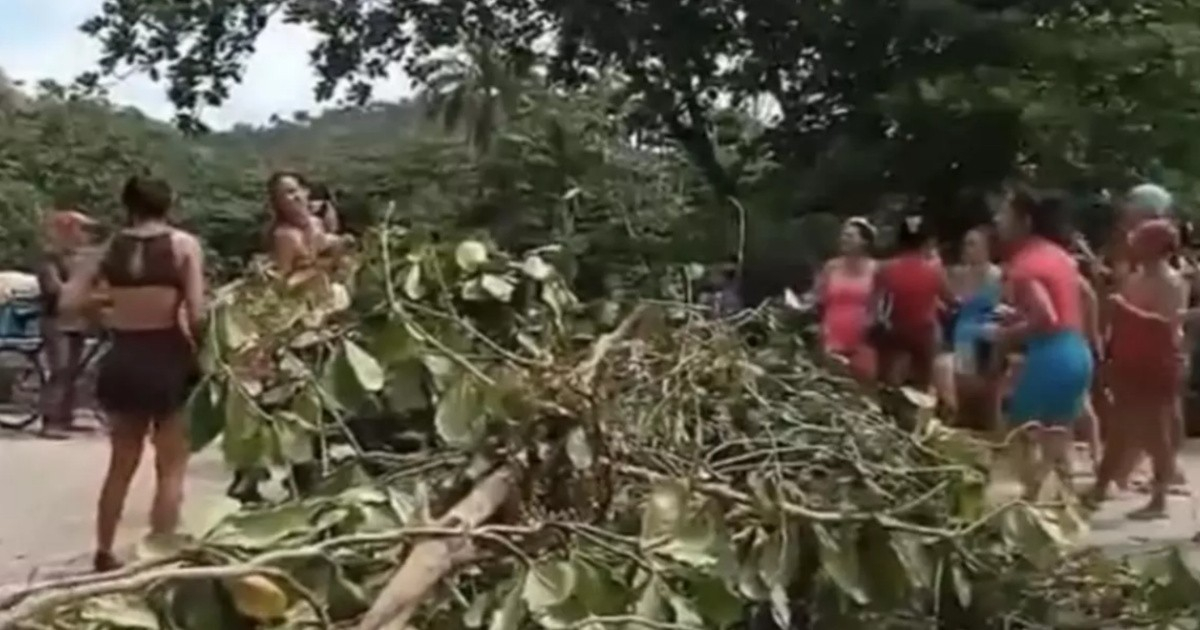
A group of women from the village of Levisa in the Mayarí municipality of Holguín took a stand at the end of September by blocking the bridge over the Cabonico River with tree branches and banging pots. They demanded the reinstatement of electricity after nearly a month-long blackout. Their protest yielded tangible results the following day, as reported by the independent outlet 14ymedio.
The demonstrators chanted, "Turn on the power! Turn on the power!" while dozens of men looked on from the sidelines, and vehicles were halted at both ends of the road. Police officers were present but did not intervene, a notable deviation from the typical repressive response of the regime to similar protests.
Immediate Impact of the Protest
The protest, documented by the independent media Árbol Invertido on September 25, led to immediate concessions by the authorities. Electricity was restored to the community, and residents received 14 pounds of rice per person, according to 14ymedio.
"Everyone in the community got 14 pounds of rice per person, and for two or three days, they delivered double bread to the store," a Levisa resident told 14ymedio.
"Some households received nearly 90 pounds of rice," the same source added.
Chronic Power Outages in Mayarí
Levisa had been without electricity for nearly a month at the time of the protest, a situation residents attributed to the Electric Company of Mayarí. The municipality has a history of severe blackouts; in March 2026, it experienced 51 continuous hours without power, sparking protests. In June, Levisa residents had already taken to the streets for the same reason.
"If the situation is terrible in the provincial capital, it's doubly so for the municipalities," a Holguín resident with family in Mayarí told 14ymedio. The same resident concluded, "What this shows is that protest is necessary. Without pressure, the government does nothing."
Protests and Repression in Cuba
The outcome of this protest is exceptional in the current Cuban context. Typically, the regime's response to protests over blackouts involves arbitrary arrests and legal proceedings.
For example, evangelical pastor Alexis Padrón Lorenzo, 58, was arrested on June 10 in Regla, Havana, after protesting the lack of power and water. He remained imprisoned for three months before being released on September 11, with precautionary measures and uncertainty over whether the legal process against him would continue, as reported by the Cuban Human Rights Observatory.
Legal organization Cubalex documented 280 repressive events across the island in August, a month in which protests decreased to 94 from the 200 recorded in July. In September, the Cuban Conflict Observatory reported 663 protests and 136 acts of repression nationwide, highlighting that public pressure persists despite the high cost it often entails.
Understanding the Impact of Protests in Cuba
What triggered the women's protest in Mayarí?
The women in Mayarí protested due to nearly a month-long power outage, demanding the restoration of electricity.
What was the outcome of the protest in Levisa?
The protest led to the restoration of electricity and the distribution of 14 pounds of rice per person to the residents.
How does the Cuban government typically respond to protests?
The Cuban government often responds to protests with arbitrary arrests and legal actions against the protesters.