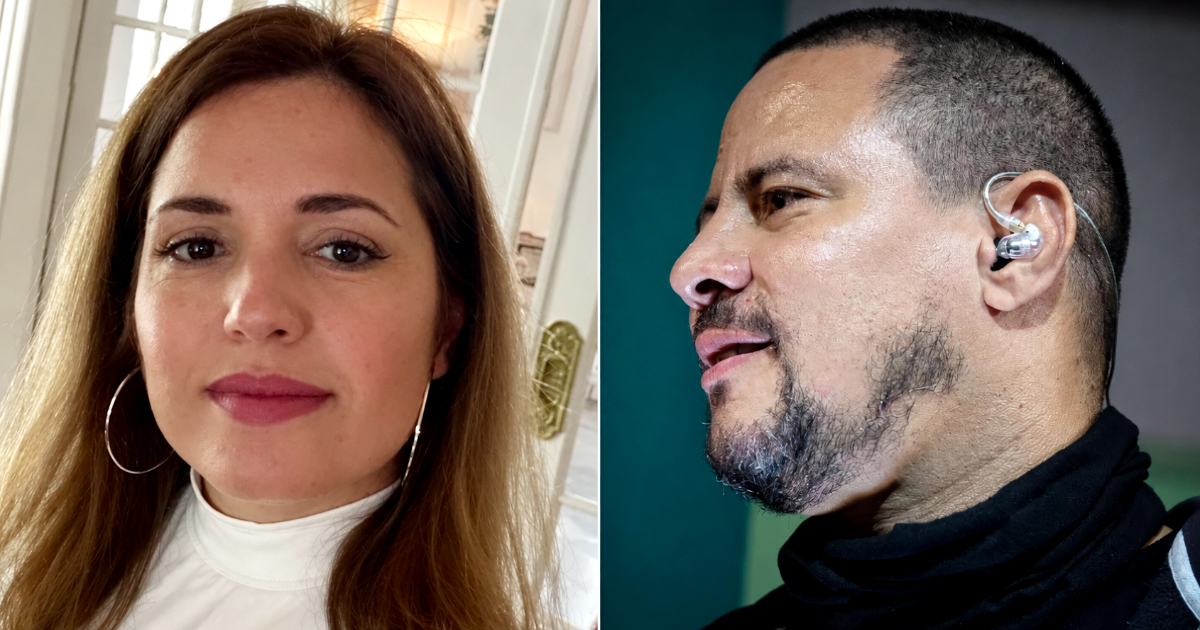
Cristina Escobar, a Cuban state journalist and partner of Israel Rojas, the lead singer of the duo Buena Fe, recently took to Facebook to deliver a striking critique of the Cuban government. She placed direct blame on the administration for the ongoing water crisis, describing the island's internal situation as a "sovereign chaos" that extends far beyond the U.S. embargo.
Escobar, who goes by "Cris Acosta" on social media and has built her career defending Cuba's political system, highlighted that water scarcity has surpassed power outages as the primary daily struggle for Cubans: "Electricity is no longer the main issue. It's the water."
On September 23, the journalist made her unusual public denunciation, attributing the crisis not to an actual lack of resources, but to institutional disarray: neighborhoods without water for 20 consecutive days while others nearby receive it, water trucks with fuel not reaching affected areas, and public companies failing to coordinate effectively.
"At the very least, there is a sovereign chaos," she stated, pointing out that the disconnect between pumping services and electricity supply signifies "another level of disorder and irresponsibility."
Escobar disclosed that even the country's president had to convene a meeting with water and electricity authorities to coordinate services "like a Venn diagram," directly referencing a meeting led by Díaz-Canel on September 1 at the Palace of the Revolution. Her conclusion was damning: "Yet, nothing happens."
She demanded that pumping stations top all electrical priority lists and called for the elimination of the word "effort" from official discourse: "The government and state exist for the people. That's their sole purpose. They don't make sacrifices. The people do, to support you and endure your inability to operate transparently and responsibly."
Her final warning was unequivocal: "A government that fails to ensure water and electricity even when basic conditions are met, because they can't organize themselves, is ineffective. Either they change, or they must be replaced."
Before sharing her post, Escobar attempted to contact two officials from Aguas de La Habana. One admitted to having no answers; the other dismissively said he would "pass it to the operators."
The post comes amid a documented water crisis: the regime admitted this week that 2.7 million people—about 35% of those receiving water through the network—have their access fully or partially affected.
Reuters reported that power outages in Havana frequently exceeded 24 hours and that around 3.5 million people were experiencing water shortages, with nearly 90% of the water infrastructure relying on electric pumps.
The Ministry of Public Health acknowledged in September a simultaneous rise in arboviral diseases, diarrheal illnesses, hepatitis, and respiratory infections, linking it directly to sanitation failures. Dengue incidence was 7.4 times higher than expected for this time of year.
Escobar's post is part of a growing trend among figures aligned with officialdom who, by 2026, have begun to challenge the narrative that solely blames the embargo. The journalist had previously criticized state media in August 2025 for its failure to report truthfully.
In March, Israel Rojas confirmed on social media that Escobar is his partner, following the circulation of photos of them in Madrid. Buena Fe has historically been closely associated with Cuban officialdom.
"Be very careful in treating the people with disdain, for the people might treat you with disdain in return," Escobar concluded in her post.
Understanding Cuba's Internal Challenges and Government Criticism
What is Cristina Escobar's main criticism of the Cuban government?
Cristina Escobar criticizes the Cuban government for its disorganization and inability to manage resources effectively, leading to severe water and electricity shortages. She argues that these issues represent a deeper "sovereign chaos" beyond the impact of the U.S. embargo.
How has the Cuban government responded to the water crisis?
The Cuban government has acknowledged the severity of the water crisis, with 2.7 million people affected. However, solutions have been hampered by poor coordination and reliance on electricity for water infrastructure, which frequently faces outages.
What impact have the water and electricity issues had on public health in Cuba?
The lack of consistent water and electricity supply has led to a rise in health issues, including arboviral diseases, diarrheal illnesses, hepatitis, and respiratory infections, as admitted by the Ministry of Public Health.