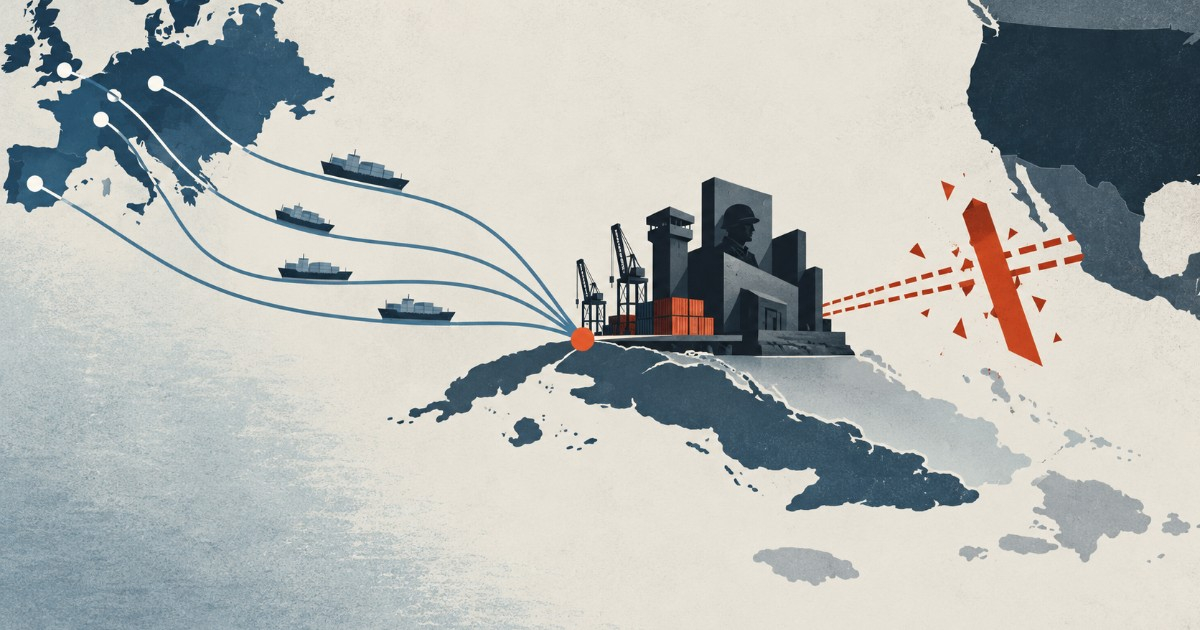
The recent retreat of the Spanish group Vima from Havana serves as a notable example of how intensified U.S. sanctions against the Cuban military conglomerate GAESA are impacting European businesses. Yet, Vima is not the only European entity now facing heightened risk.
An investigation by CiberCuba, involving corporate documents, official records, and primary sources, reveals that companies from the United Kingdom, Italy, and Belgium still maintain documented operations in the Mariel Special Development Zone (ZEDM) or related projects. This area is highlighted by the U.S. Department of State as being linked to GAESA, placing it on the Cuba Restricted List.
Notable European Presence in Mariel
Among the companies involved are Unilever, GIB Holding through Lácteos Mariel, BDC International, and Sistem Costruzioni. Each company's situation varies, and their presence in Cuba does not necessarily imply that they are sanctioned or in breach of U.S. laws.
For instance, after Vima withdrew its brand from a Havana store and scaled back its activities due to associations with the military-controlled business conglomerate, the significance of these relationships became more apparent.
Impact of U.S. Executive Order on Foreign Entities
The risk landscape shifted significantly on May 7, 2026, when the United States designated GAESA under Executive Order 14404. The Office of Foreign Assets Control (OFAC) explicitly warns that non-U.S. persons and entities could face sanctions for engaging in transactions with GAESA.
This risk extends to entities where GAESA, the Ministry of the Interior, or the Ministry of the Revolutionary Armed Forces hold a 50% or greater interest, directly or indirectly. OFAC's guidance highlights the importance of enhanced due diligence for foreign companies considering operations with such entities.
Complex Regulatory Environment as of September
On September 30, U.S. regulations further complicated matters. These rules now prohibit U.S.-jurisdiction individuals from engaging in specific direct and indirect financial transactions with entities on the Cuba Restricted List.
OFAC emphasizes that even if a foreign customer isn't American, any payment passing through a U.S. bank involving a Cuban entity on the list could be classified as a prohibited indirect transaction.
Significance of Mariel in GAESA Ties
Mariel's inclusion in the Cuba Restricted List is explicitly stated by the Department of State, identifying it alongside other entities like the Mariel Container Terminal and Tecnoimport. This inclusion necessitates that foreign companies precisely identify their Cuban partners, payment recipients, and the entities involved in their operations.
Case Study: Unilever and Mariel
One prominent example is Unilever. According to their 2025 Annual Report, published in 2026, Unilever continues to list Unilever Suchel S.A.—a joint venture with a 60% Unilever stake—located in the Mariel Special Development Zone, Artemisa province.
While this confirms Unilever's documented presence in Mariel, it does not inherently prove any prohibited transactions with GAESA. The critical issue lies in determining which entities manage the necessary services, infrastructure, payments, and contractual relationships for operations, and whether any are subject to U.S. restrictions.
Italian Investments: GIB Holding and Lácteos Mariel
Another significant player is Lácteos Mariel, owned by Italy's GIB Holding Company. GIB's official website confirms its production facility's location within the Mariel Special Development Zone.
The company produces dairy products in Cuba and maintains an active commercial website featuring contact information and job listings in Mariel. Despite this presence, it does not automatically imply a U.S. designation but highlights the importance of identifying Cuban counterparts in operations.
Belgian Presence: BDC International
BDC International, a Belgian group, also maintains visibility with its subsidiaries BDC Log and BDC Tec in Mariel. BDC's commercial website lists a BDC Log center in the ZEDM, providing logistics, transportation, storage, and other industrial services across Cuba.
Like others, BDC's operations prompt compliance questions regarding which Cuban entities participate in transactions and whether any benefit entities on the Cuba Restricted List.
Sistem Costruzioni: A Direct Italian Link
Sistem Costruzioni, an Italian firm, warrants unique consideration due to official documentation linking it to a GAESA-associated project. In February 2025, Italy's Ministry of Foreign Affairs reported that Sistem Costruzioni was building a glass factory within Mariel via a joint venture with a GAESA-affiliated state company.
Despite this, public documents reviewed by CiberCuba do not clarify whether this joint venture's structure remains unchanged following the May 2026 sanctions, was altered, or is under review.
Shifts from Tourism to Industrial Ventures
U.S. pressure had already prompted visible changes in tourism. In July, Meliá, Iberostar, and Barceló exited their Cuban operations after managing hotels owned by Cuban state entities for years. Consequently, these chains should not be seen as examples of companies still operating in Cuba solely based on hotel names in U.S. documents.
The focus now shifts to less visible sectors like factories, logistics, food production, infrastructure, and companies based in Mariel.
Beyond Sanctions: The Current Risk Environment
For European firms, the primary concern isn't just appearing on the U.S. sanctions list. OFAC notes that foreign companies risk U.S. measures for transactions with GAESA or entities where the military holds significant control. Additionally, U.S. banks serving as intermediaries may be restricted from processing payments involving a Cuba Restricted List entity.
This scenario could lead to banks rejecting transactions, suppliers demanding more information, insurers reviewing contracts, and companies needing to demonstrate the ultimate beneficiary of each payment in greater detail.
Vima's case may serve less as an exception and more as a warning about the increasing costs and risks of engaging with structures linked to GAESA, even for foreign companies not currently sanctioned.
Understanding U.S. Sanctions and GAESA
What is GAESA?
GAESA is a Cuban military conglomerate controlling a significant portion of the country's economy, including tourism, retail, and real estate sectors.
Why are European companies at risk?
European companies are at risk due to U.S. sanctions targeting transactions with GAESA or entities it controls. These sanctions affect both direct and indirect financial activities involving U.S. jurisdictions.
What is the Mariel Special Development Zone?
The Mariel Special Development Zone is an economic area in Cuba designated for foreign investment, identified by the U.S. as linked to GAESA, thus posing risks under U.S. sanctions.