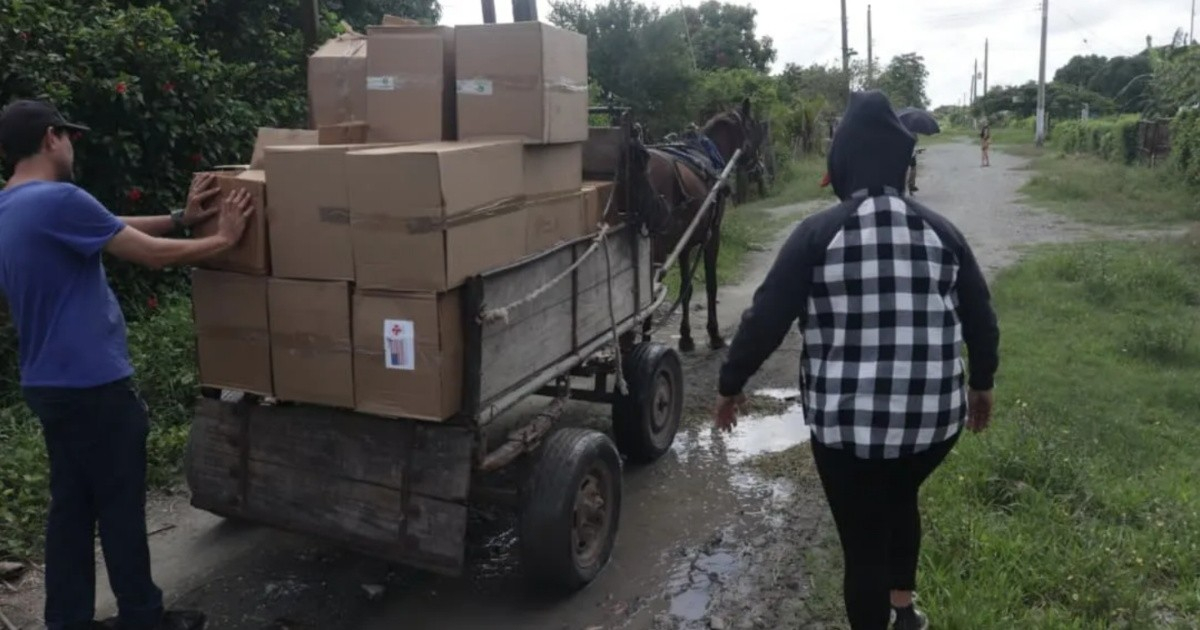
On Saturday, Caritas Camagüey volunteers began distributing humanitarian aid from the United States to the rural community of Lugareño in the municipality of Minas. This effort involved providing 300 families with food and hygiene kits, as part of a $100 million assistance program allocated by the U.S. government to aid the Cuban people, according to Caritas Cuba's website.
The shipment arrived on Thursday at Camagüey's Ignacio Agramonte International Airport, with Archbishop Wilfredo Pino Estévez of the Camagüey Archdiocese and María Rosa Rodríguez Aguilar, director of Caritas Camagüey, in attendance. During the reception, a total of 700 kits were unloaded: 300 destined for Lugareño and 400 for families in Nuevitas.
Father Reynaldo, the parish vicar, joined the distribution effort in Lugareño alongside local volunteers and Caritas Camagüey staff. The volunteers had previously been trained to ensure an organized and transparent delivery process and had identified the most vulnerable families in the community based on pre-established criteria.
Each kit contained essential food items—such as rice, beans, oil, sugar, spaghetti, sardines, and tuna—along with hygiene products like soap, toothpaste, and toothbrushes. Priority was given to elderly individuals living alone, pregnant women, breastfeeding mothers, people with disabilities, and families with children under five at risk.
Yurguit Estrada Santos, a communicator for Caritas Camagüey, described the distribution day as filled with gratitude. "The atmosphere was one of simplicity and warmth from the rural community, as they opened their homes to those providing relief for their basic needs in food, hygiene, and water storage," he stated.
Initial Distribution Point in Camagüey
Lugareño marks the first distribution point of the aid received in Camagüey, signaling the program's arrival in this central-eastern province of the island. The program operates solely through the Catholic Church network—Caritas Cuba and Catholic Relief Services (CRS)—without the involvement of the Cuban regime. Of the total $100 million, $60 million is channeled through this network, while the remaining $40 million is distributed by other independent organizations.
The aid distribution in Camagüey is part of a broader expansion to five provinces—Camagüey, Ciego de Ávila, Cienfuegos, Matanzas, and Pinar del Río—announced by the U.S. Embassy in Havana in mid-September. The initiative originally started in July 2026 in the Archdiocese of Havana, with initial distributions in Bejucal and Alquízar, and has been gradually extending. In mid-September, a shipment reached Santa Clara for the Diocese of Cienfuegos, where around 50 volunteers distributed 700 food kits and 700 hygiene kits in a single day.
The overarching goal of the program is to reach between 100,000 and 120,000 families across the country, as outlined in the U.S. assistance plan coordinated with Caritas Cuba.
Frequently Asked Questions about Caritas Aid Distribution in Cuba
What is the purpose of the U.S. aid distribution in Cuba?
The program aims to provide essential food and hygiene supplies to vulnerable families in Cuba, reaching between 100,000 and 120,000 families across the country.
Who manages the distribution of the aid in Cuba?
The distribution is managed through the Catholic Church network, specifically Caritas Cuba and Catholic Relief Services, without involvement from the Cuban government.
Which communities are prioritized for receiving aid?
Priority is given to the elderly living alone, pregnant women, breastfeeding mothers, people with disabilities, and families with young children at risk.