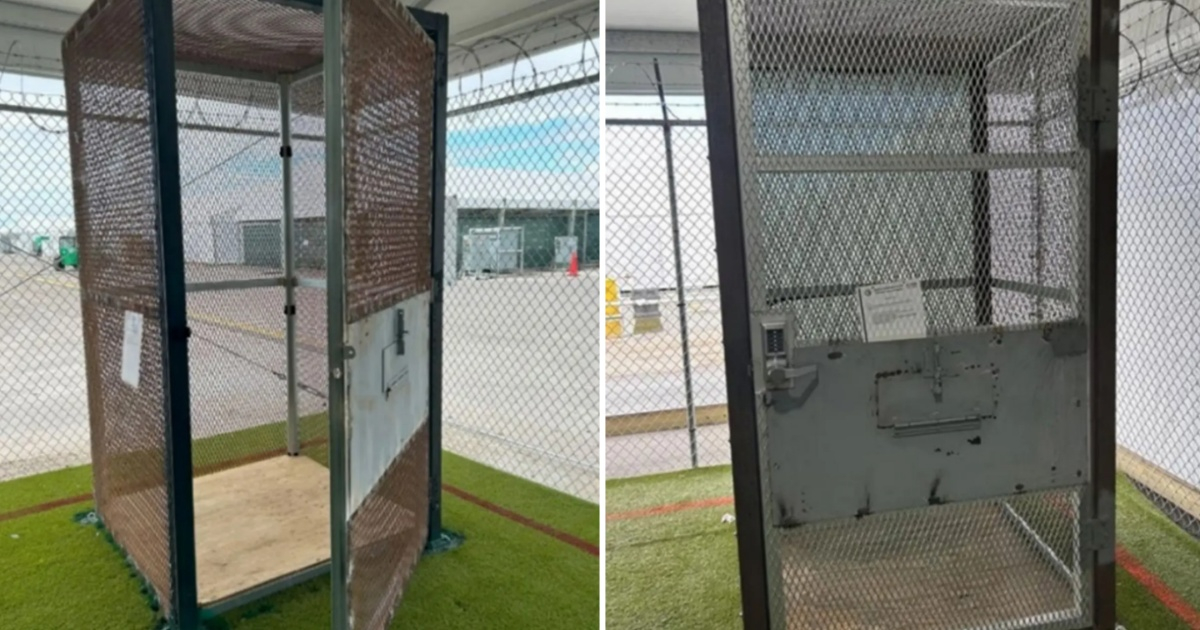
A Miami Herald investigation published on Friday has concluded that the so-called "sun cages" at the now-defunct Alligator Alcatraz immigration detention center likely violated both the U.S. Constitution and international law, according to UN-associated experts consulted by the outlet.
The report sheds new light on a document released by the Department of Homeland Security's Office of Inspector General on September 11. This document detailed the use of metal structures, each barely 1.5 square meters, where 79 men were held between July 2025 and January 2026. Some detainees were handcuffed and deprived of food and water for up to 15 hours.
One pivotal account comes from 50-year-old Cuban Tommy Lam Rodríguez, who told the Herald he was locked in one of these cages for two hours because he didn't finish breakfast on time, attributing the delay to his hypoglycemia and missing teeth.
Detention conditions in facilities like Alligator Alcatraz continue to spark debate. Stay updated on U.S. immigration news to remain informed about this and other cases impacting the Cuban and Latin communities.
Juan E. Méndez, a former UN special rapporteur on Torture and a torture survivor from Argentina, was unequivocal: "Locking someone in what amounts to a phone booth for any length of time is typically used in truly dictatorial regimes to break a prisoner's resistance, to force confessions, or simply as punishment, pure cruelty. One wouldn't expect it to happen in countries with reasonable rule-of-law standards."
Jorge Contesse, a Rutgers Law School professor and UN Committee Against Torture member, noted that if such confinement is used as punishment for misbehavior, "it could constitute torture under international law."
Alice Edwards, who served as the UN special rapporteur on Torture until July 2026, emphasized there is "no rational justification for a facility to have cages this small," and that individuals detained for immigration reasons should not be subjected to criminal incarceration standards.
Sam Lester, a Florida ACLU attorney, was more blunt: "These are akin to medieval torture devices. They're torture chambers. There's no precedent for this in ICE detention."
Despite these criticisms, the office of Governor Ron DeSantis confirmed the use of the cages. His communications director, Alex Lanfranconi, stated, "While it meets all federal standards for criminal confinement, we would make it even smaller if we could."
The case holds particular significance for the Cuban community. Raúl Suárez Herrero, 59, reported spending over 15 hours in one of these cages—from 1:00 p.m. to 5:00 a.m. the next day—without food, unable to lie down, and plagued by mosquitoes. Previously, two former guards were criminally charged for assaulting Cuban Rigoberto Rodríguez Arce, 42, during a protest over lack of food and water.
Opened in July 2025 on a former Everglades airfield built in only eight days, Alligator Alcatraz closed permanently on June 25, 2026, under pressure from humanitarian organizations. The center housed around 22,000 people and cost over $1.2 billion.
Florida Attorney General candidate José Javier Rodríguez has called for a comprehensive investigation into the center over detention conditions and potential misuse of public funds. Contesse warned that incidents like this "challenge" the United States' historical role as an international human rights leader.
Key Questions About Alligator Alcatraz and Detention Practices
What were the "sun cages" used for at Alligator Alcatraz?
The "sun cages" were small metal structures where detainees were confined, sometimes handcuffed and without food or water for extended periods, allegedly as a form of punishment or control.
Why was Alligator Alcatraz closed?
Alligator Alcatraz was closed due to pressure from humanitarian organizations over its inhumane detention conditions and the controversy surrounding its practices.
What actions have been proposed following the closure of Alligator Alcatraz?
Florida Attorney General candidate José Javier Rodríguez has called for an investigation into the detention conditions and potential misuse of public funds at the center.