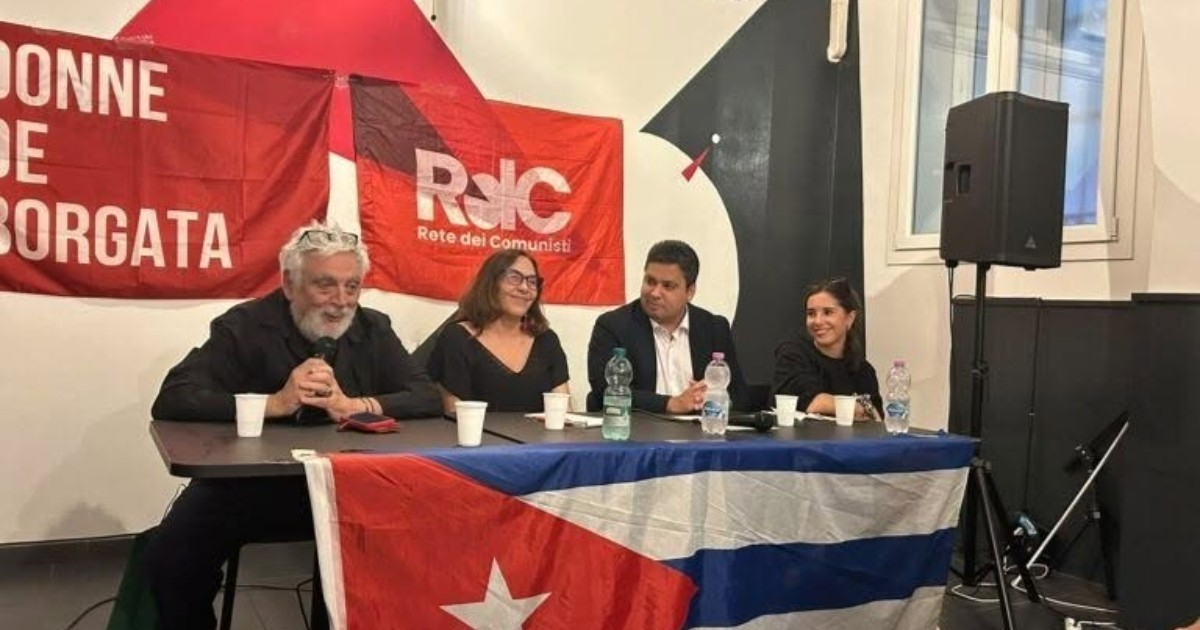
Mariela Castro Espín, who leads the National Center for Sexual Education (CENESEX) and serves as a deputy in Cuba's National Assembly, participated in a political event this past Saturday at Rome's Circolo GAP. Titled "Cuba's Resistance," the gathering aimed to defend the Cuban regime's sovereignty against external pressures, drawing an audience of academics, activists, and Italian politicians supportive of Havana.
The event, hosted in Rome's San Lorenzo neighborhood, also featured Cuba's ambassador to Italy, Jorge Luis Cepero Aguilar, and economist Luciano Vasapollo, a professor at Sapienza University and leader of the Rete dei Comunisti—an Italian organization with a long history of solidarity with the Cuban regime.
The stage was adorned with the Cuban flag, flanked by banners of the Italian communist organization. The central theme was Cuba's official narrative of "resistance." Castro highlighted the Family Code—approved in a September 2022 referendum and promoted by CENESEX—as evidence that Cuba "remains committed to expanding rights and charting its own path," despite economic pressures and the U.S. embargo.
This legislation introduced equal marriage rights, same-sex adoption, and non-commercial surrogate motherhood. The discussion also touched on the situation in Palestine, international solidarity, and the embargo's effects on the island. Vasapollo referred to Cuba as "a political and social laboratory that continues to spark international debate on issues like sovereignty, social justice, rights, and cooperation among peoples."
CENESEX concluded its coverage of the Roman event with a statement encapsulating the gathering's tone: "Cuba remains alive, defending its sovereignty and fueling the fight for emancipation and dignity."
The Rome event is part of a series of international appearances by Mariela Castro, who has amplified the discourse of resistance in recent months. In February, she asserted that "there is no room for negotiation with imperialism and all its forms, only dialogue," quoting Fidel Castro. In April, speaking before the Convoy Nuestra América, she declared, "there is pain in Cuba, but we will not kneel," labeling independent LGBTQ+ opposition as "fictitious," "fabricated," and "mercenary," accusing the United States of creating it.
Her rhetoric contrasts with documented repression of autonomous LGBTQ+ activism in Cuba and the suspension of gender reassignment surgeries in the public health system due to resource shortages. In 2019, when CENESEX canceled its official parade, independent activists organized their own march, which was suppressed by the Ministry of the Interior, resulting in at least six arrests.
The visit to Rome also came days after an investigation by El Confidencial revealed that Mariela Castro's husband invested over a million and a half euros in tourist properties in Barcelona. The Italian photojournalist Paolo Titolo, son-in-law of Raúl Castro, acquired three properties in the city's tourist zones between 2015 and 2019, while serving for nearly two decades as general director in Cuba for the Amorim business group, linked to the Portuguese magnate Américo Ferreira de Amorim, a personal friend of Fidel and Raúl Castro.
Key Questions About Mariela Castro's Advocacy in Rome
What was the focus of Mariela Castro's event in Rome?
The event titled "Cuba's Resistance" focused on defending the Cuban regime's sovereignty against external pressures and highlighted Cuba's Family Code as an example of the country's commitment to expanding rights.
Who accompanied Mariela Castro at the Rome event?
The event featured Cuba's ambassador to Italy, Jorge Luis Cepero Aguilar, and economist Luciano Vasapollo, along with other supporters of the Cuban regime.
What controversies surround Mariela Castro's advocacy?
Her advocacy contrasts with documented repression of LGBTQ+ activism in Cuba and her husband's controversial investment in tourist properties in Barcelona, raising questions about the regime's commitment to social justice.