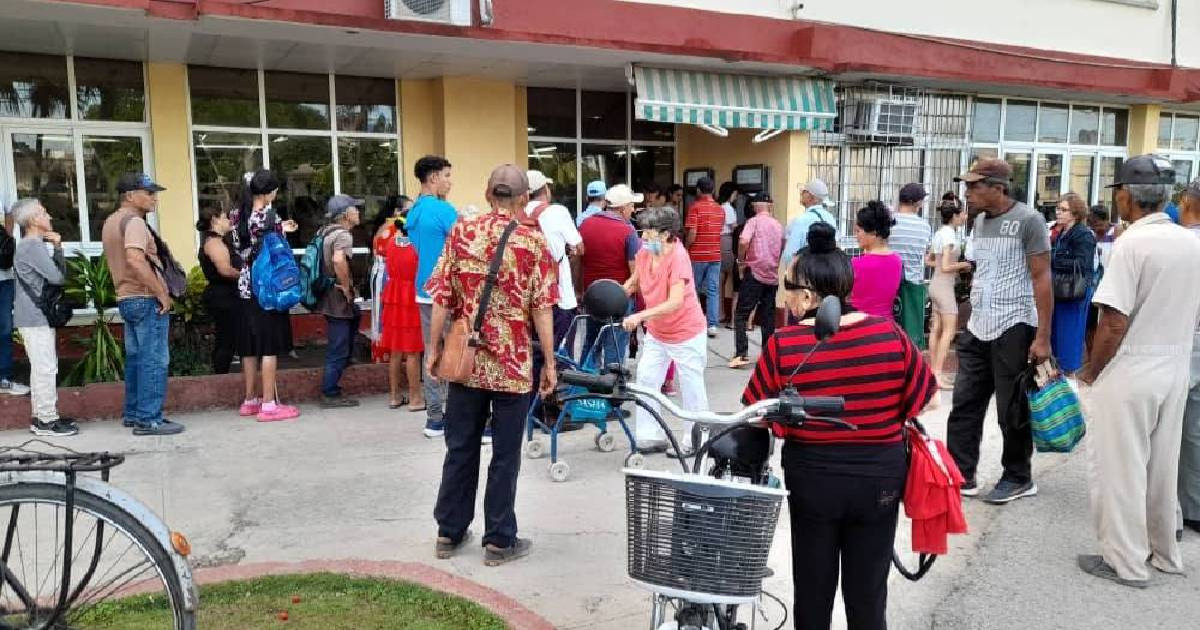
Withdrawing cash in Las Tunas has become an endurance test for many, including the elderly, as technical issues disrupt banking services, leading to long waits for dozens of individuals.
Images shared on Facebook by journalist José Luis Tan Estrada under the hashtag #TanteandoCuba reveal between 25 to 40 people waiting outside a bank with a yellow and red façade, braving the sun. One photo even shows an elderly person with a walker.
A firsthand account in the post highlights the obstacles faced by those trying to withdraw pesos. "If it's not the connection dropping, it's the panel running out of power, and everything else you can imagine," one person shared, as cited by Tan Estrada.
The reported issues include connection outages and terminals without power, which prolong access to this essential service for those needing cash.
Banking Crisis Extends Beyond Las Tunas
These scenes underscore how a basic task like withdrawing a few bills can become an extended wait without the assurance of completing the transaction. The situation in Las Tunas mirrors a broader banking crisis across the island.
In Havana, lines extend over eight hours in front of Banco Metropolitano branches. Months back, journalist and teacher Iraida Calzadilla described an entire day spent on a curb to collect her pension.
Meanwhile, in Holguín, Banco Popular de Ahorro has closed its doors as early as 3:00 p.m., leaving numerous retirees unpaid despite having electricity, cash, and internet connection.
In Guantánamo, over 31,000 retirees, accounting for 63% of the total, continue monthly visits to branches for their pensions. The local Banco de Crédito y Comercio manages to gather only around 34% of the daily needed cash intake.
Attempts to Alleviate the Crisis
Faced with this collapse, the government has turned to private businesses as a stopgap. In Cuba's easternmost provinces, authorities have signed 1,056 contracts with economic actors to disburse cash pensions to 18,344 retirees. In the municipality of Amancio, a private bar has been serving as a pension payment point since August.
The failure of the mandatory banking regulation, imposed in August 2023 via Banco Central's Resolution 111/2023, is evident. Three years later, fewer than five percent of transactions in Cuba are digital, and more than 50% of ATMs are either out of service or empty.
In July, Banco Central issued Resolution 74/2026, removing the 5,000-peso cap on cash transactions between economic entities. In September, it introduced new 10,000 and 20,000 peso bills. However, neither measure has reduced the lines.
Guantánamo's official newspaper, Venceremos, acknowledged in July that the issue "has ceased to be a banking difficulty and has become a social problem," a stark admission of the government's failure to provide real solutions for the more than 1.7 million Cuban retirees relying on a faltering system.
Understanding the Banking Woes in Cuba
What are the main issues causing long wait times at banks in Las Tunas?
Technical interruptions, such as connection failures and uncharged terminals, are leading to prolonged wait times for cash withdrawals in Las Tunas.
How has the Cuban government attempted to address the banking crisis?
The government has engaged private businesses to distribute pensions and removed cash transaction caps, among other measures, but these have not significantly alleviated the problems.
What impact has the banking crisis had on Cuban retirees?
The crisis has left retirees facing long queues and uncertainty in accessing their pensions, severely affecting their financial stability and daily lives.