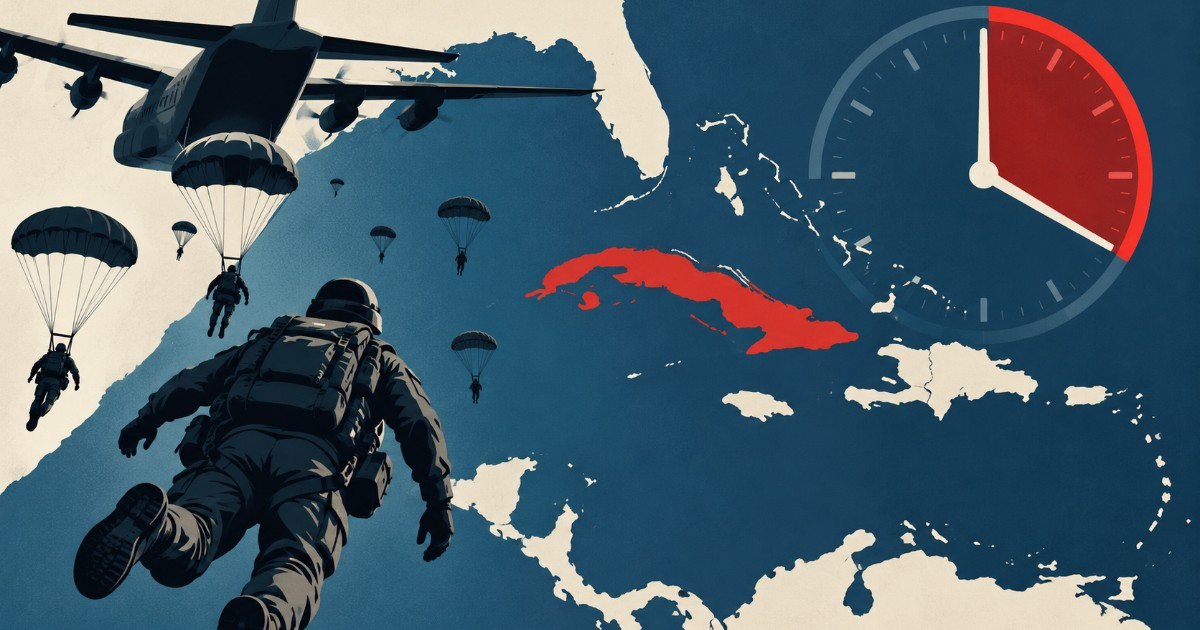
The United States Southern Command (SOUTHCOM) recently brought attention to a well-known rapid response capability of the U.S. Army: the ability to deploy elements of the 82nd Airborne Division within 18 hours of receiving an order.
On October 1st, SOUTHCOM's official account on X shared the phrase: "18 hours notice. Anywhere in the world," emphasizing this rapid deployment potential.
SOUTHCOM elaborated that the 82nd can swiftly mobilize, execute forcible entry parachute assaults, and secure strategic objectives to support subsequent military operations.
Implications for Cuba
This information is particularly striking in the context of Cuba, as the island falls under SOUTHCOM's area of responsibility, which includes 31 nations in Latin America and the Caribbean.
However, it's crucial to distinguish between showcasing a military capability and declaring an operation. The message does not specifically mention Cuba, nor does it announce a deployment order or identify any military targets related to the island.
The Reality of the 18-Hour Deployment
The 18-hour figure isn't a new revelation. The 82nd Airborne Division, based at Fort Bragg, North Carolina, has long had the mission of strategic deployment within 18 hours of notification, conducting a forcible entry parachute assault and securing objectives for the arrival of follow-on forces. This readiness is a hallmark of the division, recognized as the Army's immediate response airborne force.
It's important to understand that the 18-hour window refers to initiating the deployment of pre-prepared military units, not completing an entire operation or seizing control of a territory.
For instance, on December 31, 2019, amid rising tensions with Iran, the U.S. activated the 82nd's rapid response force. According to an official Army Legal Center publication, initial elements departed Fort Bragg within the 18-hour deadline. Ultimately, about 3,500 paratroopers were sent to the Middle East.
Understanding Forcible Entry
The term "forcible entry" used by SOUTHCOM can sometimes lead to broader interpretations than intended in U.S. military doctrine. It refers to seizing and holding a military position against armed opposition, often involving capturing an airfield or other strategic point to allow the subsequent entry of troops, vehicles, and heavier equipment.
The primary role of an airborne unit is not to single-handedly conduct an entire military campaign, but to establish a foothold and secure the necessary area for additional forces.
Why SOUTHCOM's Message Matters
The significance of SOUTHCOM's message lies in its source: not only the 82nd Division but the command overseeing Latin America and the Caribbean. SOUTHCOM's official area description includes Cuba among the 31 countries within its geographic scope.
On October 1st, the message highlighted the 82nd's capabilities as an example of rapid response available throughout the region. This serves as a public demonstration of military readiness, but it does not imply a specific mission against Cuba.
The relationship between the 82nd and SOUTHCOM is longstanding. In 2024, division paratroopers participated in the HYDRA III exercise with the Colombian Army, showcasing the U.S.'s ability to quickly employ airborne forces in the Southern Command's area of responsibility.
This message comes amid increased U.S. military activity in the Caribbean. On Friday, CiberCuba reported that SOUTHCOM announced the Guantanamo Bay Naval Base will host the first training and support site for the new SOUTHCOM Autonomous Warfare Command, dedicated to autonomous and unmanned systems.
Such developments, alongside recent exercises, new technological capabilities, and routine military contingency planning, explain why any message about the Army's rapid reaction force draws particular attention when viewed from Cuba.
Yet, these actions do not transform the 82nd's announcement into an operational order against Cuba.
Clarifying Assumptions
What is confirmed is that the U.S. maintains an airborne division ready to react with minimal notice, and SOUTHCOM has decided to publicly highlight this capability within its area of responsibility.
It is also confirmed that Cuba is part of this area and that the 82nd is trained for forcible entry operations to secure strategic objectives.
What remains unannounced is any deployment of the division towards Cuba, an intervention order, a specific number of troops destined for the island, or an 18-hour deadline for executing an operation against Cuban territory.
The distinction is critical: the 18-hour timeframe describes a permanent military readiness capability, not a countdown to action.
Key Questions about SOUTHCOM and 82nd Airborne Deployment
What is the significance of the 18-hour deployment capability?
The 18-hour deployment capability highlights the U.S. Army's rapid response readiness, allowing initial forces to mobilize swiftly for strategic operations anywhere globally.
How does this affect Cuba?
While Cuba is within SOUTHCOM's area of responsibility, there's no specific deployment order targeting the island. The message serves as a reminder of U.S. military readiness in the region.
What does "forcible entry" mean in military terms?
Forcible entry refers to capturing and holding a position against resistance, often involving seizing a strategic location to enable the entry of additional forces.