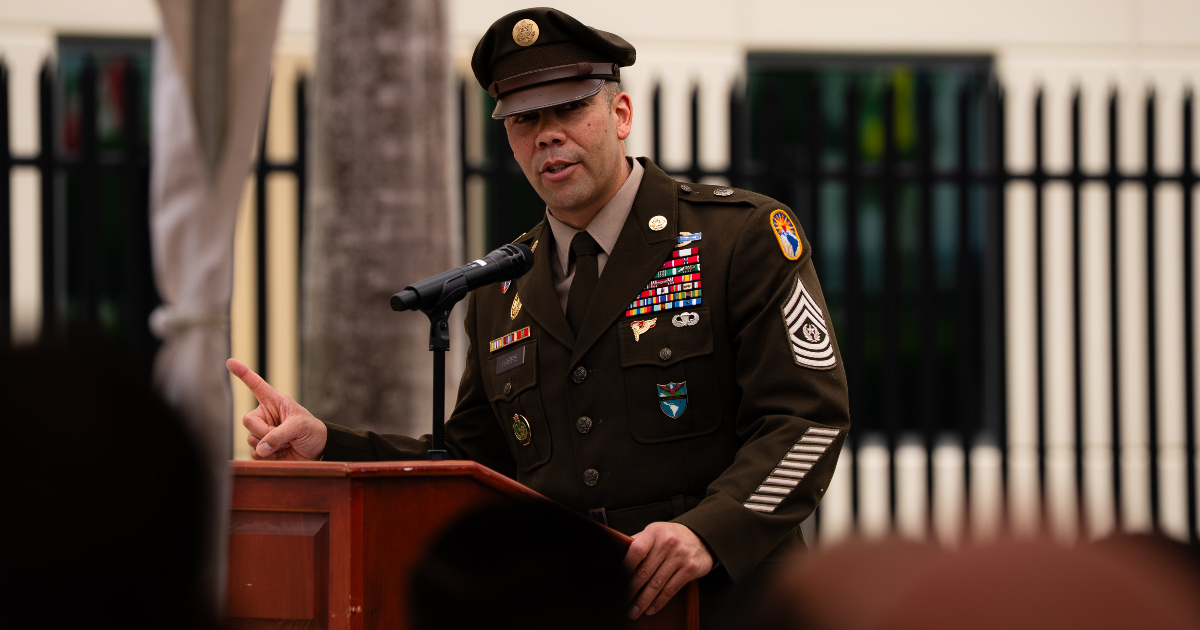
This week, the United States Southern Command (SOUTHCOM) made a significant internal leadership change, which carries special significance given the current geopolitical context.
Army Command Sergeant Major Raymond S. Harris took on the role of Command Senior Enlisted Leader (CSEL) at SOUTHCOM on September 30. This position is akin to being the top enlisted advisor within the military command that oversees Latin America and the Caribbean.
While Harris does not replace General Francis L. Donovan, the commander of SOUTHCOM, nor does he directly manage military operations, his role is crucial. He advises the command leader on enlisted force matters and conveys priorities across all ranks, focusing on readiness, discipline, morale, welfare, and internal execution.
In essence, Harris translates the strategic intentions of the commander into actionable guidance for the troops.
Leadership Transition and Strategic Timing
This leadership transition follows the retirement of Marine Sergeant Major Rafael Rodríguez after 35 years of service, as announced by SOUTHCOM on social media.
The appointment of Harris coincides with a CBS News report on U.S. Army Reserve consultations about potentially providing various support units to SOUTHCOM within a 90 to 120-day timeframe. While the document reviewed by the network did not explicitly mention Cuba, anonymous U.S. officials linked the planning to situations involving the island.
The assessed capabilities include a combat sustainment support battalion, an engineer battalion, an expeditionary sustainment command, a medical brigade, a forward surgical unit, and a military police brigade.
Strategic Preparation Without Deployment Orders
These units are not solely for direct combat but are essential for sustaining complex operations: logistics, security, transport, medical care, infrastructure, area control, and support for deployed forces.
Harris's arrival doesn't necessarily indicate an imminent operation against Cuba nor ties directly to the CBS News revelations. However, it aligns with a period where SOUTHCOM appears to be examining its ground, medical, logistical, and security support capabilities for potential regional contingencies.
Although Harris's background in the Army mirrors the branch evaluating support units for SOUTHCOM, it doesn't suggest a direct cause-and-effect relationship. Instead, it underscores the need for leaders who can coordinate diverse forces and relay operational priorities under increasing pressure in the Caribbean.
Guantánamo's Role in Regional Strategy
Meanwhile, the Naval Base at Guantánamo is becoming increasingly significant in the U.S. military strategy for the region. This week, SOUTHCOM announced that the base would host the first training and mission support site for the SOUTHCOM Autonomous Warfare Command (SAWC), following the deployment of unmanned systems overseen by General Donovan.
Guantánamo, leased from Cuba since 1903 and condemned by Havana as an illegal occupation, has been described by SOUTHCOM as a "vital operational and logistical hub" for U.S. operations in the hemisphere. With the SAWC, the base now assumes an additional role as a regional platform for drones, autonomous systems, and unmanned capabilities.
Implications and Broader Context
Harris's appointment should not be seen as a direct signal of military action against Cuba. Its importance lies in its timing with other developments: Army Reserve consultations, increased SOUTHCOM activity, autonomous capabilities expansion in Guantánamo, and heightened U.S. focus on the Caribbean.
Viewed in isolation, the change might seem like an internal transition. However, in the broader sequence, it points to a phase of preparation, coordination, and adjustment within the military command responsible for the region.
For the Cuban regime, the political message remains clear: increased U.S. pressure in the Caribbean. Meanwhile, for SOUTHCOM, the operational challenge is more immediate: ensuring its command structures, troops, logistics, medical support, and new technological capabilities are ready should Washington decide to implement any of the scenarios currently under consideration.
Key Questions About SOUTHCOM's Strategic Changes
What role does the Command Senior Enlisted Leader play at SOUTHCOM?
The Command Senior Enlisted Leader advises the commander on enlisted force matters and conveys strategic priorities across all ranks, focusing on readiness, discipline, and internal execution.
How does the leadership change relate to potential military operations involving Cuba?
While the leadership change does not directly indicate planned operations against Cuba, it aligns with SOUTHCOM's review of support capabilities for potential regional contingencies, reflecting broader strategic preparation.