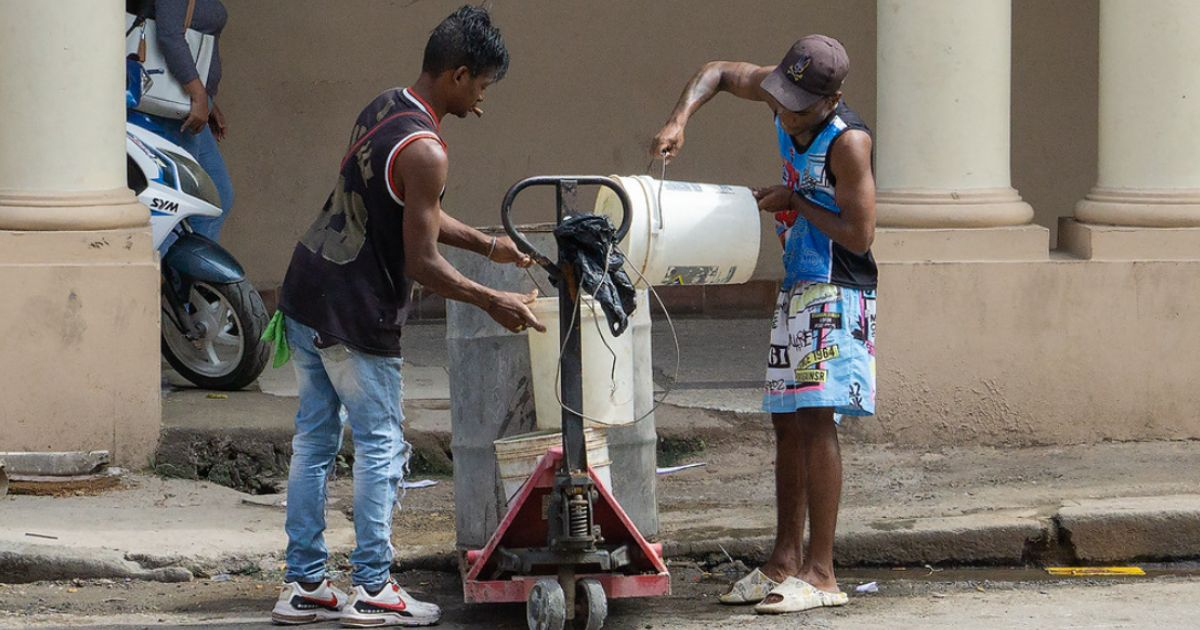
This past Friday, the Cuban government admitted that a staggering 2.7 million people face either full or partial disruption in access to potable water. This figure, representing nearly 35% of those receiving water services through the network, has remained unchanged since May, according to data released by EFE. Despite the regime's earlier announcement of an identical number, there has been no improvement.
The consistency of these figures over five months starkly contradicts the promises of improvement made by Miguel Díaz-Canel. His assurances, made during various public appearances and tours, including a September visit to the Norte water treatment plant in Havana, have proven hollow. During this visit, the regime's official newspaper, Granma, reported that around 100,000 individuals would no longer be affected following repairs to the Cosculluela system.
Regions Most Affected by Water Supply Issues
The provinces suffering the most severe water supply disruptions include Havana, Artemisa, Matanzas, Santiago de Cuba, and Holguín, as reported by Cuban water management authorities.
In the capital city of Havana, September was described as "very complex" by Yosvany Rubí, the general director of the state-run Aguas de La Habana. In statements to state television, Rubí highlighted that over 577,000 people encountered serious water supply challenges.
Compounding Challenges in Peripheral Areas
Rubí further pointed out that the peripheral municipalities of Boyeros and El Cotorro are experiencing the "most complex" situations. This is due to a combination of pump equipment failures and unstable electricity supply. "We are the largest consumer of electrical energy in the country, which directly impacts the services we provide," Rubí admitted.
In Santiago de Cuba, a television report cited by EFE revealed that nearly 180,000 residents are without water due to a mix of drought, electrical shortages, and equipment breakdowns.
Infrastructure Decay and Power Dependency
The authorities themselves acknowledge the causal chain: over 85% of the country's pumping stations rely on electricity, meaning every blackout directly halts water supply. This dependency is exacerbated by a deteriorating infrastructure that has seen decades without substantial investment or renewal. Some major pipelines in the capital have been in operation for 60 to 70 years. Leaks also contribute significantly to losses, with estimates indicating that between 40% and 70% of pumped water could be lost before reaching homes, although sources within the water sector suggest losses exceed 40%.
At the start of September, Díaz-Canel promised improvements by the end of that month and further progress in October. However, data from October 2 confirms that the national figure remains stagnant.
Health Consequences and Future Plans
The health ramifications are equally severe: the Ministry of Public Health reported a late September surge in dengue cases—7.4 times above expected levels—alongside increases in diarrheal diseases, hepatitis A, and respiratory infections, all directly linked to inadequate sanitation and water treatment.
The official long-term plan proposes the installation of 200 MW of solar energy to make water pumping independent of the national electrical grid, aiming for completion in early 2027. This means millions of Cubans will continue facing this water crisis for several more months at least.
Understanding Water Supply Issues in Cuba
Why is there a water shortage in Cuba?
Cuba faces water shortages due to a combination of outdated infrastructure, reliance on electricity for water pumps, and frequent power outages. The situation is aggravated by drought and insufficient investment in water systems.
How does the water crisis affect public health in Cuba?
The water crisis in Cuba has led to significant public health issues, including increased cases of dengue, diarrheal diseases, hepatitis A, and respiratory infections, all linked to poor sanitation and inadequate water treatment.
What are the Cuban government's plans to address the water crisis?
The government plans to install 200 MW of solar energy by early 2027 to reduce reliance on the national electrical grid for water pumping. However, this long-term solution means the crisis will persist for several more months.