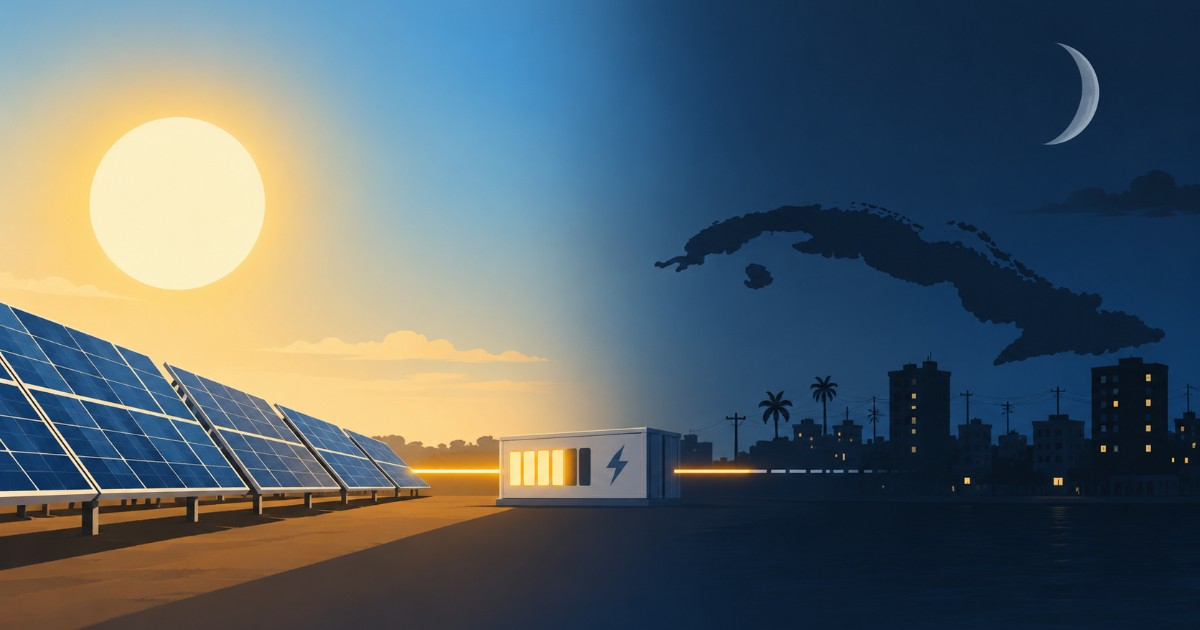
China has pledged to increase solar energy production in Cuba, yet data from the National Electric System (SEN) reveals why additional solar panels, despite their daytime benefits, are insufficient to resolve the blackouts plaguing the country during peak evening hours.
The Solar Power Conundrum: Daytime Gains, Nighttime Losses
On October 1st, the situation was particularly telling. According to data compiled by CiberCuba's Blackout Observatory, solar parks generated 3,169 MWh of energy, peaking at 493 MW during the sunniest part of the day. However, by 9 PM, as solar production vanished, the deficit soared to 2,059 MW.
The following day, October 2nd, the scenario remained dire, with the National Electric Union (UNE) forecasting a demand of 3,100 MW against a mere 1,060 MW available, resulting in a projected shortfall of 2,040 MW.
Understanding the Difference Between Power and Energy
The discrepancy between daytime and nighttime electricity availability highlights a fundamental issue in Cuba's current energy model: the sun shines brightest during the day, but peak usage and outages often occur hours later.
The figure of 493 MW refers to the maximum instantaneous power output by solar parks at a specific moment on October 1st, not sustained throughout the day. In contrast, the 3,169 MWh represents the total energy produced by these installations over the entire day.
Without prior storage in batteries, solar energy cannot seamlessly transition from midday to nighttime peak demand, leading to severe deficits despite daytime generation.
Solar Output Fluctuates Daily
Data from the Blackout Observatory also illustrates the inconsistency in photovoltaic production. On September 29th, solar parks generated 3,614 MWh, reaching a peak power of 562 MW. The following day saw a drop to 2,843 MWh with a peak of 442 MW, before climbing to 493 MW and 3,169 MWh on October 1st.
Cloud cover, weather conditions, and inherent network limitations cause available generation to vary, even with the same installed photovoltaic capacity.
The Role of Thermal Power Plants
While solar parks contribute during the day, much of the conventional power generation remains offline. On October 2nd, breakdowns were reported at several key thermal power plants, including Máximo Gómez in Mariel and Antonio Guiteras in Matanzas, with others undergoing maintenance, adding to the 377 MW shortfall in thermal generation.
Efforts to recover power included only 30 MW from Energás Varadero and 60 MW from Mariel's unit 5.
China's Promises of More Solar Parks and Storage
Chinese Ambassador to Havana, Hua Xin, recently assured ongoing support for energy projects in Cuba. In 2025, 35 MW were added in solar parks with Chinese assistance, with plans to complete an additional 85 MW across 15 sites by October.
Hua Xin announced the arrival of materials for a new 200 MW solar generation and storage project, emphasizing that storage can significantly enhance solar energy's utility by preserving daytime production for later use.
Challenges with Battery Energy Storage Systems (BESS)
Cuba is also advancing a program to establish four major battery energy storage systems, each with a nominal power of 50 MW. However, only the Cotorro system is confirmed operational so far, with others in various stages of completion and testing.
It's also crucial to understand that 200 MW of power does not equate to 200 MWh of energy capacity. The ability to sustain power depends on the stored energy capacity, which remains unspecified for Cuba's BESS systems.
The Underlying Paradox of Cuba's Solar Strategy
Cuba's Energy and Mines Minister, Vicente de la O Levy, acknowledged that the system's fragility limits the effective use of available solar energy. High penetration of photovoltaic generation in a network with limited stable conventional generation can lead to frequency issues, necessitating solar park regulation.
While solar panels contribute to reducing daytime deficits and fuel consumption, they cannot replace a fully functional electrical system. Reliable thermal plants, extensive storage, adequate fuel, maintenance, and a robust network are essential for effectively harnessing renewable energy in Cuba.
Understanding Cuba's Energy Crisis and Solar Solutions
Why can't solar energy alone solve Cuba's power shortages?
Solar energy, though beneficial during the day, cannot address evening peak demands due to the lack of sufficient storage and the unreliability of conventional power plants.
What is China's role in Cuba's solar energy expansion?
China has pledged to support Cuba's solar energy projects by providing materials and expertise, helping to increase the island's photovoltaic capacity and incorporating storage solutions.
What are the limitations of Cuba's Battery Energy Storage Systems (BESS)?
Cuba's BESS program, still in development, faces challenges such as incomplete installations and unspecified energy capacities in MWh, limiting their effectiveness in addressing nighttime energy deficits.