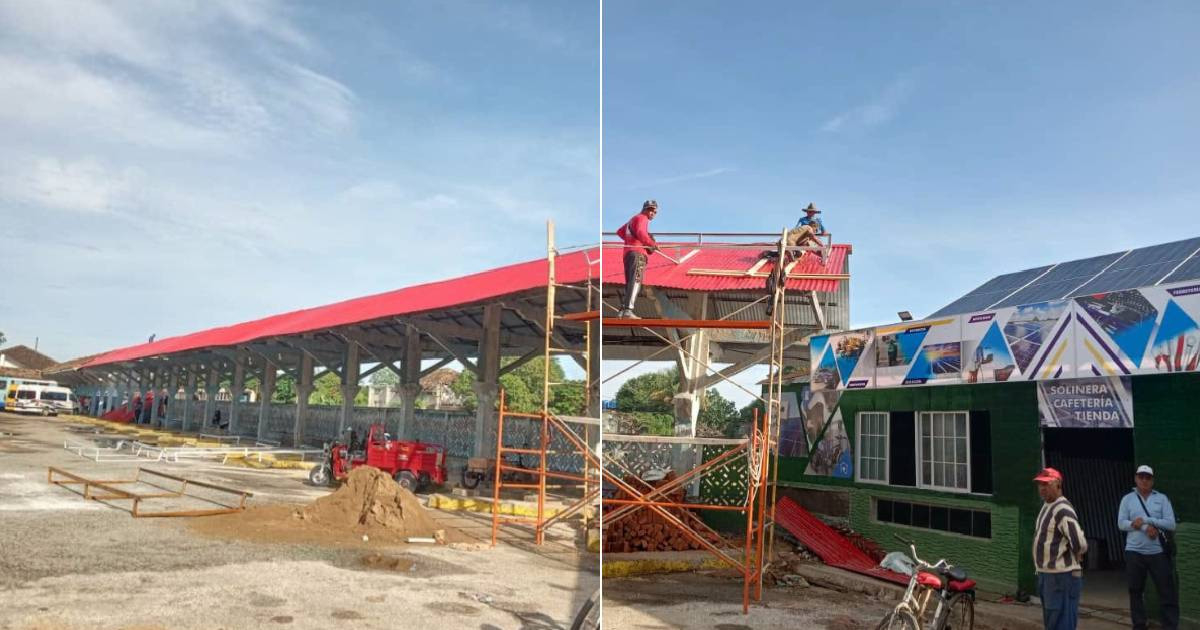
The Ferro-Ómnibus terminal in Las Tunas is witnessing the construction of the province's inaugural "solar station," as restoration efforts continue at a facility that has been in decline since Hurricane Ike struck in 2008.
This initiative is a collaborative effort between the Provincial Transport Company Cardinal and the private microenterprise Vitalcons, marking a partnership between state and private sectors, as reported on Thursday by Tiempo 21, the Facebook page of Radio Victoria, the provincial broadcaster.
Since Ike caused significant damage in September 2008, the terminal has not undergone a comprehensive recovery. The hurricane devastated several areas in eastern Cuba, leaving the facility in a state of disrepair that persisted for many years.
According to the report, the current investments aim to enhance the terminal's conditions and improve service quality for the public, while also integrating new capabilities for harnessing renewable energy.
Las Tunas boasts eight photovoltaic solar parks with a theoretical capacity of 64.8 MW. However, this infrastructure provides only about 2.5 hours of electricity per day on average for each municipality, as acknowledged by the Provincial Electric Company in late August.
The situation is even more severe in certain areas. Residents of the Manatí municipality reported power outages lasting over 24 hours almost daily throughout September.
The emergence of "solar stations," a Cuban term combining "solar" and "gas station," is part of the government's strategy to transform the island's energy matrix using clean sources.
These stations offer basic services like phone charging and food cooking, sometimes free of charge, while charging for recharging motorbikes, tricycles, and cars.
Most of these facilities are run by private microenterprises, although officially they are consistently presented as part of the state’s energy policy, avoiding acknowledgment of the state's role in the collapse of Cuba’s electrical system.
These installations are a decentralized response to Cuba's most severe energy crisis in decades, which worsened in January with the halt of Venezuelan crude oil shipments and the suspension of Mexican oil exports due to pressure from the Trump administration's sanctions.
The first "solar station" in the country launched in April in Santa Clara. This model has since been replicated with varying degrees of intensity in several provinces. Villa Clara alone has 50 operational stations aiming to reach 60 by year's end, while Guantánamo has five active sites and plans to expand to 30.
In eastern Cuba, the province of Holguín was a pioneer in establishing one of these facilities, the El Girasol solar charging station, which sparked debate on social media over whether its prices were fair or exorbitant compared to the average state salary.
Understanding Las Tunas' Solar Station Initiative
What is the purpose of the new "solar station" in Las Tunas?
The "solar station" aims to improve the terminal's conditions, enhance service quality, and incorporate renewable energy capabilities, contributing to transforming Cuba's energy matrix.
How are "solar stations" part of the energy strategy in Cuba?
"Solar stations" are part of a strategy to shift toward clean energy sources. They provide essential services and help mitigate the impact of Cuba's energy crisis by offering an alternative to traditional power sources.
Who operates these "solar stations" in Cuba?
While the official narrative presents them as part of state policy, most "solar stations" are operated by private microenterprises, providing a decentralized solution to Cuba's energy challenges.