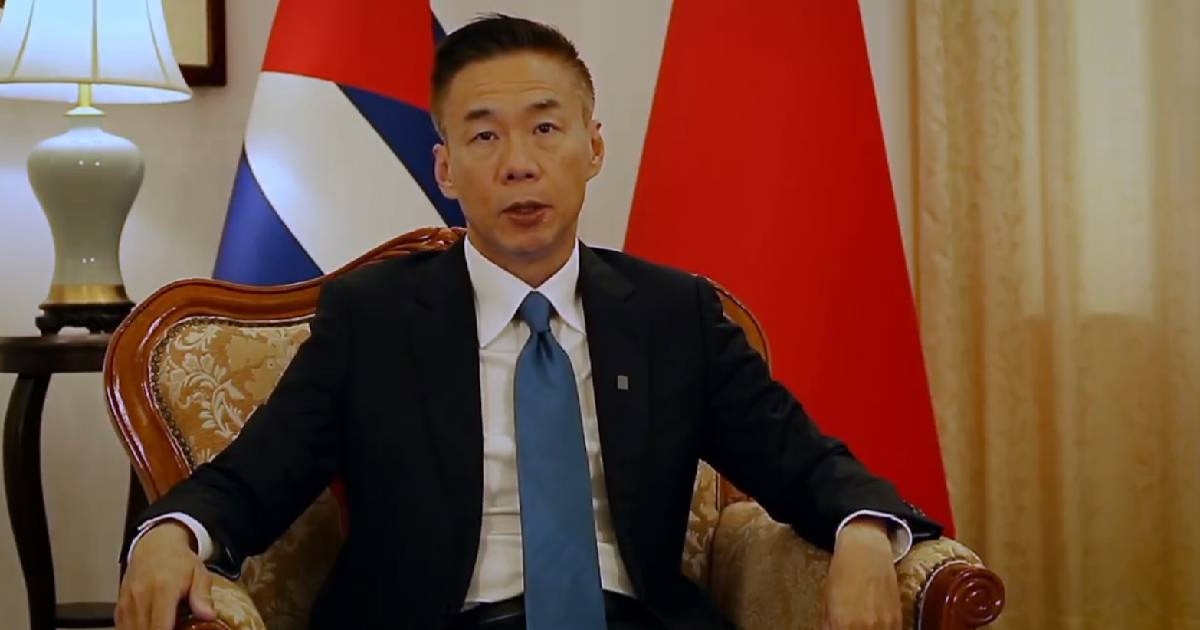
The Chinese ambassador to Cuba, Hua Xin, recently emphasized the importance of market forces in China's economic development during a discussion with the state-run portal Cubadebate. Concurrently, he announced new solar projects for the island, which is currently grappling with a severe energy crisis.
Hua made these statements on Cubadebate's podcast "Es la idea," which aired on Tuesday. The conversation was covered by EFE and analyzed by The Rio Times.
The ambassador assured that China "will not stand idly by" in the face of the challenges faced by the Cuban people. He reviewed key energy cooperation projects between the two nations.
Boosting Solar Energy Initiatives
Regarding solar energy, Hua detailed that by 2025, 35 megawatts of solar parks, supported by China, had been connected to Cuba's National Electric System (SEN). By October, the Cuban government aims to complete an additional 85 megawatts across 15 parks.
Additionally, the first shipment of materials for a 200-megawatt photovoltaic generation and storage project has already arrived in Cuba.
China has also donated two batches of 5,000 domestic solar systems each, which have been installed in clinics, senior homes, and social centers around the country.
Market Forces and Economic Development
Perhaps the most striking part of the interview was the ambassador's explanation of the foundations of China's economic growth.
Hua remarked that one of the cornerstones is "allowing the market to play a decisive role" in resource allocation and "fully respecting the people's initiative."
The contrast with Cuba's economic model is stark. While Havana's primary international ally champions the market and individual initiative, the Cuban government continues to maintain state control or restrictions over 79 economic activities.
In this regard, President Miguel Díaz-Canel has cautioned that the private sector "cannot become a space for illegality, tax evasion, speculation, corruption, or hoarding."
Energy Crisis and Bilateral Cooperation
These statements emerge amidst an ongoing electricity crisis that led the SEN to experience eight total disconnections between January and September. On several occasions, deficits surpassed 2,000 megawatts, causing widespread blackouts lasting over 24 hours in many regions.
While photovoltaic projects contribute power during sunny hours, they alone cannot resolve the nighttime deficit or the degradation of thermal power plants.
In Artemisa, the full utilization of its solar parks' production barely reduced daily blackouts from 22 to 18 hours.
The ambassador also reiterated Beijing's stance against U.S. sanctions on Cuba, urging Washington to "immediately cease all hostile and interfering actions against Cuba."
The bilateral cooperation includes an emergency aid package of $80 million approved by President Xi Jinping in January, along with the delivery of 60,000 tons of rice.
As Cuba's energy system continues to deteriorate, Beijing is providing resources and technology to sustain parts of the island's electrical infrastructure.
Understanding China's Role in Cuba's Energy Crisis
What role is China playing in Cuba's energy sector?
China is actively involved in aiding Cuba's energy sector by supporting solar projects and providing resources for the island's electrical infrastructure. This includes the installation of solar parks and the donation of domestic solar systems.
How does China's economic model differ from Cuba's?
China's economic model emphasizes market forces and individual initiative, allowing the market to play a decisive role in resource allocation. In contrast, Cuba maintains state control over many economic activities, with the government imposing restrictions on the private sector.
Why is the energy crisis a significant issue in Cuba?
Cuba faces a severe energy crisis marked by frequent blackouts and a deteriorating infrastructure. The island's reliance on outdated thermal power plants and insufficient solar energy generation exacerbates the problem, leading to prolonged power outages.