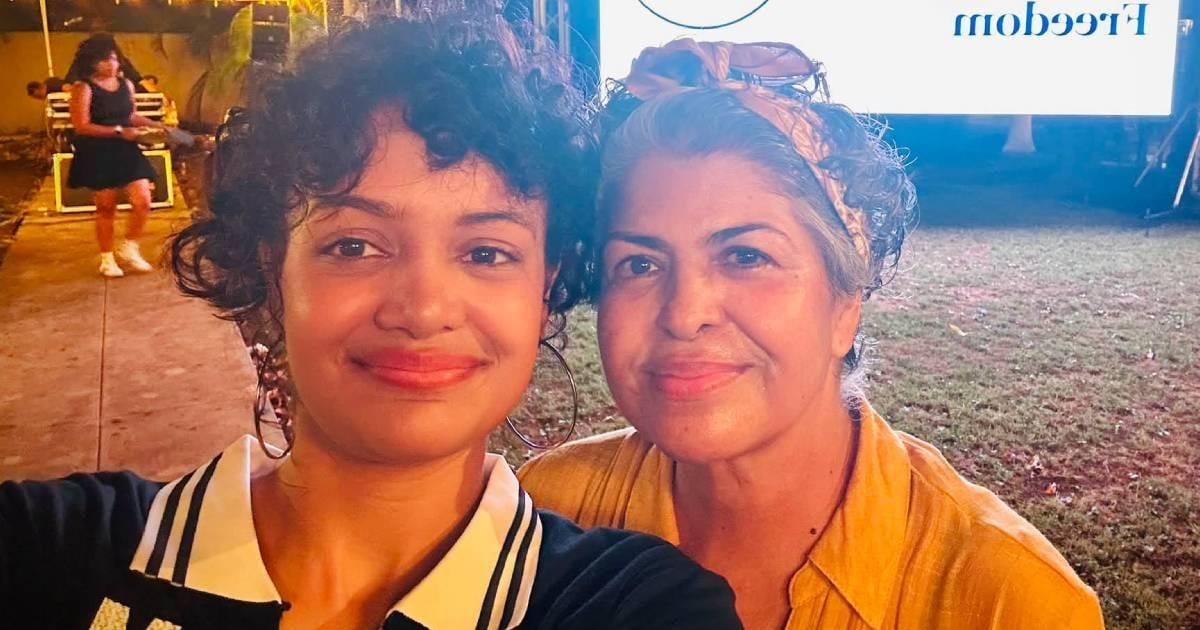
Cuban poet and improviser Juan Carlos García Guridi took to his Facebook page on Friday to share a poem dedicated to Anna Bensi and her mother, Caridad Silvente Laffita. This came just hours after the East Havana Municipal People's Court sentenced both women to two years of restricted freedom.
The poem calls for justice for these women, framing their plight as a broader societal issue: "Anna Bensi and Caridad, / through their plentiful blood, / deserve nothing less / than justice and freedom. / Dignity cannot / fall into a gray lethargy; / the roots of murky dawns need, / more than just for two women, / the freedom of a nation."
Controversial Sentence Sparks Outrage
The ruling was delivered by Judge Zamira Marrero Morgado, known for her involvement in cases related to the July 11, 2021 trials. It was based on Article 393 of the Cuban Penal Code, which addresses "acts against personal and family privacy." Human rights organization Cubalex argued that this law is meant to protect personal privacy, not to shield state officials from public scrutiny, suggesting its use in this case criminalizes citizen oversight.
The Incident that Led to the Trial
The case dates back to March 2026, when MININT sub-officer Yoel Leodán Rabaza Ramos visited the women's Alamar home to deliver a State Security summons. The mother and daughter recorded the encounter and shared the footage, in which the officer admitted he was sent by State Security. Originally closed, the case was reopened in July following a complaint by the officer himself.
Heavy Police Presence at the Trial
The trial was marked by a significant police presence, allowing only one defense witness inside. Meanwhile, evangelical pastor "Pregonero de Cristo" and activist David Espinosa Martínez were detained as they tried to attend. Authorities claimed the video revealed the officer's home address, contradicting the footage showing only his name, case number, rank, physical description, and ID expiration date.
Outside the courthouse, Anna Bensi, legally named Ana Sofía Benítez Silvente, 21, stated, "They found my mother and me guilty of the alleged crime." She insisted, "None of us are criminals," and expressed a desire for "Cuba to be free."
International Reactions and Support
The sentence prompted widespread solidarity. Cuban-American congress members Mario Díaz-Balart, María Elvira Salazar, and Carlos A. Giménez demanded their unconditional release, with Salazar calling the trial "a desperate act by a dying dictatorship trying to intimidate and silence the Cuban people." The U.S. Embassy in Havana reiterated its stance with "Thinking differently is not a crime," while Deputy Assistant Secretary of State for Western Hemisphere Affairs, Juan Pablo Segura, remarked on social media that "the cowardice of the Cuban regime knows no bounds."
García Guridi, born in Batabanó, Mayabeque, in 1968, and an active researcher of Cuban décima, added his voice to a series of protest lyrics throughout 2026, including "Without More Party," defending political prisoner José Gabriel Barrenechea, and "LUCHA," where he denounced the Cuban government as "the Judas of governance."
Key Questions on the Cuban Judicial System and Human Rights
What led to the sentencing of Anna Bensi and her mother?
Anna Bensi and her mother were sentenced after a video they recorded of a state security officer was used as evidence against them. The case was reopened after the officer filed a complaint, leading to their conviction under charges of violating personal and family privacy.
How has the international community reacted to this case?
The international response included demands for the women's release from Cuban-American congress members and statements from the U.S. Embassy in Havana, condemning the trial as an act of intimidation by the Cuban regime.