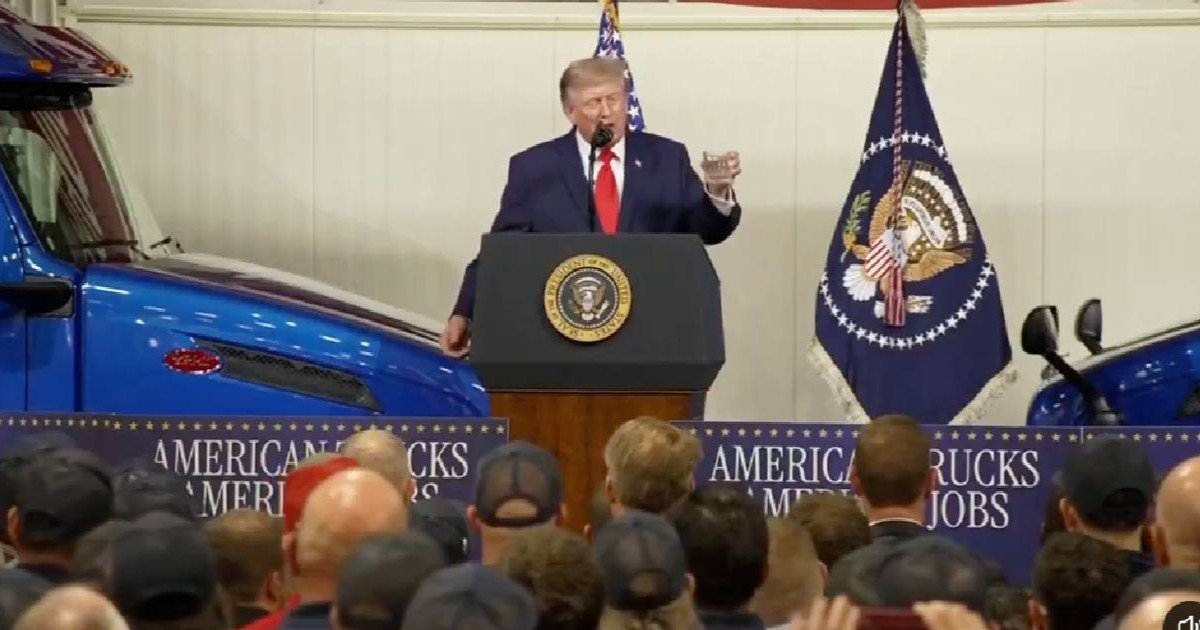
During an event at the Peterbilt truck plant in Denton, Texas, on Thursday, U.S. President Donald Trump dramatically spilled a glass of water on the floor. This act was meant to emphasize his point that conserving small amounts of fuel is unnecessary when, according to his view, the United States could potentially control a significant portion of the world's oil resources by incorporating Venezuela's reserves.
"Including Venezuela, we would have 58% of the world's fuel. Saving a glass of fuel like this is ridiculous," Trump declared before letting the glass fall and spill water in front of the audience gathered at the plant.
Additionally, Trump criticized the energy consumption control systems that predated his administration: "They had computers everywhere, and it didn’t work well. It was terrible," he remarked, implicitly referring to the vehicle efficiency standards that his government had recently dismantled.
In late September, the Trump administration finalized a rollback of federal fuel efficiency standards, lowering the fleet target for 2031 from 50.4 miles per gallon—originally set during the Biden era—to 34.9 miles per gallon, with annual improvements reduced to just 1% compared to the previous 2%.
The Denton event was part of a campaign tour for the November midterm elections, where Trump endorsed Republican candidates, including Ken Paxton for the Texas Senate. After the event, the president traveled to Durant, Oklahoma, for another rally.
Representatives from Peterbilt and its parent company PACCAR credited Trump's tariff policies with creating approximately 1,000 jobs and producing around 200 trucks daily at the Denton facility.
The claim of 58% is not new in Trump's rhetoric. He reiterated this figure at the United Nations General Assembly in September, amid heightened diplomatic and energy-related activities concerning Venezuela.
In August, Trump announced what he described as "the largest oil deal in history": an agreement granting North American Blue Energy Partners access to 17 strategic fields in the Orinoco Belt, with proven reserves of about 65 billion barrels and a projected investment exceeding $100 billion.
The diplomatic context surrounding these statements is equally noteworthy. On September 23, Trump met with Venezuela's interim president Delcy Rodríguez in New York, on the sidelines of the UN General Assembly.
Secretary of State Marco Rubio called the meeting "brief but important," focusing on debt restructuring, economic stabilization, and political transition. Rodríguez described it as "historic."
However, a subsequent poll revealed a 91% disapproval rate among Venezuelans regarding the meeting, reflecting the deep distrust of the population towards any agreements between Washington and the Chavista regime led by Rodríguez following the capture of Nicolás Maduro.
Experts consulted by Bloomberg and other outlets have pointed out that the simplification of "58% of the world's fuel" is technically debatable: Venezuelan crude is predominantly heavy and acidic, more suitable for diesel and asphalt than for gasoline, which limits its direct impact on transportation fuel supplies.
Exploring Trump's Oil and Energy Policies
What was the purpose of Trump's water-spilling act in Texas?
Trump spilled a glass of water to illustrate his argument that conserving small amounts of fuel is unnecessary when the U.S. could potentially control a large share of the world's oil, including Venezuelan reserves.
How did Trump's administration change fuel efficiency standards?
The Trump administration rolled back federal fuel efficiency standards, lowering the fleet target for 2031 from 50.4 miles per gallon to 34.9 miles per gallon, with annual improvements reduced to 1%.
What was the significance of Trump's meeting with Delcy Rodríguez?
The meeting between Trump and Venezuela's interim president Delcy Rodríguez focused on debt restructuring, economic stabilization, and political transition, although it faced significant disapproval from Venezuelans.