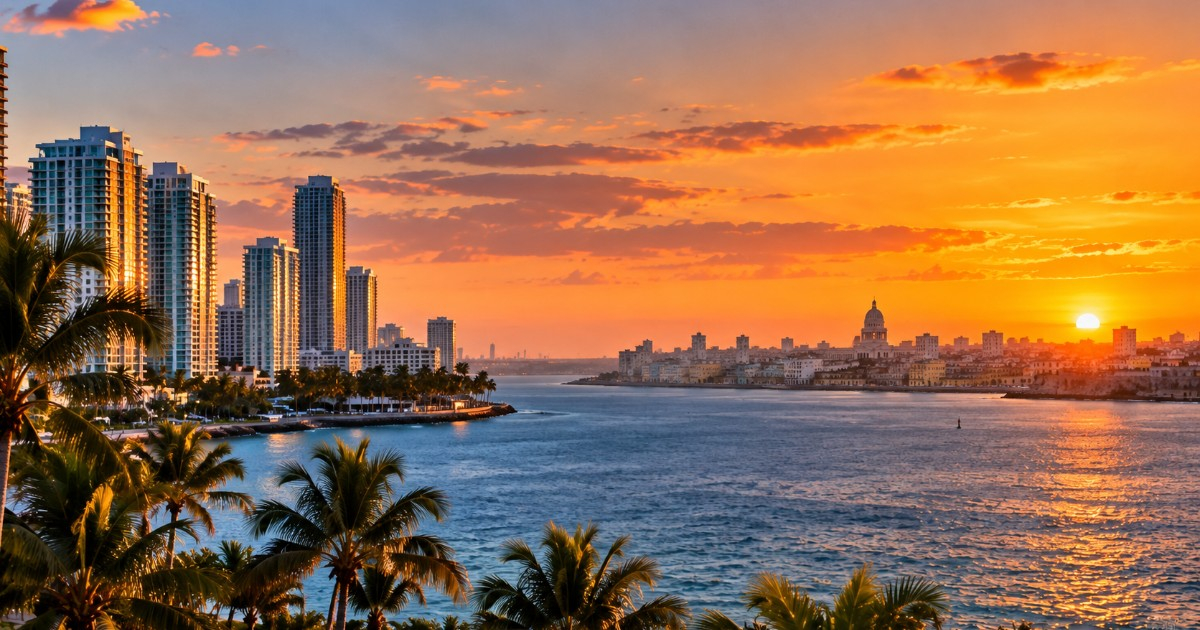
In an opulent mansion overlooking Biscayne Bay in Miami, some of the wealthiest Cuban-American business leaders in Florida convened to discuss their vision for a post-dictatorship Cuba.
This gathering was a focal point of a feature by BBC correspondent Will Grant, published this Friday, highlighting the anticipation among the business exiles who are preparing their capital for when the regime falls.
The event marked the fourth assembly of the Cuban-American National Chamber of Commerce (CANCC), an organization established in April 2026.
Plans for Economic Reconstruction
Prominent exile families such as the Bacardis and Babuns discussed the state of the Cuban economy and recent political developments on the island while gathered by the pool.
Juan Omar Sixto, an 82-year-old real estate developer and president of the CANCC, who fled Cuba as a teenager, encapsulated the evening's goal: "The aim is to gather the most prominent Cuban-American entrepreneurs in Miami-Dade under one roof, with the objective of being in Cuba once the regime falls."
The organization has already drafted a proposal to establish a Cuban Stock Exchange and committees for energy infrastructure and food security.
Sixto also mentioned that the group is in touch with individuals close to Secretary of State Marco Rubio: "Along with delivering humanitarian aid and medical supplies, we plan to conduct business in Cuba immediately."
Broader Business Ventures
The ambitions of the business exiles extend beyond the CANCC. Architect Willy Bermello, aged 75, holds biweekly video conferences with airline executives and investment fund managers to refine an $8 billion project aimed at renovating eight Cuban airports.
Jorge Mas Santos, chairman of the Cuban American National Foundation, is working on a 28-page transition bill involving a provisional government lasting up to two years. He assured Trump that raising the $90 billion needed for the first three years of transition would be "a piece of cake."
Experts gathered in July at the American Museum of the Cuban Diaspora estimated that rebuilding Cuba could cost between $275 billion and $375 billion over a period of 10 to 15 years.
Challenges and Skepticism
The most contentious issue in any plan is the restitution of properties confiscated after 1959. Sixto acknowledged to the BBC that his father lost five properties and a farm in Pinar del Río: "I worked on that farm for five years with my father, and it was taken from us. I want restitution or compensation. Even if it's just a penny on the dollar, I'll accept it."
Cuban-American agricultural expert Hugo Orizondo advocated for investors entering the Cuban agricultural sector, despite current limitations: "Right now, Cuba is like a black hole; we don't know what's happening there. But we do know its potential."
Not everyone shares this optimism. Mike Bustamante, an associate professor of history at the University of Miami, cautioned that expectations for an immediate "day after" have been "postponed."
With the November midterm elections looming and the Trump administration entangled in the Iran conflict, he believes there's little room for further foreign ventures: "It's hard to think they will escalate beyond what they are doing, which is this constant drip of sanctions."
The new OFAC sanctions effective since September 30 eliminated authorization for banks under U.S. jurisdiction to maintain accounts for Cuban private entrepreneurs, and prohibited "U-turn" bank transfers.
The regime responded with 176 economic liberalization measures, which CANCC attendees dismissed as "cosmetic." Sixto was adamant: they would not "set foot in Cuba" as long as the dictatorship remains in power.
Rubio, on the other hand, ruled out setting a fixed timeline in July: "We're not a miniseries where everything gets resolved in three episodes. These are complex issues that take time."
Frequently Asked Questions About Cuban-American Business Plans
What is the Cuban-American National Chamber of Commerce?
The Cuban-American National Chamber of Commerce (CANCC) is an organization formed to unite prominent Cuban-American business leaders in Miami-Dade, with the goal of preparing for economic opportunities in a post-dictatorship Cuba.
What are the economic plans for a future Cuba?
Plans include establishing a Cuban Stock Exchange and committees focused on energy infrastructure and food security, as well as renovation projects for Cuban airports and drafting a transition bill for a provisional government.
What challenges do Cuban-American investors face?
Challenges include dealing with confiscated properties from the post-1959 era and the uncertainties surrounding Cuba's current political and economic landscape.