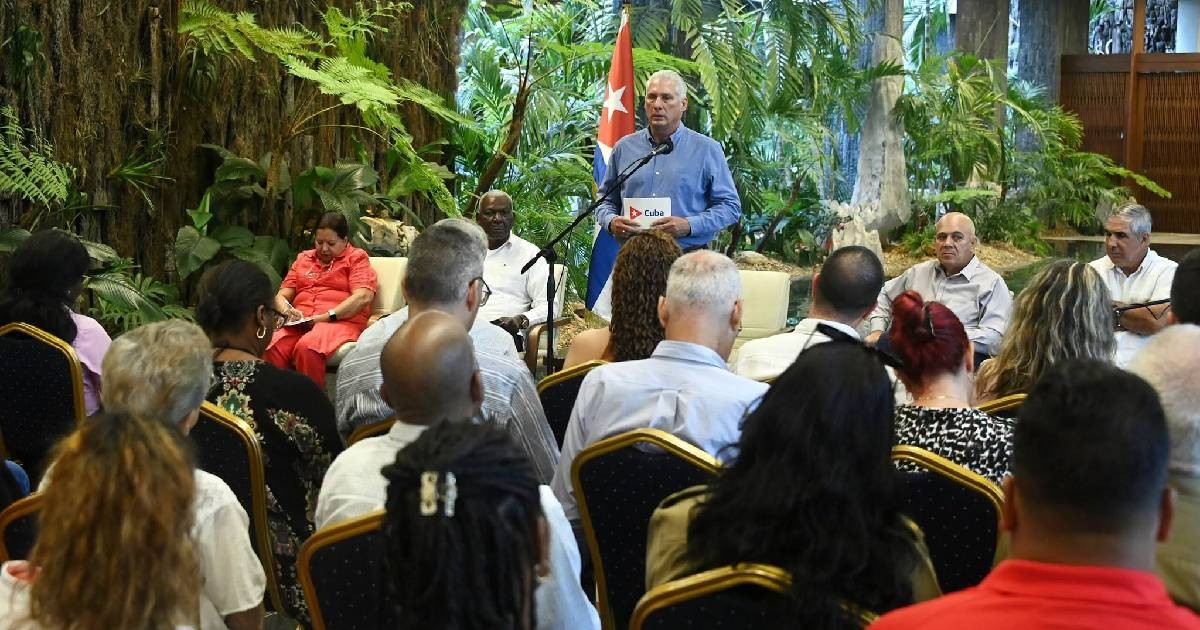
As Cuba faces severe economic challenges, with millions unable to afford basic necessities, President Miguel Díaz-Canel convened a meeting on Thursday with community leaders and representatives from various organizations. The purpose was to promote what the regime describes as the social aspect of its economic reforms, according to an official report from the Cuban Presidency.
On his Facebook page, Díaz-Canel summed up the event with the message, "We continue working for a better society," describing the meeting as an "emotional exchange." He claimed it underscored the commitment to uphold social justice amid the country's ongoing transformations.
Moderated by Jesús Otamendi Campos, Minister of Labor and Social Security, the gathering included around twenty participants involved in the so-called 176 Economic and Social Transformations, which were approved by the National Assembly in June 2026.
Prominent figures from the Political Bureau, such as Esteban Lazo Hernández, President of the National Assembly; Roberto Morales Ojeda, Secretary of Organization of the Central Committee; and Teresa Amarelle Boue, General Secretary of the Federation of Cuban Women, were in attendance, along with Deputy Prime Minister Eduardo Martínez Díaz.
Díaz-Canel emphasized that social justice is the hallmark of their reform package, stating, "For us, economic growth is meaningless if it doesn't impact social development. Generating economic wealth makes no sense if it doesn’t support social programs, and above all, the wealth we build must be distributed with a concept of social justice."
The president asserted that Cuba prioritizes social opportunities and promotes inclusion and equity, contrasting this with what he termed the "shock policies" of those who "attack" and "blockade" the island, alluding to the U.S. embargo.
Examples highlighted during the meeting included the work of community leaders in Ampliación de Almendares with retirees and vulnerable individuals, sports programs in the Playa municipality for youth with addictions, and the efforts of the microenterprise Hidrox S.U.R.L., which since 2022 has supported health and education facilities with no extra charges, funded by expanding its car wash business.
Despite the official rhetoric of social justice, the economic reality remains uncertain. At the end of September, Prime Minister Manuel Marrero Cruz reported that 89% of the reforms had been implemented, yet their real impact on production, income, prices, and employment remains unverified.
The Economic Commission for Latin America and the Caribbean (CEPAL) forecasts a 10.3% decline in Cuba's GDP for 2026, marking the worst in Latin America, with annual inflation reaching 25.19% in August and the peso depreciating by 39.1% in the first half of the year.
An independent study cited by France 24 estimated that 6.45 million Cubans—66% of the population—cannot afford a basic basket of goods, a stark contrast to the official narrative of inclusion and equity that Díaz-Canel reiterated at the meeting.
In September, the government itself admitted uncertainty about the effectiveness of its economic changes, exposing the fragility of the model Díaz-Canel promotes as a guarantor of social justice.
Understanding Cuba's Economic Challenges
What are the key challenges facing Cuba's economy?
Cuba's economy is facing significant challenges, including a projected 10.3% decline in GDP for 2026, high inflation rates, and a depreciating currency. Additionally, a large portion of the population struggles to afford basic necessities.
How does the Cuban government plan to address these economic issues?
The Cuban government is implementing a series of economic and social reforms aimed at improving social justice and economic growth. However, the effectiveness of these reforms remains uncertain and is yet to be fully realized.
What is the impact of the U.S. embargo on Cuba?
The U.S. embargo is often cited by the Cuban government as a significant external factor affecting the island’s economy. It restricts trade and access to resources, complicating economic recovery and development efforts.