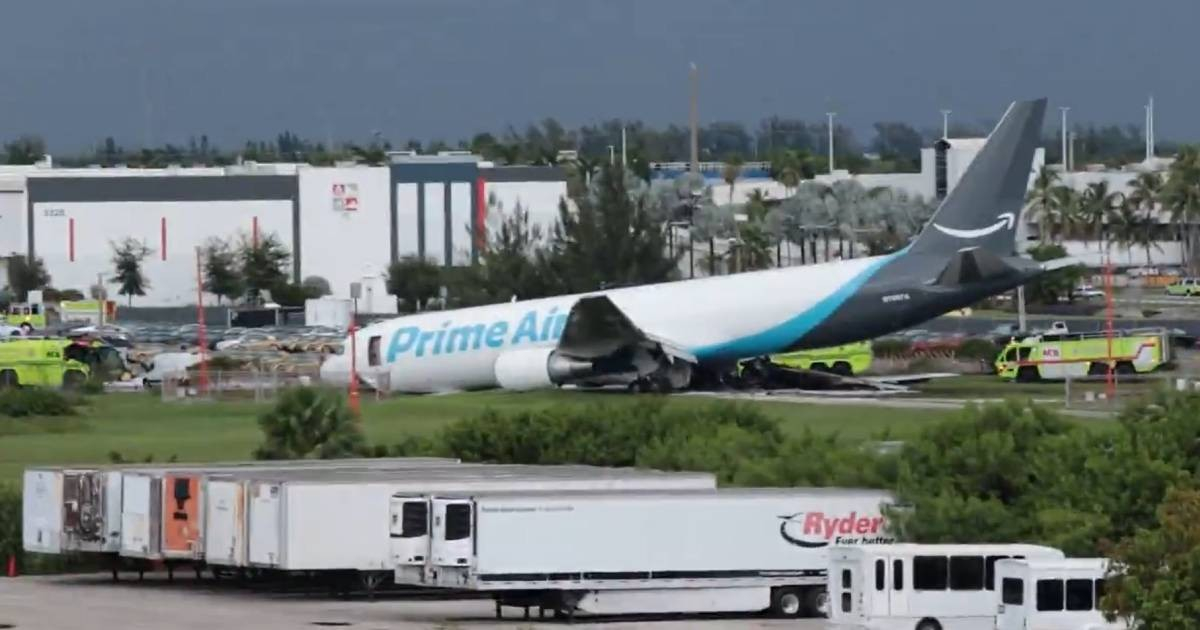
The National Transportation Safety Board (NTSB) of the United States released a preliminary report on Thursday regarding the September 6 crash involving a Boeing 767 cargo plane at Miami International Airport. This tragic incident resulted in the loss of five lives and highlighted a series of warnings during the aircraft's final approach and landing.
The NTSB's preliminary report reconstructs the last minutes of flight 7598 operated by 21 Air for Amazon. The flight originated from Luis Muñoz Marín International Airport in San Juan, Puerto Rico, bound for Miami. Utilizing data from the plane's black boxes, the report provides a detailed chronology of the events.
The investigation found that the Boeing 767-33A crossed the threshold of runway 30 at a ground speed of approximately 177 knots and touched down about 3,750 feet beyond the threshold, still moving at around 160 knots. Despite efforts, the aircraft continued, veered off the runway at 113 knots, and ultimately breached the airport perimeter.
Critical Insights from the Cockpit Voice Recorder
Significant findings emerge from the cockpit voice recorder (CVR) analysis. With one minute and 42 seconds left on the recording, the captain instructed to set the flaps at 20 degrees, while the first officer warned that the aircraft was approaching too rapidly. The NTSB noted that the first officer continued to express concerns about excessive speed, but these warnings did not elicit a consistent verbal response.
Automatic alarms in the aircraft also repeatedly sounded during the approach. Initial warnings of a "sink rate" indicated a dangerously high descent rate. Subsequently, a "too low terrain" alert triggered multiple times, indicating the plane's proximity to the ground. The first "too low terrain" warning occurred 48 seconds before the recording ended, repeated four times, followed by another similar alert shortly after.
About 31 seconds before the recording concluded, sounds akin to the plane touching the runway were captured. However, 16 seconds later, the captain called for a "go-around," a maneuver to abort the landing and ascend for another approach attempt.
Flight Recorder Data Uncovers More Details
The flight data recorder (FDR) offers additional crucial details. The NTSB found that the speed brakes remained retracted, and thrust reversers were not deployed during the landing or subsequent roll along the runway. Manual brake application occurred while the aircraft was still traveling at 146 knots. Eight seconds later, the brakes were released, and throttle levers moved to settings consistent with aborting the landing, leaving about 930 feet of runway.
Four seconds afterward, engine power returned to idle, and brakes were re-applied, but only 415 feet of runway remained. Ultimately, the Boeing departed the paved surface at about 113 knots.
Communication Lapses with Air Traffic Control
Details about communications with air traffic control are also included in the report. Miami's tower cleared flight 7598 to land on runway 30, but without providing wind information. The NTSB noted that Federal Aviation Administration (FAA) regulations require wind direction and speed to be communicated when there's a tailwind component.
Approximately four minutes prior to clearing the landing, the same controller informed another aircraft of winds at 190 degrees at 19 knots, with gusts reaching 22 knots. However, flight 7598 was not yet on that radio frequency at that time. Meteorological observations around the accident time reported thunderstorms nearby and wind gusts up to 26 knots.
The NTSB has not yet attributed the accident to any specific factors and emphasized that the investigation is ongoing and the current information is preliminary and subject to change.
Tragic Loss of Five Cuban Nationals
The Boeing eventually collided with two vehicles after crossing a public road near the airport. A Ford Econoline carrying seven passengers was struck before the aircraft crossed NW 67th Avenue. Five occupants perished, and two others sustained severe injuries. The plane later hit a Toyota Corolla Cross, severely injuring its sole occupant. The Boeing's two crew members suffered minor injuries.
It was later confirmed that the five deceased were Cuban nationals: Yoel Rodríguez Naranjo, Rolando Alemán León, Julio C. Pineda, Carlos Acosta Fajardo, and Javierkys Reyes Quevedo, employees of an airport services company traveling in one of the vehicles hit by the plane.
In the aftermath, Amazon suspended its operations with 21 Air while federal investigations and legal actions related to the crash continued. The newly released report significantly expands the technical reconstruction of the incident, though it has yet to determine the probable cause of the accident. This conclusion will emerge in a subsequent phase of the NTSB investigation.
Key Questions About the Miami Cargo Plane Crash
What were the main factors involved in the Miami cargo plane accident?
The preliminary report cites excessive speed during landing, lack of deployment of speed brakes and thrust reversers, and communication lapses with air traffic control as critical factors. However, the investigation is ongoing, and the NTSB has not yet determined the probable cause.
Who were the victims of the Miami cargo plane crash?
The accident claimed the lives of five Cuban nationals: Yoel Rodríguez Naranjo, Rolando Alemán León, Julio C. Pineda, Carlos Acosta Fajardo, and Javierkys Reyes Quevedo. They were employees of an airport services company and were traveling in one of the vehicles struck by the plane.