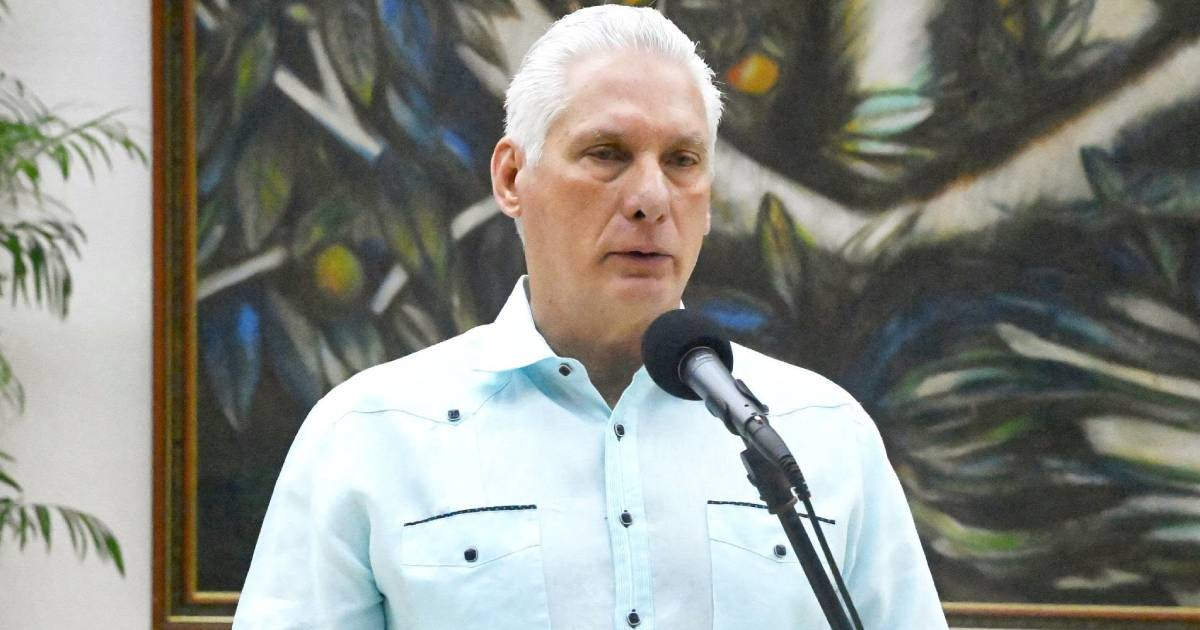
On Wednesday, Miguel Díaz-Canel expressed his discontent over the latest batch of sanctions imposed by the United States on Cuba. He criticized the restrictions targeting the island's private sector, challenging Washington's claim that its pressure tactics are mainly aimed at the state apparatus.
In a couple of posts on X, the Cuban leader asserted that the new measures "expose those who claim they are solely against the Cuban government and its enterprises."
"These actions against the Cuban private sector plainly reveal that the sole intention is to inflict maximum suffering upon our people and hinder the implementation of economic and social transformations," he added.
This reaction came after the U.S. announced on Tuesday a further tightening of its sanctions on Cuba, with measures that took effect on Wednesday, impacting certain private sector operations.
Impact on Cuban Entrepreneurs
One of the significant changes includes the revocation of authorization starting in 2024 that allowed Cuban private entrepreneurs to open, maintain, and use bank accounts in the United States. The U.S. Department of the Treasury's Office of Foreign Assets Control (OFAC) has also ordered the blocking of accounts affected by this change, which can only be accessed with a specific license.
The sanctions package also revokes permissions for certain financial transactions linked to Cuba, extends restrictions on restricted Cuban entities, and removes the general license for organizing specific professional conferences on the island.
Background on U.S. Policy
These measures are part of the enforcement of Executive Order 14404, signed by President Donald Trump on May 1, 2026. The order broadened Washington's tools for sanctioning individuals and entities connected to the Cuban government and authorized actions against foreign financial institutions facilitating specific operations with sanctioned individuals.
Washington justified these actions by citing threats from the Cuban government to U.S. national security and foreign policy, as well as corruption and serious human rights violations.
Contrasting Conditions for Cuban Entrepreneurs
The criticisms from Díaz-Canel regarding the sanctions' impact on Cuban entrepreneurs contrast sharply with the restrictions and controls his own government imposes on the private sector within the island.
Despite some regulatory relaxation in 2026, Decree 160, approved in July, still maintains prohibited or conditioned activities for private companies, micro, small and medium enterprises (MSMEs), cooperatives, and self-employed workers. This regulation replaced the previous list of 125 banned activities with a differentiated system of restrictions depending on the type of economic actor.
Moreover, in August, Cuban authorities conducted crackdowns on private businesses. For instance, in Central Havana, a fiscalization operation involving 232 economic actors resulted in 363 fines, 15 closures, 11 forced sales, and two licenses being revoked. In Villa Clara, the provincial government set maximum prices for products like eggs, oil, powdered milk, and sugar, followed by reports of forced sales and closures due to various infractions.
The private sector also lacks an independent business organization equivalent to a chamber that specifically represents its interests. Economist Pedro Monreal even questioned how the so-called "representatives" of the private sector who meet with Díaz-Canel are selected and what their mandate is.
Simultaneously, the government has introduced measures this year to expand the scope of private businesses, such as removing the cap of 100 workers and allowing individuals to participate in multiple enterprises. It also eased regulations on wholesale trade and opened the possibility for direct import and export, although these are subject to requirements and authorizations.
Official Responses and Ongoing Developments
Díaz-Canel's response aligns with that of Foreign Minister Bruno Rodríguez Parrilla, who accused Washington of obstructing economic transformations and stated that the new measures "openly attack both the public and private sectors, which some U.S. officials claim they wish to support in their development."
Rodríguez also criticized recent statements by Secretary of State Marco Rubio, who had declared on Fox News that "Cuba has already fallen" and described the island as a failed state.
"Less than 24 hours ago, the Secretary of State said Cuba has already fallen, and yet it now needs to apply additional measures," the foreign minister retorted.
The Trump administration maintains that its policy aims to increase pressure on the Cuban government and those who support it. Executive Order 14404 establishes sanctions against officials, entities, and individuals linked to the state apparatus, cases of corruption, serious human rights abuses, or material support to the government.
In contrast, Havana argues that U.S. sanctions complicate the execution of its economic program. The Cuban government claims to have implemented 158 out of the 176 economic and social measures announced in June, although Prime Minister Manuel Marrero Cruz has acknowledged that these measures still need to translate into tangible results in areas such as production, prices, and employment.
FAQs on the Impact of U.S. Sanctions on Cuba
What changes have been made to Cuban entrepreneurs' bank accounts in the U.S.?
Starting in 2024, Cuban private entrepreneurs will no longer be authorized to open, maintain, or use bank accounts in the United States. The OFAC has ordered the blocking of these accounts, which can only be accessed with a specific license.
How do U.S. sanctions affect Cuba's private sector?
The sanctions impact Cuba's private sector by revoking permissions for certain financial transactions and extending restrictions on Cuban entities, hindering their ability to operate freely and impeding economic transformations.
What is Executive Order 14404?
Executive Order 14404, signed by President Trump, expands Washington's tools for sanctioning individuals and entities linked to the Cuban government. It authorizes actions against foreign financial institutions facilitating operations with sanctioned individuals.