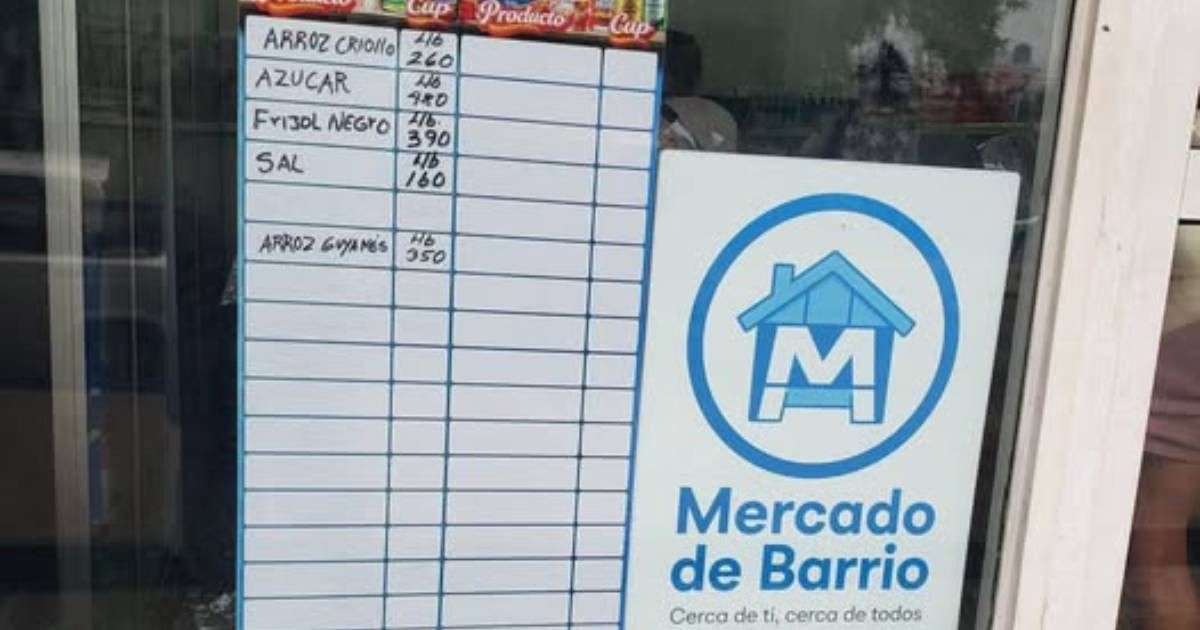
A resident of Boyeros, Havana, recently highlighted the stark contrast between the image of abundance portrayed by state television about "local markets" and the reality he encountered in one such market: a sign listing only five products amidst mostly empty shelves.
José Ernesto Veitia Pérez shared on Facebook his findings from two markets in the same area. While the market in Sierra Maestra, within the Nuevo Santiago community, was showcased on TV with well-stocked shelves, the reality at "El Actia" market in Rancho Boyeros was far less promising.
The Reality of Local Markets
The meager selection included local rice priced at 260 pesos per pound, sugar at 420, black beans at 390, salt at 160, and Guyanese rice at 350.
“The TV shows neighborhood markets with plenty on offer for everyone, but the reality is quite different when we encounter other neighborhood markets without advertisement, offering anemic selections,” Veitia Pérez remarked.
Background on Neighborhood Markets Initiative
Neighborhood markets were officially established by Resolution 16/2026 from the Ministry of Domestic Trade, effective August 11. This model allows small businesses, cooperatives, and self-employed individuals to manage state-owned facilities like grocery stores and butcher shops through bidding, although the state retains ownership of the properties.
The pilot project kicked off on July 23 in Plaza de la Revolución, and according to the government-run newspaper Granma, by late September, 37 neighborhood markets were operational across nine provinces: Pinar del Río, Artemisa, Havana, Matanzas, Camagüey, Holguín, Granma, Santiago de Cuba, and Guantánamo.
Challenges and Criticism
Authorities have promoted these markets as offering prices 10% to 15% lower than other outlets. Yet, Veitia Pérez questioned if such discounts are sufficient in light of the deteriorating purchasing power of Cuban citizens.
“This neighborhood market solution won't be accessible to most, even if a 30% discount is honored, much less the initial projection of 10% to 15%,” he warned.
Veitia Pérez also linked the emergence of these markets to the severe crisis within the state-run food distribution system.
“In reality, today the local grocery only dispenses donations... there is no basic supply basket, that’s a fact,” he stated.
Widespread Scarcity and Economic Struggles
The shortage particularly affects those relying on state salaries and pensions. The Food Monitor Program reported in September that 33.9% of surveyed households had at least one member who went to bed hungry in the past 30 days, while 79.4% spent 80% or more of their income on food.
Veitia Pérez also questioned whether the new markets will honor the announced prices, accept bank transfers, and provide basic staples like oil, eggs, and chicken at reasonable prices.
“What will the retirees and pensioners do, who are increasingly becoming part of the large vulnerable, if not extremely poor, population?” he asked.
For Veitia Pérez, these neighborhood markets signify another step towards the weakening of the ration book system, which has experienced delays and incomplete deliveries of essential products in recent years.
In December 2024, Prime Minister Manuel Marrero announced the gradual removal of subsidies for basic basket products, asserting that this process “is irreversible.”
Amid official promises and the scant selection of five products at the Boyeros market, Veitia Pérez summed up his view succinctly: “We are simply still screwed.”
Insights on Cuba's Neighborhood Markets
What are the key challenges facing Cuba's neighborhood markets?
The main challenges include insufficient product offerings, high prices that are still unaffordable for many, and a failure to meet the promises of lower prices and adequate supply of basic staples.
How do neighborhood markets affect the ration book system in Cuba?
Neighborhood markets represent a shift away from the traditional ration book system, which has suffered from delays and incomplete distribution of essential goods, further undermining its effectiveness.
Why are many Cubans critical of the new market initiative?
Cubans criticize the initiative because the supposed price reductions do not compensate for the loss of purchasing power, and the availability of essential products remains inadequate.